

Sign Up to PPP Today
You have to be a member to comment at PPP. Membership is free and requires only an email address.
Become a MemberAlready have an account? Sign in
Brandon Duhaime was signed on July 1 by the Leafs to three years at $2.6 million. This is the most he's ever made, but that's true of a lot of players signing deals now as the salary cap is set to rise precipitously while still lagging behind projected revenue. His deal also contains a full no-trade clause until next June 15, and then drops to 10 teams after that.
Duhaime is the second newly-acquired forward after Nick Paul who is signed past the expiry of Auston Matthews' contract in 2028.
Born in Florida, Duhaime's family is Canadian and his father is listed as from Toronto.
This 'getting to know' article is going to have a different format to the others because the key to understanding Duhaime is in how much he's exactly like someone we already know.
Player A and Player B
This old trick comes in handy right now. I've used a lot of sources for the various stats in these articles to spread around the work I've drawn on and to include a more consensus view on players, but for convenience today, most of the following comes from Evolving Hockey.
| Stat | Player A | Player B |
|---|---|---|
| Age | 30 | 29 |
| Height | 6'4" | 6'2" |
| Weight | 218 | 209 |
| Position | LW/C | LW/RW |
| Shoots | Left | Left |
| Draft | 186th | 106th |
| Minutes played | 4167 | 3646 |
| EV TOI/GP | 9.7 | 9.7 |
| Goals/60 | 0.5 | 0.5 |
| Points/60 | 1.2 | 1 |
| iCF/60 | 11.3 | 12.2 |
| SH% | 8 | 7.7 |
| ixG/60 | 0.78 | 0.76 |
| Blocks/60 | 2.8 | 2.4 |
| Hits/60 | 10.7 | 13.9 |
| Hits Taken/60 | 7.4 | 6 |
| SH TOI | 409 | 508 |
| SH TOI/GP | 1.09 | 1.39 |
Both players have been with several teams over their careers, although Player A dipped down into the ECHL before making the NHL. Player B went to college and that likely took care of his early discovery of what sort of game he needed to have to graduate from junior hockey and stick in the NHL. Player A was on the power play a very small amount on a bad team a few years ago, but both are, clearly, fourth liners who PK some.
Brandon Duhaime is Player B, and this is his career trajectory to the Leafs:
Player A is Steven Lorentz.
The Differences
These are not identical players, but is the distinction between them very meaningful?
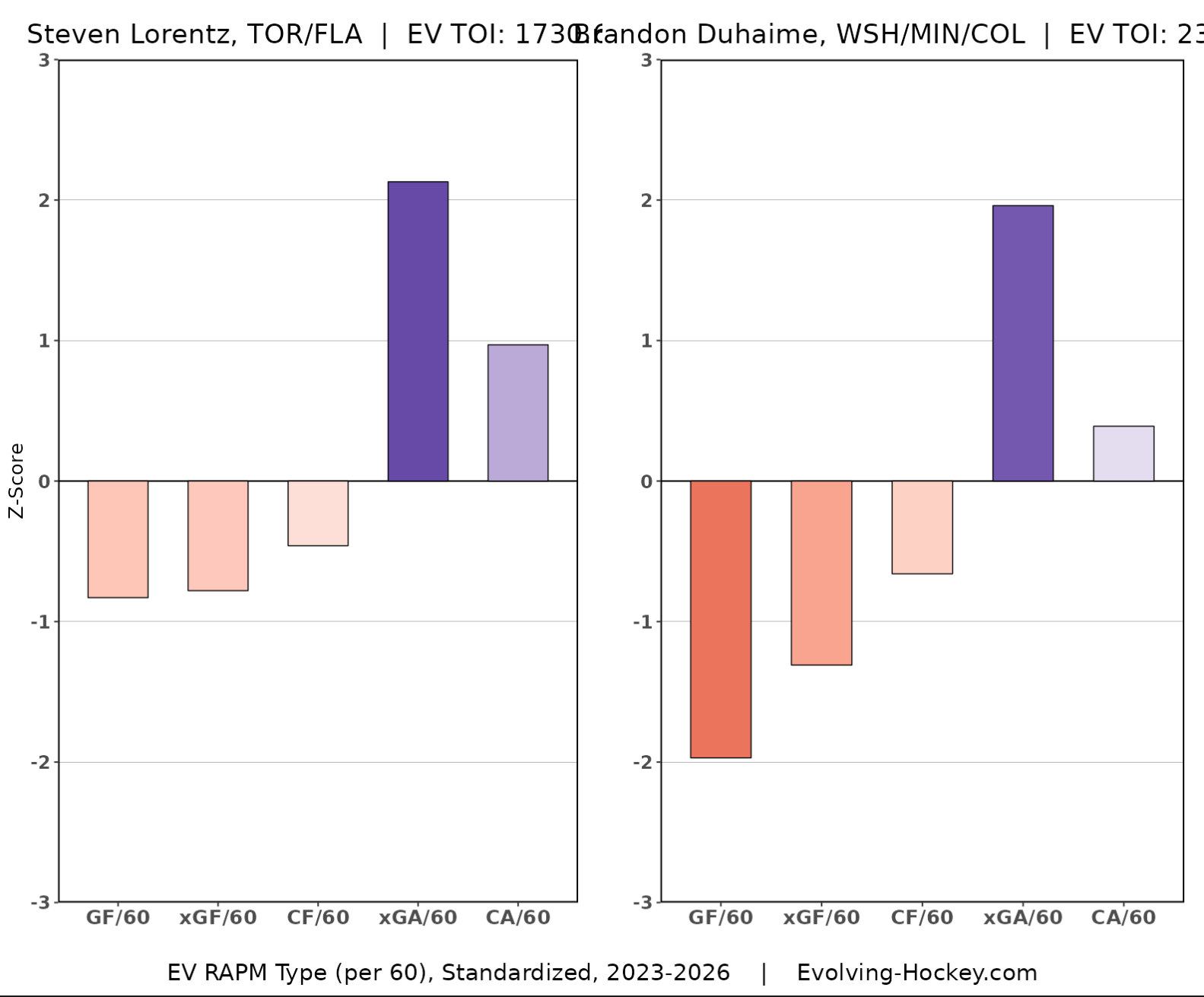
The above shows the defensive value both players share, and is the reason they are useful depth wingers. I should note, that while Lorentz plays as a centre occasionally, he's not exceptionally good at it, and it's not his primary role. Duhaime is not as good with the puck on his stick, but the results of their shooting, as seen above, boil down to the identical rate of goals and points.
NHL Edge from last season shows some subtle differences in skating and shot speed:
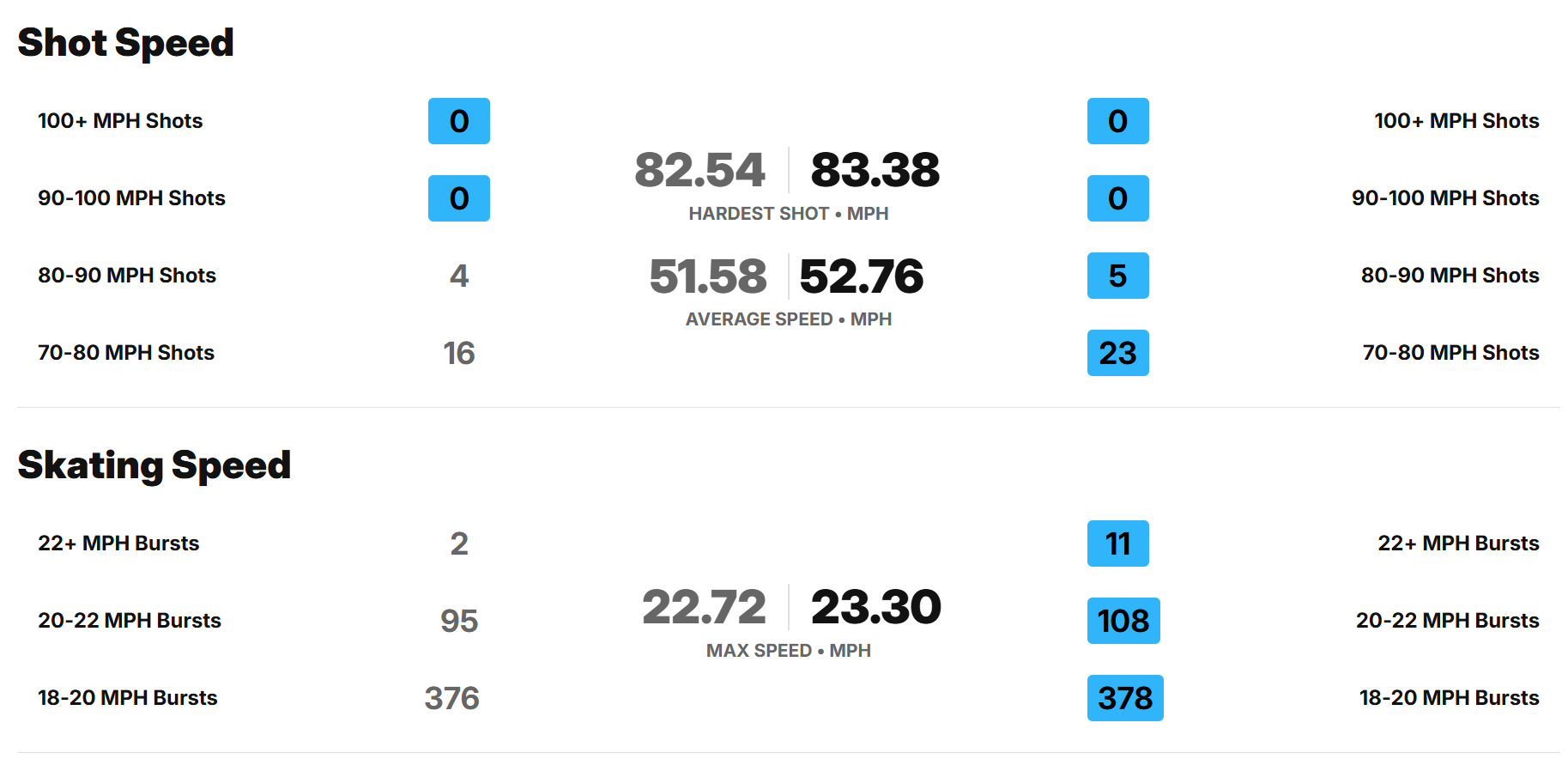
(I don't know what the blue highlights signify.)
Zone starts have no meaningful effect on player results most of the time. Very low minute players can be an exception, so let's see them. Edge is the place for this as well:
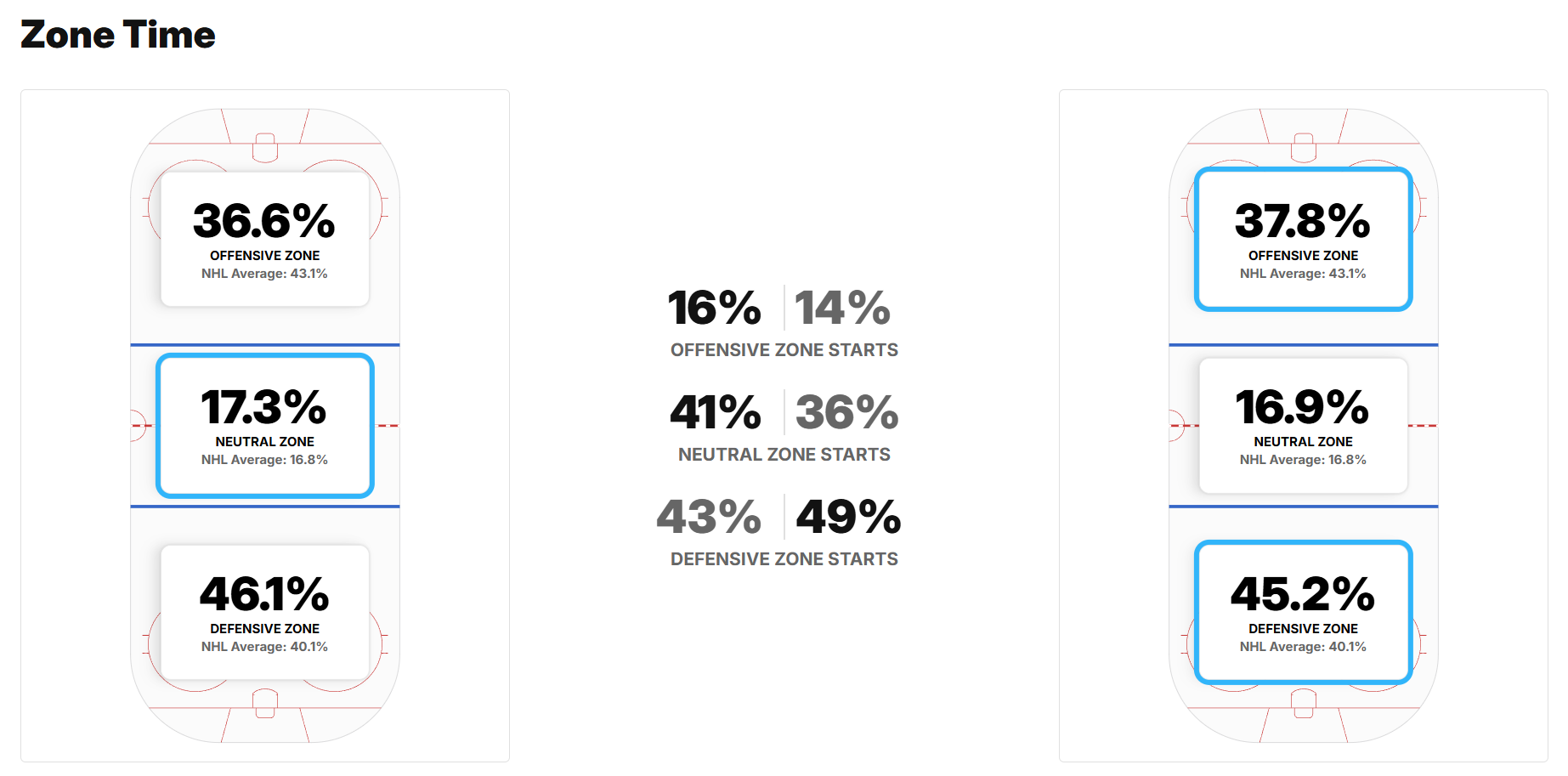
Duhaime's 2024-2025 season (not shown), also with Washington, has him more heavily used defensively, but that could simply be that Washington struggled more that year to get out of the zone. Oddly, given the Leafs woes last year, Lorentz's usage was unchanged from the prior year. They are essentially similar players in how their lines have been used as well. Not a surprise, as there's only so many ways a fourth line does get used.
The Significant Difference
Duhaime takes a lot more penalties. So while the rate of hits and blocks doesn't show any difference in how these two play, that measure definitely does. I'm going to focus on last season first.
Duhaime ranked 31st in the NHL in total PIM with 78, which is higher than anyone on the Leafs save Max Domi. Lorentz had 16, 17th on the Leafs. For Duhaime, he was the highest on the Capitals save Tom Wilson. But when we factor in the low minutes played, we get the full picture of Duhaime's penalty taking.
The NHL gives a PIM/TOI as a percentage, and Duhaime is at 8.6. The players with higher numbers in this measure are callups looking to make an impression who believe that penalties are the way to do that. Or they're overwhelmed by the pace of the NHL, one of the two. Michael Pezzetta led last year at 60% in nine games. Our friend Arber Xhekaj was at 16%. Eliminating anyone who didn't at least play half the season, Duhaime is 22nd behind such notables as Ryan Reaves, Nikita Zadorov, Ross Johnston, AJ Greer and Nick Cousins. Lorentz is 398th.
Taking penalties is only half the equation. Penalties Drawn is a very different sort of stat. The leader last year was, and nearly always is, Connor McDavid. He has the puck a lot, and he's the most dangerous player with it. Matthew Schaefer came second to him last year, which is very interesting, but not our topic today. Once you get past the fast, puck-moving, high-scoring, high-skilled forwards (plus Schaefer and Quinn Hughes), you get into some interesting players. Players that might just be good at destroying their opponents' impulse control.
The big penalty drawers last year of that sort were Zadorov, Michael Bunting, Pontus Holmberg, Scott Mayfield, and then Duhaime, with 23 drawn compared to his 27 taken. To put this in rate terms, the NHL helpfully gives us per/60 numbers, and Duhaime is 23rd in drawing penalties with 1.52 per 60 or the same as Brady Tkachuk and Brad Marchand. On his career, Duhaime is at 1.06 two minute penalties taken to 1.02 drawn per 60 minutes. His majors taken and drawn are at a draw as well.
I resorted to Google's AI search to help me find out what types of penalties he takes. I'll give you the entire answer complete with citations:
Stat Breakdown by Penalty Type. While exact individual game logs tally minor variations, his 78 PIM profile for the 2025–26 season historically aligns with the following tracking types:
Minor Penalties (2 Minutes): Roughly 24 to 26 minor infractions (totaling around 48–52 PIM). The vast majority of these were physical, aggression-based whistles, specifically roughing, boarding, and interference, alongside typical stick infractions like slashing.
Major Penalties (5 Minutes): Duhaime logged multiple fighting majors throughout the season to account for the core of his remaining PIM. A notable example occurred on January 27, 2026, when he fought Jacob Melanson of the Seattle Kraken. [1, 3, 4]
Misconducts (10 Minutes) / Bench Minors: He rarely picked up full 10-minute misconducts, meaning his high PIM total was almost entirely built through active minor and major penalties accumulated on the ice.
Notable Disciplinary Incidents
The Bench Poke Fine: On January 28, 2026, the NHL Department of Player Safety fined Duhaime $2,500 for unsportsmanlike conduct. During a January 27 game against Seattle, Duhaime extended his stick from the Capitals' bench to jab opponent Jacob Melanson. This incident later boiled over into an active 5-minute fighting major and a 2-minute roughing minor between the two players later in the third period. [1, 2, 3]
Overall Assessment
There is no plausible case to say that any given team should choose to play Duhaime over Lorentz because of their hockey skills or outcomes. In fact, there is some evidence that Lorentz is gently better overall at positive game outcomes because his offensive game is a touch better. That's one of those not significant differences, however.
How you assess the one significant difference, and therefore Duhaime's value difference to Lorentz, requires an answer to the question about penalty taking and drawing, and what value it holds. It's not a coincidence that he has been on the Capitals for two years, nor that his penalty show ceased on the Avalanche after a deadline deal in 2024. The Capitals were sixth highest in the league last year in minutes spent not at even strength. They have traditionally wanted to be off five-on-five, where they are usually weak, and onto special teams where they do better. This has long been the argument for the utility of Tom Wilson. Duhaime was just more of the same, with a lot more control over his own impulses than Wilson's suspension record indicates he has.
So is that a good idea? It sounds like it might be useful if a team has a particularly good set of special teams and scores more on the power play than most of their opponents can. That's not the Capitals, though, that's the Oilers, Stars, Lightning, Senators, Avalanche and Panthers over the last four years. The Leafs rate very high on goals scored per 60 minutes on the power play, even with recent troubles, but they don't get many power play opportunities. Auston Matthews doesn't draw like McDavid does. Or it's a plot, plan, scheme and/or conspiracy, however you want to think of it.
This is the argument for Duhaime: He's smart about how he plays. He takes someone to the box with him a lot, and he doesn't cross lines too often into dangerous play. He's entertaining and makes the game more exciting. The Leafs spend a lot of time at even strength and some more time shorthanded could be manageable with the right goalies and some good PK forwards, which a lot of the new additions seem like they should be. If more time on the power play and a return to their high-scoring rate once they get a man advantage gets them more goals, then it might be all a great idea that leads to the a higher goal differential, which is the thing that wins you more games.
Is Duhaime's distinction from Lorentz just style and flash, fun and excitement or is it really going to lead to better outcomes? It's hard to find a satisfactory answer to that largely because analyzing the PK even once you realize PK% in nonsense, is very difficult. I'll say this much on that score, though. Sergei Bobrovsky has never been better than average shorthanded. Anthony Stolarz is another story. But is that their ability perfectly described or the PKers in front of them?
This idea that you get more power play time by taking more penalties because then you draw more is a clever scheme that fits in with the even-up refereeing concept. I find it very hard to believe in it as a significant impact. I find it very difficult to believe that one player like Duhaime is going to tilt the goal differential. Both of these ideas are a distraction from the base need of hard-working, straightforward and successful special teams play. None of it matters unless the power play is excellent and lucky and the PK is solid and the goaltending good enough.
Duhaime seems fun, though, in a way that won't lead to spinning the wheel of player safety.
PPP Runs on Your Support
If you enjoy reading PPP Leafs, and want to see it continue, please consider becomming a paid subscriber. We want to keep all our content open to all users, but to be a sustainable site, we need more support from paid members.
Subscribe Now



Comment Navigation & Markdown
Navigation
cc to focus on comments section
c next comment
x previous comment
z next unread comment
Inline Styles
Bold: **Text**
Italics: *Text*
Both: ***Text***
Strikethrough: ~~Text~~
Code: `Text` used as sarcasm font at PPP
Spoiler: !!Text!!