

Sign Up to PPP Today
You have to be a member to comment at PPP. Membership is free and requires only an email address.
Become a MemberAlready have an account? Sign in
Jack Roslovic is a versatile forward with a somewhat itinerant career so far in the NHL. He went from the USNTDP where he was on a roster with Auston Matthews and Matthew Tkachuk to one year in the NCAA before hitting the NHL. After four years in Winnipeg, he was traded as an unsigned RFA to his hometown team, Columbus, as part of the Patrik Laine deal – a deal that didn't work out for anyone except Roslovic for a time. After almost four years where he played a solid, but not elite game in Columbus, he was dealt to the Rangers at the deadline. He then signed two one-year deals in Carolina and then Edmonton.
The Leafs signed him to a tw0-year deal for $4 million, the same AAV of the deal he signed in Columbus in 2023. He is paid less than Colton Sissons, but more than any other forward on the team not in the top-six.
The Basics: Vitals and Stats
- Age: 29 (turns 30 in January)
- Position: C, RW
- Height: 6'1"
- Weight: 198
- Draft: 25th overall in 2015 by the Jets
Stats
Once established in the NHL, Roslovic has gotten top-six, but not the top of the top-six, ice time most seasons. At 15 to 17 minutes a game, he's not a Matthews workhorse, but he's not often been the pretend top-sixer you sometimes see where a player manages 13 minutes at most by being the first one left off the rotation in certain situations.
In Edmonton last year, he was the fifth most used forward. In Carolina the year before, a deeper forward group pushed him to 10th most used, and that season is his least successful of his career.
The Rangers had a solid and unchanging top-five when they acquired him, and he became one of their choices for number six, but was that guy who often wasn't on the shift rotation, playing a lot less than his linemates.
NHL Edge stats show him to be a fast skater with a very high number of speed bursts.
Advanced Stats
In general, Roslovic shows up on isolation models as a forward with variable impacts on offence, with "okay for a winger" levels of defensive value. He's not always been a winger, however.
He shows particularly good impacts on shot differential, transition, and good impacts on other people's chances of scoring as well as his own.
Highlights
Watch him first.
Personal Shooting
Both Moneypuck and HockeyViz show Roslovic as a good shot with finishing talent above average – most players are not able to regularly score over expected, but he often does. However, he only has three 20-goal seasons, and a lot more seasons with 10-12 goals. Adding to the confusion, two of his 20-goal seasons are his most recent which is not how players usually approach age 30.
There's a good reason for all that. He changed how he played.
Up to 2023, he was a 10-12 Individual Corsi per 60 shooter in all-situations. It's hard to find a player of note with an NHL career habit of that sort of shot rate. Tom Wilson, Jonathan Huberdeau, Elias Lindholm. Either they're a top play-maker, a centre in the top six or Tom Wilson. Roslovic was cruising through the NHL with an Individual Expected Goals of .60 or so and getting by on limited talent at offence creation or getting assists, depending on how you like to measure things.
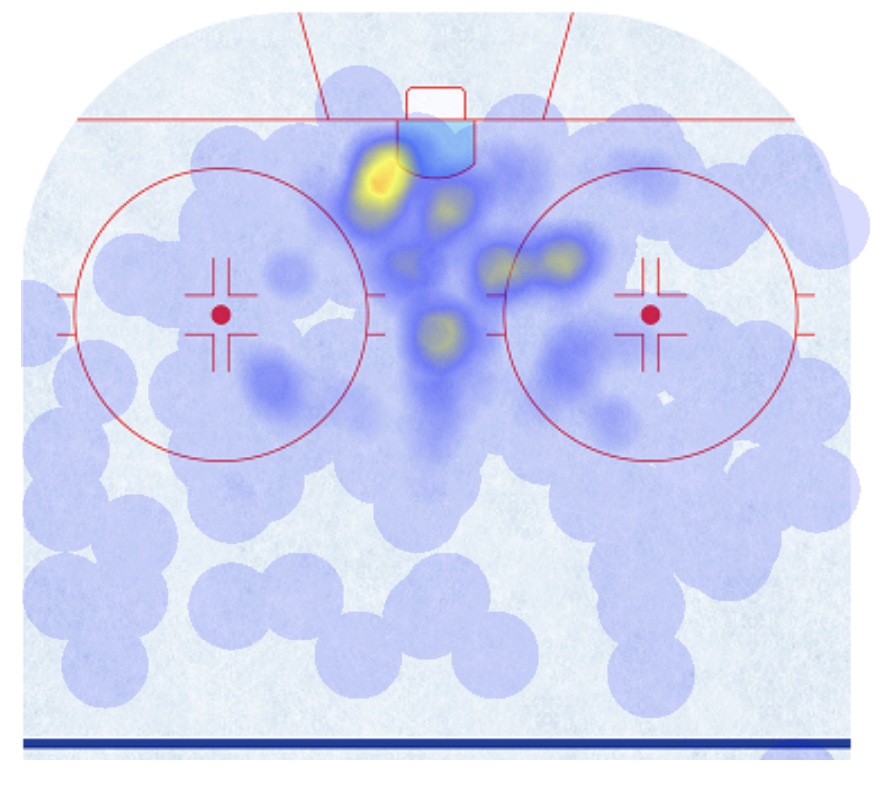
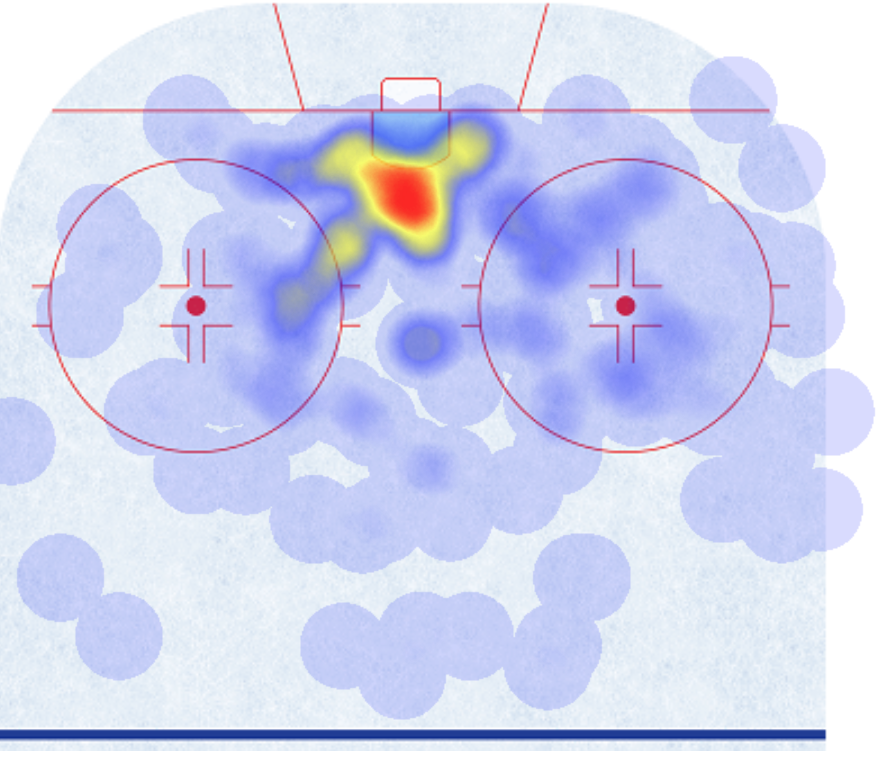
The first image is 2022-2023, where he has 0.57 Expected Goals per 60 minutes and scored 11 goals on 12 expected. Moneypuck shows him with a very high shooting talent, and I think we see that in the results because most of that per 60 amount of Expected Goals was coming from the accumulation of garbage shots in not very high quantity. He was either really lucky or very good.
The second image is from the next year which was split between Columbus and New York. Suddenly, he's concentrating his fire more, but hasn't actually stopped the junk from everywhere. This can be an effective shooting pattern for a playmaker just getting the puck in play, however. As happens in hockey to confound the viewer, he scored under expected by a larger number, getting just nine goals on 13 expected. Luck is always a factor here. His results in New York were worse than Columbus for no discernable reason.
In Carolina and Edmonton his shot rate climbed to around 15 Corsi per 60 minutes adding to his new style of more net-front offence, and his goal rate climbed with it. In Edmonton, his average shot distance fell as the junk shooting diminished.
The result was the two 20-goal seasons.
More Highlights
If you're dedicated, you can click through this video and see a grittier, more physical and less rush-oriented style on the Oilers.
Going to the net is the common factor in both seasons. In Carolina, suddenly Jack Roslivic is there and shooting. In Edmonton he seems to be doing more to play with his linemates, not just take his own shots, and the models back that up.
Power Play
Roslovic's shot obviously lends itself to power play usage, but he has traditionally been just a shot, not a factor in creating the chances on the power play. His most recent two years are very good in terms of Expected Goals, but he scored under expected in Carolina. He was second unit in Edmonton.
The Good:
Roslovic can play a rush game, lurk at the right circle, tip in from the net-front, be the third man rolling in, or grind out a more physical game in the offensive zone. His newly acquired nose for the net will let him use his quick, accurate and hard shot to score some goals.
His speed will get him through the neutral zone, and his overall impacts on shot share will help everyone do more at the right end of the ice.
He has good positional awareness and knows how to play with his linemates, and he's had a long history of success as the third-best player on a line with very highly talented forwards.
He can play as a centre, but has no real faceoff skill – he's adequate, though, and a right-shot centre is always needed from time-to-time.
The Flaws:
He is heavily dependent on his linemates for offence creation, and his defensive abilities are mild and not the reason he's on the roster.
Even with his newly found discernment in shot location, his style of bang bang shooting with no tricky deception or toe-drag can either get him goals from places usually only Auston Matthews scores from or see him score well under expected on a very down year.
Overall Assessment
The expectations were set for Roslovic back in the USNTDP is his pre-draft season when he trailed only Matthews, Tkachuk and one other in points on the U18 team. That other was Jeremy Bracco. He has not met the expectations because he just doesn't have the ability to create offence, rather he's just very good at participating in it once someone else does. This is obvious in the highlights above where Connor McDavid, Sebastian Aho, Leon Draisaitl or even Ryan Nugent-Hopkins are doing the structural work that he fits into.
In many ways, he's been dogged by bad luck or at least bad timing. He's missed time with injuries – including one that interrupted his good start in Edmonton and contributed to him sliding down the lineup once Zach Hyman was ready to play. He's had some seasons of very good play that coincided with terrible shooting luck that made him look worse than he was.
His renaissance came in 2023 as Columbus was going through its Mike Babcock debacle. They hired Pascal Vincent at the last minute, and he played Roslovic with Johnny Gaudreau and Boone Jenner. Suddenly, Roslovic could just play his role and leave the heavy lifting to them. His increased shot rate in the next two years is likely down to the teams he played on, the lines he played on, and the base level of shot differential – particularly in Carolina. But it could also have been a revelatory experience for him that his changing pattern of shot choices just needed some volume increase to make him a better player.
When training camp is fully underway, I expect we will see Roslovic on the top line with Auston Matthews. This is not just an attempt to recreate the old magic, but rather, it's an exercise in using Roslovic's skills to the utmost while having his flaws – which are really just things he doesn't excel at – matter less.
Yes, that sounds like the Max Domi formula, and that comparison is valid to some extent. But the differences are very important. Domi has one skill, and it sure isn't his shot, it's his playmaking (or was until this past year). Roslovic just doesn't have much of that. And yet, because of his solid and uncomplicated playing style, he can fit in with an offensive cycle in ways Domi never does. Maybe Roslovic is quicker in his decision making, or maybe he's just learned rote behaviours that are more effective. He's also better at all the basics of hockey that Domi never learned while he was getting points on a top line in Arizona or Chicago. Meanwhile Roslovic was toiling away, often playing centre, on mediocre teams while also learning how to build a game that adds more value.
The Leafs are, I think, gambling on the fit here, and they have a lot better foundation to think that's a good bet than Treliving did when he signed Domi.
The question for the team is: what happens if top-six Jack doesn't work? For Roslovic it will simply mean dropping to the third line, to a simpler and more direct style of play that can also have some speed on this new team. His points will likely disappoint people if that happens, but he won't be an anchor dragging his line down. For the team, they may have a harder problem to solve.
PPP Runs on Your Support
If you enjoy reading PPP Leafs, and want to see it continue, please consider becomming a paid subscriber. We want to keep all our content open to all users, but to be a sustainable site, we need more support from paid members.
Subscribe Now

Comment Navigation & Markdown
Navigation
cc to focus on comments section
c next comment
x previous comment
z next unread comment
Inline Styles
Bold: **Text**
Italics: *Text*
Both: ***Text***
Strikethrough: ~~Text~~
Code: `Text` used as sarcasm font at PPP
Spoiler: !!Text!!