

Sign Up to PPP Today
You have to be a member to comment at PPP. Membership is free and requires only an email address.
Become a MemberAlready have an account? Sign in
The Maple Leafs made a big move no one talks about much, a sure sign it's a big gamble that few people like. It's an awkward thing when a big-name player acquisition falls flat on July 1. Sergei Bobrovsky was signed for three years at $7 million, a sum in this cap inflated world that might get you a complementary winger with low-level skills, and at a term that's almost impossible to get on Free Agent Day. But that's not how the deal is viewed, it's viewed as a gigantic overpay because Bobrovsky was 37.
Throughout this series on the newly acquired players, there is a theme underlying the profiles. These players are all on the downslope of their careers, they are all paid average to above average amounts in today's cap world, not yesterday's. They all might be able to play in a bigger role than they have been with success enough to get the team back on its feet.
All of these players are short-term hires (Darren Raddysh the exception to all of this). And as a group they max out the cap space, a sign that saving up for a deadline trade isn't in the cards. There is some flexibility, but this team has a holding pattern roster designed to see for sure, rather than assume, what happens when the core of skill is surrounded by competent players and a coach with a plan to utilize that skill.
We are used to – or led to – thinking about the dichotomy of "going for it" or "tanking" with no other mode of team building. This season is neither, it is a test, a scientific and analytical test of the players already on the team, of Gavin McKenna, of Raddysh and perhaps Ben Danford and Tinus Luc Koblar. Most of all of Jim Hiller.
Bobrovsky and Anthony Stolarz are the mature, steady but highly competitive goalies tasked with producing good enough results for the test run to return usable data.
The Basics: Vitals and Stats
- Age: He turned 38 three days after Auston Matthews turned 29
- Position: Goal
- Height: 6'2"
- Weight: 183 lbs
- Draft: Undrafted
Bobrovsky was born in Novokuznetsk in the east of Russia and began his hockey career with Metallurg. He was Russia's goalie in the WJC in 2008 when James van Riemsdyk led the tournament in scoring. JvR is unsigned as of this writing and is nearly at the end of his hockey career. Bobrovsky had the third-highest Save % and the Flyers, who had been watching him for years, signed him to an ELC in 2010 when he was about to turn 22. He immediately became the starter for the Flyers, had a poor playoffs and was essentially dumped off to Columbus the next year.
There have been a lot of years since then, a Vezina, two Cups, some ups and downs but a very steady run of 50-60 games played every season without a lot of time lost to injury.
Stats
Every season there are goalies who perform extremely well, small in number, but big in impact on their teams. Bring the best out for another season and they won't all repeat the feat. Keep doing that for a few years and the list of consistently above average goalies is very small.
This is the core of the conundrum with goalie evaluation. The why of it is up for debate. Part of this problem is that the measures (Save % being the most common and the least useful) are not measures of the goalie, but of the team. When you can watch a broadcast and have the commentators tell you which team has good defence by the Goals Against and which team has good goalies by the Goals Against, it should become clear how nonsensical that all is. All Save % is, is a way to say Goals Against with enough precision to measure the very small differences between goalie seasons.
Last year Bobrovsky's Save % was .877, the first time it had been below .900 since 2011 when he was traded away from the Flyers. However, the league average Save % was .896, the first time it had dropped below .900 since 1996. The Panthers were also an average team at five-on-five who got fewer goals than the Leafs (and also let in a lot less).
All those things together – the big slide in team play, the overall league decline in goaltending results*, Bobrovsky's own play – and you have the perfect setup for angry outrage that this signing was terrible. Consistently bad is actually more common that consistently good after all.
*there is convincing evidence that Save % has changed because of data collection changes, but that discussion is beyond the scope of this article.
Advanced Stats
Goalies, as you know, play a lot fewer games in a season than they used to. Connor Hellebuyck and Juuse Saros each played 64 games in 2023-2024 and Karel Vejmelka did it last year. But something in the 40-50 range, like what Bobrovsky has been playing for years, is now the norm. Perhaps he was onto something.
In the NHL last year, only 29 goalies played at least 40 games. Bobrovsky was one of only 19 who played at least 50. He was 24th of the 29 in Goals Saved Above Expected per 60 minutes (Moneypuck). In raw numbers, he allowed 154 goals on 142 expected. Expanding the list to goalies who played less puts him equidistant from Anthony Stolarz and Joe Woll, and as is obvious, Bobrovsky is the only one of the three not injured or unavailable for large stretches of time.
Measuring goalies by GSAX is nearly as volatile (as in it fails to predict anything) as Save %. It is used here only to describe the past.
HockeyViz's graphical picture of his career is pretty straightforward:
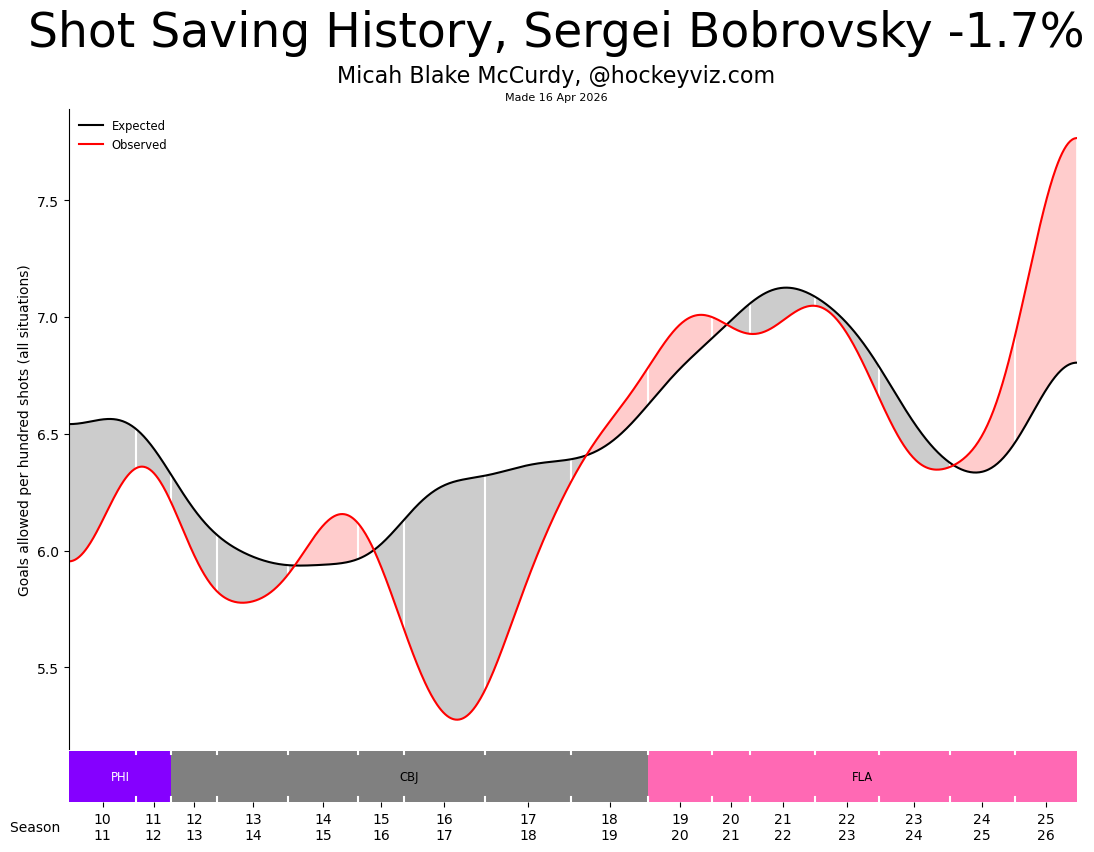
When the red line rises above the black line, he is below expected, as he was last season. You can also see that Florida has been a rollercoaster ride of up and down Expected Goals season-to-season.
NHL Edge and some assists from the numerical table on Natural Stat Trick show that Bobrovsky has only ever been an average goalie at saving high-danger shots – those closest to the net and in the slot. He makes his impact with exceptional low and medium danger play. That play deserted him last season, and in 2022-2023 to a lesser extent. Both seasons were Florida's worst in recent years for allowing higher danger shots as well, so he was dealing with poor defence in both cases.
Highlights
How Bobrovsky sees himself:
A good compilation to see his athleticism and mobility:
The Good:
Bobrovsky has quite literally seen it all. He has put together a long list of good seasons where he shows up, he plays, he goes home, and he does it again for 50 repetitions.
He is not so big that his weight is an issue, and he is not so small that his lack of coverage can be exploited. He brings a very high level of athleticism and mobility to his game.
The Flaws:
His age is the obvious issue. He will not be and should not be expected to be as good as he was in his best seasons in Columbus. That was, of course, true when he was acquired by Florida. It's more true now.
His agility and athleticism is a double-edged sword because he has to have that working for him or he can't make the saves he needs to make. He is not gifted at high-danger saving. That's Anthony Stolarz's claim to fame. So if he can't be at least average at high-danger work, he's going to be a net negative.
Overall Assessment
Anthony Stolarz is a very different type of goalie to Bobrovsky. He is very big, uses his size and positioning to just not have to make a save more often than Bobrovsky can. Bobrovsky has been better overall with a stellar career because he is both positionally sound and agile in the net.
I hesitate to post line graphs like the one above because people are naturally inclined to see trends that may or may not be there. At the time Bobrovsky was traded to Florida, he had a subpar year, and then he didn't. No trend was started in that first season. He dipped down and then he was outstanding for two Cup runs.
There is no reason to believe goalies are actually more or less consistent than any other person on skates; rather, they are just exposed to a kind of individual scrutiny skaters only get for their points totals. All of these things – points, Save %, Goals Saved above some value, they are all team efforts, subject to player fit, coaching and a myriad of other things. We lack a reliable way to extract some measure of a goalie that shows mostly his efforts, his impacts. And we lack completely the ability to know how any player will perform in the future down to the level needed to tell us if a goalie will be below, above or well above average. The distinctions are just so fine.
The goalie only does one thing, unlike all the new forwards who can contribute on defence or transition, who can fight or agitate or check. Bobrovsky can only make saves. So his variance is more visible than anyone else's. And the responsibility of the skaters for his results harder to see.
It is both reasonable to expect Bobrovsky's ability to play in the NHL to expire during the run of his Leafs contract and impossible to know when that will be. However, the meaningful time is now, and no one can live in the now like an experienced goalie can. We need to get there with him while this test is run of the New Maple Leafs 2.0.
I make no prediction on how well Bobrovsky will play, though. That's a fool's game.
PPP Runs on Your Support
If you enjoy reading PPP Leafs, and want to see it continue, please consider becomming a paid subscriber. We want to keep all our content open to all users, but to be a sustainable site, we need more support from paid members.
Subscribe Now



Comment Navigation & Markdown
Navigation
cc to focus on comments section
c next comment
x previous comment
z next unread comment
Inline Styles
Bold: **Text**
Italics: *Text*
Both: ***Text***
Strikethrough: ~~Text~~
Code: `Text` used as sarcasm font at PPP
Spoiler: !!Text!!