

Every year there's at least one player who takes an unusual path ahead of the draft. This year, one of those is Haoxi – or Simon – Wang. He was born in Beijing, China, started playing hockey at the age of 4 despite there being only two rinks in the whole city at the time, made the jump with a friend's family to join a North America hockey academy in the GTA at the age of 12. When the COVID pandemic hit and shut down all hockey leagues in Ontario, he returned to his home in China for school and to keep playing. Outside of that, he's been playing hockey in Canada since he was a pre-teen.
Scott Wheeler has a full profile on him at the Athletic, with more background into the explosive growth of hockey in China ahead of their Winter Olympics bid, and his history adjusting to life and hockey culture in Canada the past few years.
It's a fascinating story, but stories aren't going to get you drafted or drafted high. So let's look at who Wang is as a player.
THE BASICS: STATS AND CONTEXT
- Position: Left-shot defenseman
- League(s): OHL
- Height: 6'6"
- Weight: 222 lbs
- Birthdate: July 27th, 2007
Here are his draft rankings, as of writing this:
- Bob McKenzie: 31st
- Corey Pronman: 44th
- Will Scouch: Honourable mention
- Elite Prospects: 49th
- Scott Wheeler: 45th
- Dobber Prospects: Honourable mention
- FC Hockey: 109th
- McKeen's Hockey: 70th
- HockeyProspect.com: Not ranked
Let's get back to that unusual path that Wang has been taking, and skip forward to this year. He is one of the main players who saw his development path altered significantly by the new agreement made between the NCAA and the CHL that allowed for players in the OHL, WHL, and QMJHL to maintain eligibility to join college hockey south of the border. Initially, Wang seemed content to play in the OJHL in Ontario to maintain eligibility to Boston University, one of the top programs in the NCAA. But with the new rules, he could join the Oshawa Generals who made back to back OHL championships.
You may think that this would be a good thing for his development and his draft hype, but so far it looks like only the first half of that statement is true. To start the season, he was leading his OJHL team in points by defenseman and was reportedly playing 20-25 minutes per game. By the time he made the jump to the OHL, he was 7th in the league among defensemen his age for points per game. I can also share with you that Wang had a lot of hype early in the season. He was considered by a lot to be a mid-first rounder. His game may have been raw, but he was much bigger and better than just about everyone he played against.
But when Wang joined Oshawa in January, he was no longer the top dog. Oshawa was a deep team, especially on defense. Ben Danford was a first-round NHL pick. Luca Marrelli had a huge breakout as one of the best offensive defensemen in the league. They acquired a second-round NHL pick and Team Canada member at the World Juniors in Andrew Gibson the same week that Wang permanently joined Oshawa. Then they had two OHL veterans in Luca D'Amato and Zach Sandhu.
I think seeing him not immediately dominate the OHL cooled some of the excessive excitement and draft hype he had earlier in the season. He went from being The Guy to being a third-pair guy, though arguably on the best third pair in the OHL between him and Andrew Gibson. He wasn't getting power-play time, or top even-strength minutes. He had 2 points in 32 games in the regular season, then 3 points in 16 playoff games as of writing this. If he was on a middling OHL team, I could see him still being a top-pairing guy and at least getting some time on the second power-play unit.
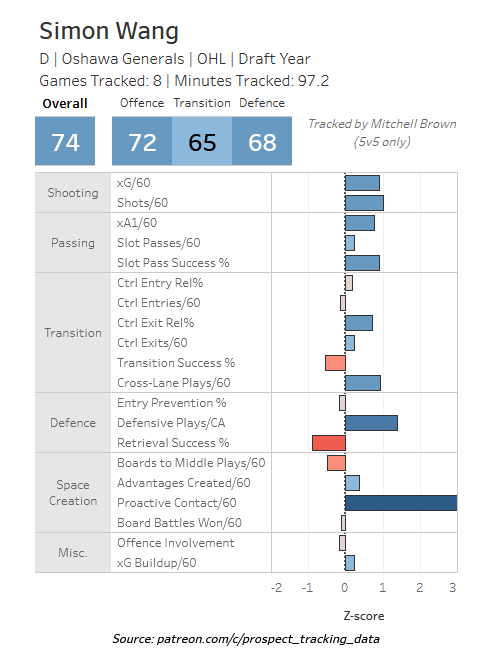
THE GOOD: SIZE, SKATING, RAW POTENTIAL
There are two things that Wang already has to a very high level: he is very tall, and he is already a borderline elite skater. Apparently his grandfather on his mother's side was a speed skater in China, and whether it's genetic or something taught to him at an early age, skating is definitely his biggest strength – more than even being 6'6". The combination of the two is why scouts have been pretty hyped about him as a two-way defenseman.
This isn't one of those "he's a good skater for his size" things, like I sort of mentioned for Amico yesterday. Wang has truly exceptional mobility and speed. Just like with Amico, his skating strengths are what drives his impacts on both sides of the puck. With the puck, his agility allows him to join the rush, create separation and present a late trailing passing option, and he can skate deep into the offensive zone to find open spaces. He has some good shiftiness with the puck, with the potential to beat defenders one on one – moreso in open ice, mind you.
Wang's pure athleticism is just something that stands out, and he proved it at the draft combine. He was in the top 20 for the Anaerobic Fitness Peak Power Output test, the 7th best vertical jump, the 3rd best no arm jump, the 3rd and 8th best left and right hand grip strength respectively, and had the biggest wingspan of all the players at 82 and 1/4 inches (Amico was tied for 2nd by the way).
Haoxi (Simon) Wang (#7 on Oshawa, #27 on King) - Skating and Transition Highlights
Defensively, Wang has smooth pivots and reverse skating so he can match pace with opponents on transitions, so he can keep a good gap. He can make quick, hard lateral cuts with great footwork to cover a lot of ice efficiently, making him a difficult player to beat one-on-one in defensive situations. Aside from his skating, he has a huge amount of reach with his size and stick length and he uses it to his advantage. He uses it to disrupt passes and puck carriers around the net and along the boards, where he can lifting sticks and harass opponents that smaller, slower players cannot. This year he also started to show a developing physical edge to his game. At the very least he isn't afraid to throw or take a hit, and he has the size and strength to make his peers bounce off him more often than not.
Wang's skating also helps him with puck retrievals on dump ins or when his team regains possession in their own end. The agile pivoting and explosive first steps help him avoid forecheckers so he can drive zone exits much more effectively than most others. This adaptability, evidenced by his quick learning and simplification of his game in the OHL, suggests a promising trajectory for continued growth in his overall defensive game.
Haoxi (Simon) Wang (#7 on Oshawa, #27 on King) - Defense and Physical Highlights
Offensively, Wang has shown flashes of potential to develop into more than just a defensive specialist. His skating helps a lot in this area as I already mentioned, but it goes beyond that. He is showing a mind that can see opportunities and makes attempts to make a play to capitalize on it. His skating helps that somewhat, he just needs to refine his puck handling and passing to be able to execute the remaining part. He already shows the ability to hit longer outlet passes in motion, a good example of his vision and playmaking potential.
Beyond that, Wang has the brain and the instincts to be an offensive defenseman. In the OJHL he was one of the better point producers, and in the highlights I've seen from his games there he was doing things you'd expect from one. He was able to carry the puck end to end, weaving through the defense with good stick handling at speed. He showed good puck protection, a good shot, good puck handling, he jumped into the play offensively, all of that and more. In the OHL, however, he seemed to simplify his game to be more of a steady defensive guy who can move the puck up the ice well. He is not asked to be an offensive contributor, not considering how deep Oshawa's defense was. But the flashes of potential are still there, just not as often as it was in a lesser league.
Haoxi (Simon) Wang (#7 on Oshawa, #27 on King) - Offense Highlights
THE FLAWS: LACK OF REFINEMENT
The problems with Wang are very common for players of his type. Coming from a more obscure hockey environment, he didn't grow up in the same structure that helps teach kids more refined technique and mental processing for hockey. Even though he's been in Canada for 5-ish years, he's still catching up in these areas. It's a good and bad thing, not unlike what I say about guys who are skinny and have an obvious opportunity to get stronger and improve the physical aspects of their game. On the good side, Wang is 'thin' when it comes to the ability to process the game in real time and have his body react to it with good, high end plays. This is the kind of thing that seems like an obvious open path for his development, and the more improvement he makes the more it will unlock additional elements of his game.
On the bad side, there are no guarantees. Just because Wang is lagging behind in this kind of area, doesn't mean he'll automatically improve to any great extent. For every prospect that 'fills out' and improves their strength (Knies, Greb, Cowan), there are others that just never do (Niemela, Ovchinnikov). There's a point where there is no catching up, either because the specific player reaches the ceiling of what they're capable of or because they run out of time.
So despite Wang's promising offensive potential, there are consistency and refinement issues that he'll need to fix – and it's not just little tweaks that are needed, but more substantial improvements. While he shows flashes of creativity and the ability to get into good scoring areas, his puck skills and vision at higher speeds need further development to consistently manipulate opponents and execute high level plays effectively. This applies to his breakouts, his transitions through the neutral zone, and his plays in the offensive zone. While he's already capable of making clean breakouts reliably with the time and space of junior, it's for more simplistic plays like a significant portion of his offensive transition passes have been observed to miss their targets, suggesting a need for improvement in his puck distribution under pressure and at speed.
Defensively, the story is more or less the same but, I think, not to the same degree. Wang has some inconsistencies, particularly with his in-zone coverage. Again, it's a refinement and experience issue, and he's said in interviews that in China the sport was played very free and with little structure. He's still catching up to the idea of rotations, assignments, positioning, and other things like that which can lead to defensive breakdowns. While he possesses incredible physical tools, between his size, reach and skating, he does need to work more on building his strength, using it more to his advantage, and how to use it to his advantage.
The final area for Wang's development will be with his decision-making and overall hockey sense. While he can read individual players, processing more complex plays and making quick, effective decisions is something that lags behind a bit. Handling the puck sometimes seems to detract from his ability to read the play developing around him, as an example. He can spot a player that's open but not necessarily in seeing a player that will be open in a different area in another second or two.
OVERALL ASSESSMENT
Wang is another guy who's physical tools I think will be coveted by many NHL teams, and there are more than a few teams with more than one pick before Toronto's. I can easily see someone being willing to take a bet on his upside. In McKenzie's mid-season ranking, Wang was at 31st. That was before he made the jump to the OHL where I have seen public scouts cool on him, so that is something that I think is possible from NHL teams too. And there are other reasons why I think he could be available in Toronto's range.
First, Corey Pronman hasn't ranked him at all all season. He's only covered the first round, more recently the first round and a few other picks. That does suggest that, to Pronman, he's not likely to be a first rounder. I don't like Pronman's analysis, but he is probably second only to Bob McKenzie when it comes to reflecting what NHL teams tend to do on draft day. Another bit of evidence is NHL Central Scouting having Wang as the 34th best North American skater, and that would definitely put him in Toronto's range as a late second rounder.
So if he is a realistic option to be available in Toronto's range, the question becomes if he would be a good pick. I profiled him, so obviously I think so. I definitely think those tools are very enticing, and I know he fits the type of prospect Treliving seems to like. I also have more faith in Toronto's development staff than most other NHL teams when it comes to unlocking the most of his potential. Strength and nutrition training, refining mechanics with skills coaches, helping him process the game better and just generally get caught up in those areas I talked about.
He's one of the few players I think could be in Toronto's range that I think has the potential to become a star player. The chances of that may be small, and it's more likely he just becomes a solid second-round guy, but the potential is there. The problem with Wang is that, as of now, he's much more potential than he is anything real... and that means risk.
Thanks for reading!
I put a lot of work into my prospect articles here, both for the draft and Toronto's prospects. I do it as a fun hobby for me, and I'd probably do it in some capacity even if PPP completely ceased to exist. But if you like reading my work, some support would go a long way! I pay for a few streaming services (CHL, NCAA, USHL, the occasional TSN options for international tournaments that are broadcast) to be able to reliably watch these prospects in good quality streams. I also pay for some prospect-specific resources, such as tracking data and scouting reports from outlets like Elite Prospects, Future Considerations, McKeen's Hockey, The Athletic, and more.
Being able to get paid for this helps me dedicate more time and resources to it, rather than to second/third jobs. And whatever money I make here, a lot of I reinvest back into my prospect work through in those streaming and scouting services. Like I said, I'd be doing whatever I can afford for this anyway, so any financial help I get through this is greatly appreciated!


Comment Navigation & Markdown
Navigation
cc to focus on comments section
c next comment
x previous comment
z next unread comment
Inline Styles
Bold: **Text**
Italics: *Text*
Both: ***Text***
Strikethrough: ~~Text~~
Code: `Text` used as sarcasm font at PPP
Spoiler: !!Text!!