

Sign Up to PPP Today
You have to be a member to comment at PPP. Membership is free and requires only an email address.
Become a MemberAlready have an account? Sign in
The first meaningful player added to the Leafs this summer was, of course, defender Darren Raddysh. Acquired in a sign-and-trade in late June, he is on the books for eight years with an AAV of $8.5 million. That makes him the highest paid defender and the third-highest paid player on the team. His contract runs the longest of anyone currently on the roster making this deal a very different one to the "let's see how this goes" science experiment of the short-term deals for forwards, or even Sergei Bobrovsky's contract.
Raddysh, William Nylander and Gavin Mckenna are Maple Leafs for the long haul. Everyone else, even Matthew Knies and Easton Cowan, have at least some questions beside their names. While he's barely been mentioned so far in this series, this two-year plan is all about Auston Matthews. He can commit to the new core or choose not to. The team can work to add him permanently or choose not to. With Raddysh the choices have already been made by both sides.
Despite the contract, and the commitment to what many see as a gamble on an unusual defender, the focus for Raddysh and everyone else is the next two years. The Leafs have no one on the NHL roster whose contract expires at the end of this coming season making this a full two-year run for everyone, not just Matthews. At least that's the initial plan.
The Basics: Vitals and Stats
- Age: 30
- Position: RD
- Height: 6'1"
- Weight: 203 lbs
- Draft: Undrafted
Undrafted just like Chris Tanev was, there are some surprising similarities between the two, considering they are vastly different sorts of defenders. To start with, they are both Toronto-area players who grew up as Leafs fans. For another, they made their impacts later in their career.
Stats
Raddysh played for the Toronto Marlboros as a kid, and then after his OHL career in Erie that involved two long playoff runs and some all-star awards, he was signed to an AHL deal by Chicago's affiliate. They upgraded him to an ELC after his first season. He played on their AHL team for another year before he was traded to the Rangers for Peter Holland in 2019. Holland was coming to the end of a minimum-salary contract and went to Europe after to play, so this was strictly an AHL-level trade of no importance at the time.
In a situation very reminiscent of Nick Paul's career path, Raddysh didn't get much notice until he ended up in Tampa. In his case, he left New York as a UFA at age 25 and signed three low-AAV one- and two-year deals with the Lightning. He had earned an estimated $2.92 million before he cashed that $10 million signing bonus cheque he got in the summer.
Even though he's 30, Raddysh has only played three full NHL seasons, although, curiously in his first 17-game NHL stint in Tampa, he played 17 minutes a game. Last year, he hit 23 minutes and was their most-used defender – a big change from a role as the number 4/5 in his prior years. Tampa had swapped out two defenders ahead of him for replacements that kept him from promotion until Victor Hedman and Ryan McDonagh were both out of the lineup at the same time. To say he rose to the challenge is an understatement.
The fluctuations in his ice time had been primarily driven by power play time prior to his increased use last year at even strength. He leapt from less than two minutes per game on the power play in 2024-2025 to over 3.5 last year. When Hedman was out of the lineup, he was the power-play defender, there was no other meaningfully used player. Those minutes gave him some very shiny points stats, and punched up his goal total in ways that aren't necessarily going to be repeated.
NHL Edge shows he has an extremely hard shot, one of the hardest in the NHL, but an interesting skating speed pattern. Unlike Morgan Rielly, who is fast all the time, Raddysh has a below average standard skating speed, but he puts on speed bursts a lot. Not quite as much as Rielly, who is one of the fastest in the NHL, but it's clear he can accelerate when he needs to.
Advanced Stats
Goals come from opportunity, but the opportunity has to be met by some level of player talent or the puck does not go in. Unlike the majority of defencemen, Raddysh routinely scores over expected and has genuine shooting talent as evidenced by any model that isolates his impact. But he is a defenceman who stays closer to the blueline than what you might imagine of an offensive defender in the NHL today.
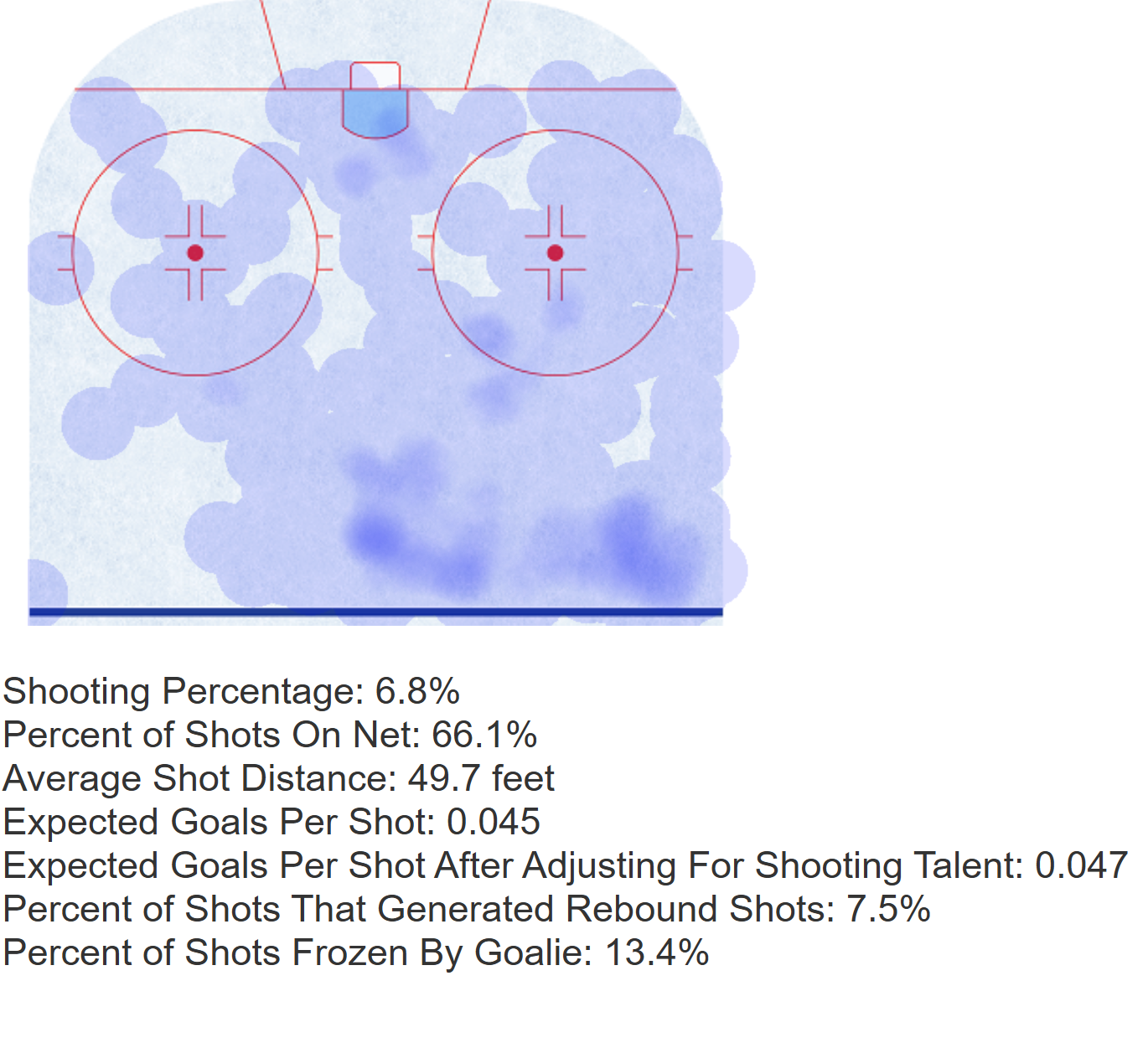
I'm not all that used to looking at shot data for defencemen, and we've looked at a bunch of them for forwards over this series so you may want to do what I did and compare him to some others. What Raddysh shows last year on the Lightning (and similarly the year before) is a very high shot rate, a defender-typical shot concentration well outside the high-danger area, with enough of a darkening of some zones around the right circle and in the net-front area to account for his very high expected goals rate. It's not coming just from volume. He has a longer average distance than Cale Makar – the quintessential offensive defender – but not by a lot. He gets to an individual expected goals amount just under Makar's. Makar is an outstandingly elite shooter, and Raddysh touches the hem of his cape, something very few defenders in the NHL do.
HockeyViz's model shows Raddysh with a heavy tilt towards offensive value over in-zone defence, but also shows a great deal of his positive impact is from transition skills moving the puck and then creating offence as the end result.
His shot and his volume of shooting are very unlike the classic model of Leafs offence since Sheldon Keefe became coach. There is going to need to be a rethink of the power-play system and the even-strength offensive cycle. We might see Raddysh shooting less than in Tampa, but it's very likely the Leafs will not be at the bottom of the list in defender shots taken anymore.
Raddysh's power-play time on the Lightning was spent fulfilling a role, not creating offence there. You can see that in this chart of his three seasons:
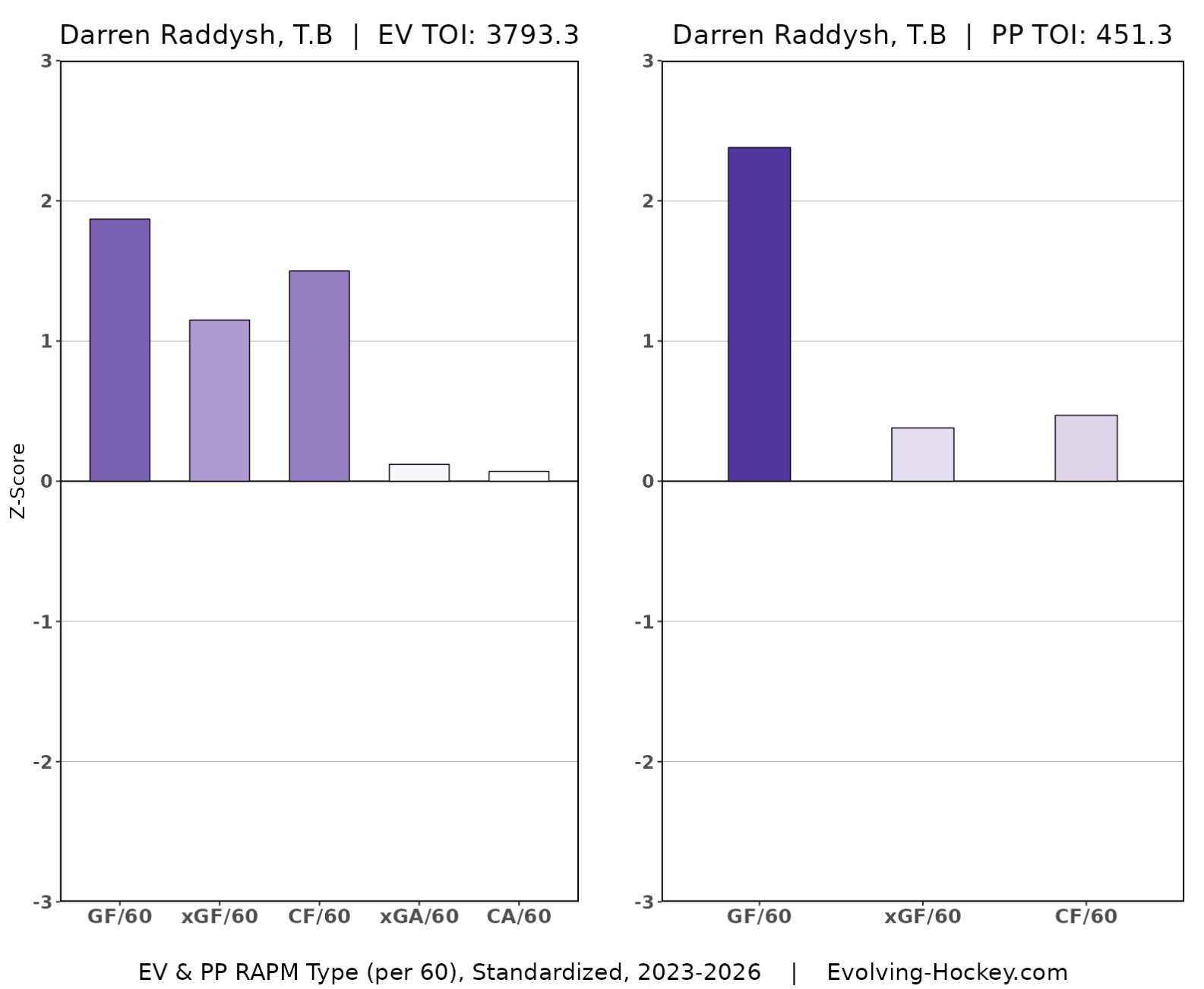
The right side shows his power play as all about the goals, and much less about the creation of conditions for goals to happen. This belies entirely the idea of the defender as the "quarterback" of the power play in terms of running the strategy. Raddysh is the cannon, someone else loads it. Or at least that's how Tampa did things largely because they had the elite creator on the ice in Nikita Kucherov.
In this article about Raddysh: Executive's Eye: Darren Raddysh - Toronto's New Quarterback, the case is made for Raddysh to succeed with more of a creative role on the power play with the Leafs. It is true that Auston Matthews and William Nylander are not elite power-play creative forces like Kucherov. How much of that is years of interesting coaching decisions tilting results isn't clear, but just a better system alone is unlikely to make the Leafs one of the elite teams at actually scoring power play goals. They need more creativity.
The left side of that RAPM chart also agrees with the HockeyViz results in that he shows big impacts on both the end results of offence, and on the creation of the conditions for offence. His defence is fine, but no one should be expecting him to be anything like Tanev in that respect. This evidence of creation at even strength is covered in the article linked above if you prefer an action description of on-ice activities, and it is the foundation for hoping for more on the power play than just the cannon.
Defensively on the Lightning, something exciting was going on last season. J.J. Moser and Raddysh showed up with 58% Expected Goals and were a top-10 defensive pair (over 200 minutes together). Neither player had ever had a season like this before. This obvious synergy of skills is not something you can recreate on demand. None of the isolation models or talented scouting successfully identify how much of that result was Raddysh's actual skill and execution. They are the best approximations, though, and they show both players as cause to the big effects.
Highlights
This is an excellent look at both the cannon, the loading of the cannon, and what happens when it doesn't work. Because he doesn't score on every shot.
The Good:
Raddysh is a valuable shooter in all situations, and he will score goals. Much more importantly he is a puck handler and transition player of measurable skill, and that is something the Leafs desperately need. He can play big minutes, he's a big enough player with enough defence, toughness and speed on demand to get the job done as a top-pairing defender.
The fact that he can actually create more offence at even strength beyond just what his transition skills provide makes him a genuine top-pairing option.
He's a right-shooter, and that matters and aids his power-play performance, and avoids having a lefty moving the puck up the right side.
The Flaws:
His defence is not elite nor is his skating. Defenders like Cale Makar and Quinn Hughes are much, much faster and more agile on the ice, and they bring a dynamism to their offensive game that Raddysh just doesn't have. Again I'll reference the scouting-based article above for his comments on Raddysh's lack of lateral agility in the defensive zone.
Defending in small areas is where the largest limitations can be found in Raddysh’s game. There are a few factors that come into play here. One crucial element of his D-Zone limitations stems from a lack of mobility. Raddysh possesses straight-line speed. However, his mechanics limit his 4-way mobility and agility, and it shows when he rushes out to engage.
His offence creation is not elite, and only partially offsets his lacklustre in-zone defence.
Overall Assessment
Darren Raddysh will not be the best top-pairing defender in the NHL, but he will be one who fills the 1RD role the Leafs have had open for a long time. That they got him at all is the single biggest move the team made in the offseason. The pressure will be on him to perform.
For all his latest season is a bit of an aberration, it is that performance of rising to the occasion when the door was opened that the Leafs are basing their gamble on. But it is a valid position to take that his prior seasons, while not dreadful, were not quite as impressive.
He has tools that fit into the open spaces on the Leafs, notably on the power play, but the importance of his ability to influence how much zone time the key forwards will get cannot be overstated. Before Craig Berube arrived, the Leafs were already undermining their offensive pace with too much time spent in the defensive zone and playing very ineptly there. Chris Tanev was the first good attempt to fix that, and, while Raddysh is not here for his defending, his puck moving skills should also improve things just by allowing the team to exit the zone more efficiently.
There are all these fast-skating new forwards added to the team, and someone has to get them the puck to send them zipping off in the right direction. Raddysh can do that as well as help maintain control of the puck in the offensive zone.
He had an outstanding season in Tampa because he clicked with J.J. Moser, fit well with the forwards and the team system and got an opportunity. Ignore his goals and points; the key to his success in this first two years on the Leafs will be how fast he can click with the players here now and find a role within the new coaching system.
If we understand that he is now a key part of the team, then we can understand that the new system has to be built around these key parts, not some old vision. The power play will be reimagined with his skills in mind. The offensive cycle has to include him. And more important than all of that is that all these systems have to work with the hockey brain of Gavin McKenna. It's tempting to assume that the loader of the cannon will be McKenna, but that's a concept not a reality at this point.
What spaces still exist on the team that can be filled in with someone new will become obvious as we move into the winter. The longer term plan is to take all those forwards we just got to know over the last few days and replace them. Every last one. So while the team looks static now, it is also designed to be changed at will.
If there are things Raddysh can't do, and at less than half the AAV of Cale Makar, I bet there are plenty, the response has to be to find someone who can, not to trot out the "gotta be better" stuff that has been said about Morgan Rielly for years.
Player evaluation is the core of team building, and the teams that do it with clear-eyed honesty and emotions in check are the ones that build winning teams. If the Leafs understand who Darren Raddysh is and is not, they are on the right path.
PPP Runs on Your Support
If you enjoy reading PPP Leafs, and want to see it continue, please consider becomming a paid subscriber. We want to keep all our content open to all users, but to be a sustainable site, we need more support from paid members.
Subscribe Now


Comment Navigation & Markdown
Navigation
cc to focus on comments section
c next comment
x previous comment
z next unread comment
Inline Styles
Bold: **Text**
Italics: *Text*
Both: ***Text***
Strikethrough: ~~Text~~
Code: `Text` used as sarcasm font at PPP
Spoiler: !!Text!!