

On the opening day of training camp for the Leafs, Brad Treliving said something that got little notice. He suggested that the Leafs aren't looking to score more goals, but to allow fewer. Defence and limiting chances are their aims.
More than, fewer than – that's all vague. Fewer than what?
I looked at this two ways, first for people who think about goals in a season in whole numbers, this is the Matthews era, as if every season had 82 games in it:
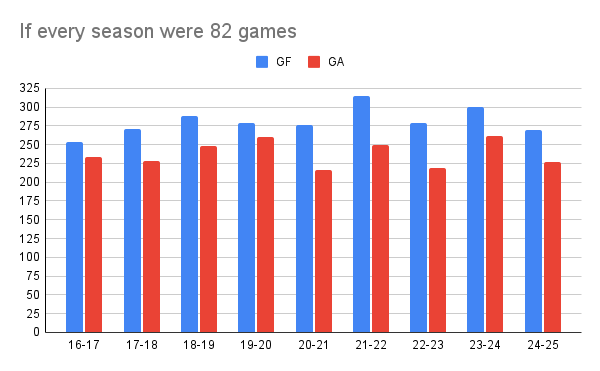
By results, last season was most like 2017-2018, a year everyone remembers fondly as more fun. The difference between last season and 23-24 is marked, and also marked by Matthews' goal glut one year and drought (by his standards) the next. And yet, that's a result that wins division titles.
The more accurate measure:
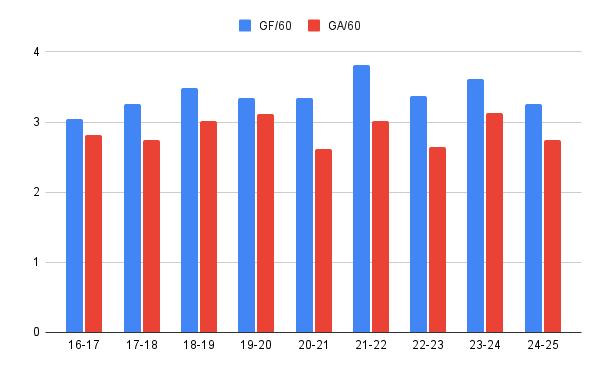
And how they got to those results (note that this is all-situations to match the goals chart):
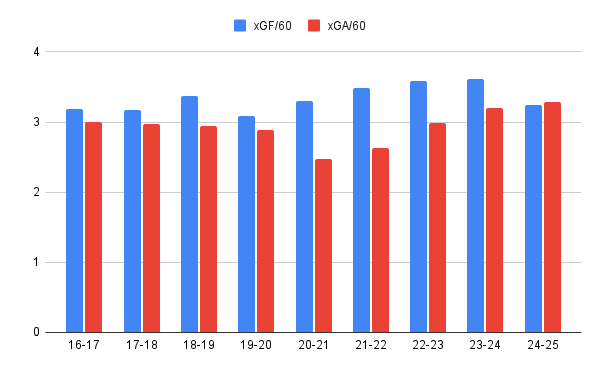
This shouldn't be news to anyone that the Leafs categorically did not limit chances against last year as well as they had the year before. They did not limit shots. They didn't allow a whole lot more than the prior year, in what had been an upward creep since long before Treliving or Berube joined the team. They coped with it and made it work with goaltending. They made the goals for as good as they were with the power play by a not insignificant amount.
We know all this, but consider that 17-18 year. That's the year the Leafs had the highest team Save % in all-situations. They weren't laying down a solid game that season either. They rode the goalies just like last year. A lot of it was unsustainable.
That was then, and we are embarking on a new now without a major player who used to generate offence. It's necessary to assume the Leafs will score fewer goals, and it follows that they must allow fewer goals. And you can do that the hard way – like last year – or the easier way and genuinely limit both quantity and quality of shots against, get the hell out of the zone in under an hour and generate more offence at five-on-five to make the power play the dessert, not the main course.
Whenever someone goes off on a bit about "Berube Hockey" like there's zero difference between him and Randy Carlyle, I have to roll my eyes. There is no one in the Leafs organization today who does not understand the relationships in those charts. They may use different words, but they grasp the concept. Carlyle genuinely believed – it seemed – that skilled offence would just so overwhelmingly succeed that shots against were not relevant. And that was something no one should have ever needed mathematical proofs to realize was fantasy.
What I'm getting at here is that assuming the Expected Goals, or scoring chances or whatever less useful thing you want to measure, were the intended outcome is a false view of events. What a coach or GM wants and what a team can deliver are not always the same thing. So how did the team deliver those bad xGA numbers? Once you've stopped suggesting the coach put the wrong Xs and Os on the board, it's common to look for the guilty and demand they be traded or just put on waivers, but instead, I want to start with the players who were good at limiting shots in quantity and quality.
I'm using Evolving Hockey's RAPM here, not on-ice stats. RAPM in numerical form isolates out some measure of the individual impact from confounding factors like differences in usage or teammate quality, so is more appropriate for looking at individual responsibility. This is now even-strength as well. In terms of xGA, negative numbers are good, and the onus is on the consumer of the numbers to realize that values very close to zero are effectively equal and not get caught up in a good/bad dichotomy over a plus and minus sign.
There were five skaters on the Leafs last year with more than 300 minutes played who had xGA/60 results significantly good and another five with values shading down rapidly to zero. Zero, in this context, can be seen as do no harm, do no good.
The good:
- Chris Tanev – he's so good he ranks sixth in the entire NHL under this criteria
- Pontus Holmberg – very good, but still 33% closer to zero than Tanev
- Steven Lorentz – effectively tied with Holmberg
- David Kämpf – also effectively tied with the other two
- Brandon Carlo – it's only 20 games played, but he was very good, coming in at about half the value of Tanev's reach over zero.
Now, you might notice one of those people is gone off the team and another is constantly in trade rumours. There is more to hockey than defence, even when defence is the thing you want more of. Holmberg had such dramatically negative impacts on Goals For, that you have to take that fairly weak measure a little seriously in this case. And his impact on Expected Goals For was also in the actually harmful, but not horrible range. Kämpf is more extreme. His negative impact on offence is absolutely one reason he spent time in the pressbox, in my opinion.
Now, to be fair to Holmberg, Lorentz's numbers are very similar on both sides of the ledger, and I think Holmberg is gone because Lorentz has a better game for the fourth line, where that overall impact is actually desirable. Holmberg was a concept of a complementary middle-six forward who just didn't quite pull it off well enough to prove the idea. Maybe he needs to play with someone who needs fewer compliments? Or maybe he's just not really enough for the NHL.
Three guys adding meaningfully value in limiting the goalie's workload, is the takeaway. And one of them is a fourth liner.
How about the guilty, then. There are three skaters who are significantly bad, and two who are in the shading towards zero territory but play so many minutes, they are a concern.
- Simon Benoit – his results were truly awful, so bad he is 20th worst in the NHL last year, and his offensive impact is also the worst on the team, is terrible, and he played 1,100 minutes, and he is a defenceman
- Max Pacioretty – his poor defensive results should be taken a lot less seriously just because he is a winger, but his offence did not make up for it – maybe he is done
- William Nylander – his poor performance, again as a winger, is a bit eye-popping, if not as bad as Pacioretty's, but considering his offence, it really is actually fine since he's a massive net positive
- Auston Matthews – yes, that is a surprise in some ways, but his offence – better (just) than Nylander's in a down year – also excuses what is a merely slightly troubling number we can likely lay at the door of his injury
- Morgan Rielly – he was also only a little bit bad, but his offensive impact was very poor, considering his role, and he played over 1,500 minutes, and he's nominally a defenceman, so it matters
The takeaway here is that the Leafs have a top-six line bad at defence (John Tavares was much closer to zero, but no star at limiting shots) and two defencemen who were big problems. Surely you aren't shocked by that? But it's nice to quantify the scale of the issue.
And here it is: there's way too many members of the team at or around zero. They aren't hurting anything, but they don't help, and only two of the defencemen made meaningful impacts at the core job of defence.
Oliver Ekman-Larsson, who for some bizarre reason takes a lot of heat, was okay. That's what you get with a guy like him at his age. Put him with anyone at all – a broomstick – who can perform better than Benoit did last year, and a lot of this problem improves. And there's nothing saying that new broom won't be Benoit himself bouncing back.
Morgan Rielly is talking already about having dedicating himself to training and to being better, and that's good, because I don't expect his defence to suddenly improve, but having his offensive impact back is necessary, and might help Jake McCabe be less overstressed.
What's the other thing that can help? Well, sorry to harp on this, but having a third line that has a function and can perform it well will go a long way towards increasing the overall chances of the Leafs having that lovely positive goal differential again and also making it less of a problem if the Tavares line are a bit flustered in the defensive zone.
If you watched the TSN free agency show this year, you saw another mock argument about the Leafs, which they've made a feature of their time-fillers. This time it was Frank Corrado who was scolding the forwards on the panel about being ready to take the pass out of the zone. They were mock-blaming the Leafs defence for not making clean exit passes. And herein lies some truth in the amusement – the Leafs had whole defensive pairs on the ice some of the time who are at best just barely capable defensively and at worst were actively making the team play like it was 2014 again.
Think back to 17-18, and you know full well why the xG chart looks a lot less lovely than the goals chart for that year. The defence now is better, and Carlo might be enough to push them into good enough this year, but dig down below the level of xG results and into the dirt of zone exits and play through the neutral zone, and the answer keeps coming up that the defenders other than Tanev have to step it up. All of them, even if the forwards improve some this season.
Now go back to worrying about top-six wingers, because Frankie isn't wrong, and some of the blame does land on forward shoulders, but I think there's more than one path to a healthy goal differential, and the new Leafs are not that old supercharged sports car with no brakes anymore. They actually need to be able to stop some of the time.


Comment Navigation & Markdown
Navigation
cc to focus on comments section
c next comment
x previous comment
z next unread comment
Inline Styles
Bold: **Text**
Italics: *Text*
Both: ***Text***
Strikethrough: ~~Text~~
Code: `Text` used as sarcasm font at PPP
Spoiler: !!Text!!