

Hidden gems can often be found on the best teams that are so stacked with talent, especially older talent, that their younger prospects don't have as big of a role and don't have as much chance to shine. Then, after they're drafted and suddenly those older stars have moved on from junior, suddenly that guy buried on the depth chart has a top role and people are shocked when he emerges as a star.
To me, that's the case with Alexander Bilecki. When Kitchener didn't have their full roster, either from injuries or players being away from the OHL for things like NHL training camps or international tournaments like the World Juniors, he was who Kitchener turned to in order to fill those shoes, and every time he got the chance he stepped up and did not look out of place on the OHL champions. He's been one of my favourite prospects I've followed all season, and I like him so much I am writing his profile in one of the spots for Toronto's second round pick even though he's either not ranked at all or mostly in the third round.
THE BASICS: STATS AND CONTEXT
- Position: Left-shot defenseman
- League(s): OHL
- Height: 6'1"
- Weight: 181 lbs
- Birthdate: May 9th, 2008
Here are his draft rankings, as of writing this:
- TSN NHL Scout Poll: Not ranked
- Cam Robinson NHL Scout Poll: Not ranked
- Corey Pronman: 76th
- Will Scouch: Not ranked
- Elite Prospects: 47th
- Scott Wheeler: Not ranked
- McKeen's Hockey: 39th
- Upside Hockey: 80th
- NHL Central Scouting: 49th (North American skaters)
Bilecki is a local guy from Mississauga. He played AAA there before being drafted by Kitchener in the 2nd round of the OHL draft in 2024. He was a 6'0" and skinny (152 lbs) kid who had a pretty good but unspectacular offensive profile, with 24 points in 33 games in the GTHL. That was good for 8th in the league for defensemen, notably behind future teammate Jacob Xu who led the league with 39 points in 37 games.
After that season and being drafted, Bilecki immediately joined the Rangers as a rookie for the 2024/25 season. Kitchener was relatively young but becoming a powerhouse – they had the second best record in the OHL but lost in the playoffs to the more dominant London Knights you may have heard of. Bilecki had a good season as a 16-year-old rookie, putting up 14 points in 45 games but only getting into three playoff games. His tracking stats showed him as a decent offensive and transition driver, with poor defense. Not unusual for 16 year old defensemen with his profile.
This year, the Rangers were one of the favourites to win the OHL to start the season and they did wind up winning the championship. Bilecki started buried down their depth chart. Kitchener had Cameron Reid, a first round draft pick of Nashville's last summer who also played on Canada's top pair at the World Juniors. In fact, after making various trades, Kitchener had four drafted prospects on their blueline in Reid, Andonovski, Woolley and MacNiel. They also had other promising young defensemen like the aforementioned Jacob Xu, or undrafted but established veterans in Jakub Chromiak, Carson Campbell (one of their assistant captains), and Maxim Dirracolo.
As the season carried on but before all those trades, whenever they had opportunities for their depth defenders to play in a bigger role – injuries, NHL training camps, international tournaments like the WJC – it was Bilecki who was getting that increased usage. And it was Bilecki among all their superfluous veterans and promising prospects who Kitchener decided to keep for their OHL playoff/Memorial Cup run. Xu and Chromiak were both traded away to make room for Wooley and Bilecki. Their departures gave Bilecki more opportunity, even if he was started on the "third" pair in some games, his total ice time and usage were bumped up.
Bilecki rewarded their faith. When he was needed to play heavier minutes, he got bumped to the all situations leader and had some games playing over 30 minutes per game. His biggest offensive games came in these moments, otherwise he was on the 2nd powerplay more often as the year went on behind Reid's top unit. Bilecki finished this season second on the team in points for defensemen with 29 in 66 games. Eight of those points were on the powerplay.
Bilecki's game went to another level down the stretch and into the playoffs, even if his ice time was relatively reduced as Kitchener was fully deploying their healthy defensive core. That said, in the 12-15 minutes he was typically getting, his point production increased from 0.44 per game in the regular season to 0.61 (11 points in 18 games) per game in the playoffs, good for third on the team's defense. As of writing this, Kitchener has won the OHL championship but the Memorial Cup hasn't started yet. So by the time this comes out, we'll see how his game looked on the biggest stage in Canadian junior hockey against the best of the best from the other two leagues.
THE GOOD: ELITE TRANSITIONS & PUCK MOVEMENT, HIGH-END MOBILITY, TWO-WAY POTENTIAL
I've mentioned in the past that I value a defenseman's skills from his own zone outward. I want them to be able to defend well, and in that statement I include the ability to move the puck out of their own zone effectively. No turning it over when dealing with forechecking pressure, no blindly flipping it in the air hoping it clears the blueline but just gives possession right back so you're still stuck in your own end. I want outlet passes that hit your man, the ability to shake off forecheckers to buy yourself and your teammates time and space to initiate an effective counter attack.
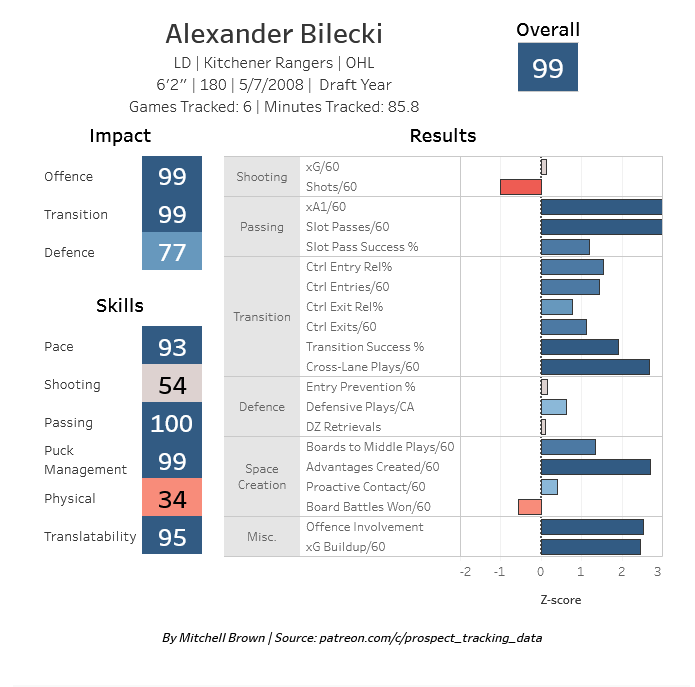
Bilecki is an elite transition driver in the OHL this year. In fact, I'd argue he is only behind Chase Reid in terms of being an effective transition driver in the entire CHL for this year's defense prospects – and maybe the second best in this entire draft class. It starts when he retrieves a dump in or gets the puck back in his own zone. He remains calm in the face of heavy forechecking pressure, and has good awareness and vision to know or quickly find teammates who are or will be open for a breakout pass.
When taking an action with the puck, Bilecki is poised, calm, smart, and has a solid set of tools when handling the puck to avoid turning it over. He is a very good passer where he can make the easy and obvious play, but he can also create rush chances out of nowhere by springing a teammate who you didn't even realize was open for a breakaway or odd man rush. His transition game as a result is highly efficient but also capable of generating dangerous rush chances with his playmaking.
Aside from just passing the puck, Bilecki is also a wizard handling it. He's not necessarily an elite dangler, but he's so shifty in his movements that he doesn't need to be. I'm not an expert but I'd bet that Bilecki's mobility is already at an NHL level. He's smooth and explosive, fast and agile, everything you'd want a good skater to be. I wouldn't necessarily say he's an elite skater right now, but I think he could become one with time and development.
More than just how mobile Bilecki is, it's how he uses it that's so valuable to me. He has a great brain for understanding how he can weaponize his skating. When he makes a good play, he doesn't just stand and watch the play unfold. He'll immediately take off into open space to present an option for the pass to come back, often catching defenders off guard as a result. If they do notice him creeping He can be a bit of a roamer in the offensive zone, but he chooses his spots well. He also loves to activate on a rush, making the outlet pass then getting on his horse and becoming one of the leading players on his team to take a pass in the offensive zone or as a late trailer. He has the speed to make that happen.
Once he's in the offensive zone with the puck, Bilecki has the brain and skill to have a positive impact on the offense. He's not a guy who just has a bomb he uses from the point – though he does have a good shot, his shot rate isn't that high for the usual offensive defenseman in junior. If and when he does shoot, it's because the defense gave him room to walk in and fire it from a more dangerous range. Or he's jumped in from the point for a pass into the slot or at the back door. He uses his skating to dance along the blueline looking for passing or shooting lanes, or to evade a forward and skate into the more dangerous parts of the ice. I do think he could be a high level powerplay quarterback, and will have the chance once Cameron Reid moves on from Junior, or one of them is traded. You can see from his tracking data that he is an exceptional playmaker in setting up his teammates, but his shot rate is just okay. Honestly, that's the kind of offensive defenseman I like. He has a good enough shot and shoots enough, only from dangerous locations mind you, to be able to capitalize when defenses and goalies sell out on his passing.
Then there's Bilecki's defense. As of right now, he rates out as an average to above average defender in junior. But I think he has the potential to be above average even in the NHL. He has the tools, for him it's about finding better consistency. He has the skating to stay with just about any zippy winger, he has the size/potential size to deal with the vast majority of power forwards, and he has good instincts and anticipation.
When defending transitions, skating helps him manage an aggressive gap to force a dump in or turnover, and to seal the forward on the boards if they try to go wide on him. He has a good stick to poke or sweep away the puck when they try to dangle past him, and he has good anticipation to jump into passing lanes to create a turnover. His positioning in his own end, when he's on his game, helps keep the other team away from the middle of the ice to the perimeter, where again he will try and stop a puck carrier by erasing him on the boards.
Alexander Bilecki (#89) - Defense Highlights
THE FLAWS: INCONSISTENT DEFENSE, HIGH-RISK OFFENSE, STRENGTH
The biggest concerns about Bilecki are mostly around his defensive projection and whether his offense is too 'high-risk' to project well to professional hockey.
Defensively, the problem is consistency. The most glaring flaw in Bilecki’s defensive profile is tendency to become too passive and just watching the puck when he's not the active defender, instead of checking to see where everyone is around him in his area of the ice. Those lapses in focus leaves him and his linemates vulnerable to those late trailers, back door activations, the forward he was battling in front of the net slipping higher in the slot for an open shot, things like that. At times his defense can look very mixed from shift to shift. He can execute a perfectly cromulent defensive stop one shift, then overcommit and wind up off-balance and out of position the next.
That's why there is a lot of disagreement between different scouts regarding Bilecki’s actual defensive value now and projecting into the future. One scout could point to his heavy usage as a penalty killer on the OHL's top team and another rave about his puck retrievals, net-front box-outs and mature defensive floor. On the other hand, others will point to those lapses in focus as a (admittedly, legitimate) reason to question his projection. Not every prospect who has such issues is able to improve on it, and remain inconsistent for their whole careers.
The other, smaller issue that affects his defense is his physical strength. He has the frame that projects well with a 6'2" height, but while being 180 lbs isn't skinny per se, he also isn't strong enough yet. His physical engagement has inconsistent results as of right now, in junior, especially when trying to defend the cycle along the boards. I do expect that, with time in general and specific time in the gym working with NHL strength and conditioning coaches and nutritionists, he'll put on that muscle and get into the shape expected from professional hockey players. But I've also learned there's no guarantee with that either (cough Niemela cough).
OVERALL ASSESSMENT
So, despite listing out those flaws which would normally be something that's concerning, I want to note just how much Bilecki improved through this season – and in those specific areas as well. His defensive consistency got much better, especially by the time the playoffs came around. His offensive decision making tightened up as well, and he played much more responsibly while still looking for his spots to make a more creative push.
Even looking at his scouting reports, at the start of the season in September, Bilecki was heavily criticized for playing a low-paced game. His skating was okay, not great. He didn't have a lot of intensity or physical elements to his game. All the concerns and flaws I mentioned originate from this earlier period in the season. Over the course of the season, he changed his approach and improved his decision making and play style to a pretty dramatic degree. He was playing with more pace and urgency, and he was giving up on plays or looking out of focus far less often. In his transitions, offensive impact, and defensive consistency he looked a lot more refined and efficient, and he was rewarded by Kitchener as much as their deep lineup allowed.
So if I evaluate Bilecki as a prospect with how he looked down the stretch of the regular season and into the playoffs, I see his value right now and his projection in the future as being worthy of a second round pick. Especially a second round pick that's a borderline third round pick. He's only behind Malte Gustafsson as far as defense prospects that I really love in this draft.
Thanks for reading!
I put a lot of work into my prospect articles here, both for the draft and Toronto's prospects. I do it as a fun hobby for me, and I'd probably do it in some capacity even if PPP completely ceased to exist. But if you like reading my work, some support would go a long way! I pay for a few streaming services (CHL, NCAA, USHL, the occasional TSN options for international tournaments that are broadcast) to be able to reliably watch these prospects in good quality streams. I also pay for some prospect-specific resources, such as tracking data and scouting reports from outlets like Elite Prospects, Future Considerations, McKeen's Hockey, The Athletic, and more.
Being able to get paid for this helps me dedicate more time and resources to it, rather than to second/third jobs. And whatever money I make here, a lot of I reinvest back into my prospect work through in those streaming and scouting services. Like I said, I'd be doing whatever I can afford for this anyway, so any financial help I get through this is greatly appreciated!


Comment Navigation & Markdown
Navigation
cc to focus on comments section
c next comment
x previous comment
z next unread comment
Inline Styles
Bold: **Text**
Italics: *Text*
Both: ***Text***
Strikethrough: ~~Text~~
Code: `Text` used as sarcasm font at PPP
Spoiler: !!Text!!