

Well... that was certainly a busy day. The Maple Leafs finished off the 2026 NHL draft having made ten picks in total, including nine today. Three of those picks were extras that they only acquired today through two trades they made.
General Thoughts on Toronto's Draft as a Whole
I'm pretty, very happy with what Toronto did in the draft this year. Did they take my favourite or my best available player with each pick? No, but I don't really care about that. All the guys they took were players I already knew at least a bit about, and I liked to some degree.
I'm not the only one. Scott Wheeler's post-draft wrap up said much the same things I did about none of the picks being bad, he rated them as one of the big winners of the draft. Corey Pronman graded their draft with an A+, and hey you know who else Elite Prospects also graded Toronto's draft an A+. Cam Robinson, a Vancouver/west coast guy, said he really liked Toronto's draft even when taking McKenna out of the equation. Brandon Holmes, a scout for First Star Scouting who is a New Jersey fan, lauded Toronto's picks. This isn't just me as a biased Leafs fan, or biased because they picked players I like, saying it's great. Things can change, but as far as a lot of independent people and scouts know and think as of right now, the Leafs did very well in their draft this year.
I may take some pride in picking players to write about that I am guessing would be of interest to Toronto, but I'm not so arrogant that I think I know best. I trust the players they take more than my own opinion. Most of the time, anyway... I still have questions about a certain pick taken late in the draft last year.
There are certain things I picked up watching video interviews with Mark Leach that helped me guess what players he'd like or not like. In some cases I'm kind of guessing, but the last two years I've apparently been thinking in lock step with him with at least 2-3 of my guesses each draft.
You look through the picks they made, and while there is a pretty wide variety in the profiles and styles of each player, there are some common themes that I'm guessing will come in the post-draft pressers with Chayka, Sundin, Leach, and Wickenheiser:
- The big thing that came up when listening to Leach and researching his background, he loves players that just do not give up on a play – and on the other side, he doesn't like players who do. You see that in every player they drafted, including the goalies. "Battle" is a word that came up for all of them, even the guys who aren't known for being very physical, like McKenna or Bilecki.
- One thing that was common too all of the defensemen is they're all known for their ability to move the puck, even if it's to varying degrees. Bilecki, Mackenzie, Gudmundson, and Fedoseyev are all good to very good skaters and puck carriers, and good passers for moving the puck out of their own end.
- Physicality is something that isn't known for all their picks, but was common when looking at Olsen and Pepoy. Both of them gave me and Cathy some Landon Sim vibes. Olsen was voted as the most underrated in this draft class when other prospects were polled at the Combine. Most of those votes came from defensemen playing in the WHL who were very experienced dealing with the terror that was Olsen's forechecking with speed and a physical edge. And Pepoy was part of a delightful line on Saginaw that was collectively called "The Weasel Boys".
So all in all, I was happy with this draft class. My plans for the next week is to work on writing full profiles on all the skaters Toronto drafted who I haven't already gotten a full profile before the draft. The exception is the two goalies, both because goalies are harder to do that kind of thing, but also because I have no means of re-watching their games from last season given where they played.
So that means: Ethan MacKenzie, Zach Olsen, Cooper Williams, Yaroslav Fedoseyev, and Brody Pepoy. McKenna, Bilecki, and Gudmundsson already have full write ups I'll link with each of their mini-summaries below.
Pick #1 – Gavin McKenna (LW)
A+, 10/10, no notes. They had the top pick in this draft and they took the best player available. He may have his warts and imperfections, but as a person he seems like a guy who can survive in this hellscape market which is not insignificant. Even as the player he is, he brings a lot to the Leafs that they desperately needed. And I trust they can develop him to improve in the necessary areas.
No need to really add more.
 Brian S
Pick #60 – Alexander Bilecki (LD)
Oh, my heart! I was so excited to see multiple scouts in their mock drafts have Toronto take him at 60, and even more excited when Toronto actually picked him. I was very high on him for a lot of this season because of what he showed in his limited opportunities on the best team in the CHL, with a very deep defense group. When he had the chance to play higher in the lineup because of injuries or players at NHL pre-season/national team camps for the World Juniors, he stepped up and looked even better.
Bilecki has an exciting combination of skating, skills, and the potential to fill out his frame to be a true two-way force. He isn't the most physical, and his defensive tracking data and scouting opinions are mixed. He could wind up as a pure glass cannon guy, but I don't think so. I saw potential there, and while there's no guarantee his defense gets developed into being a big strength, as long as he can hit a certain level to be even a bit above average in its projection, he could make for a solid second-pairing guy who plays in all situations.
 Brian S
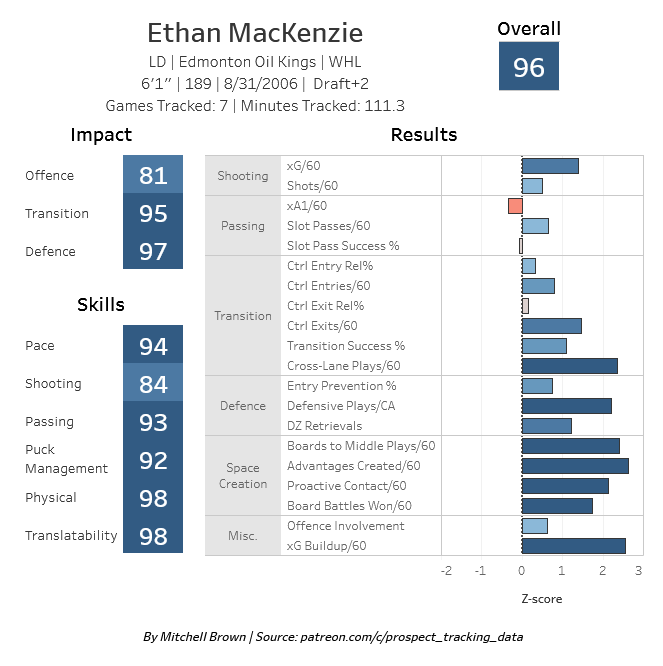
Pick #69 – Ethan MacKenzie (LD)
While a part of me says, well you could have drafted him as a D+1 guy last year in the seventh round instead of a certain Kitchener Ranger forward, I can't be unhappy with this pick. MacKenzie is very young for his draft year, with a September 2nd birthday he's only 15 months older than McKenna despite being separated by two different draft years.
MacKenzie is like a version of Bilecki that did develop the other parts of his game. He maintained his mobility and high level puck movement to drive transitions, made Team Canada's World Juniors roster and was one of their top all situations defensemen, and learned how to use his mobility and intelligence to become a legitimate play killer in junior. He'll have more time to develop in college as he committed to North Dakota in the NCAA. He's a solid pick and has the bonus of being an older re-entry, makes him closer to the NHL (in theory) which the Leafs sorely need from defense prospects. His ceiling may only be as a third pairing guy, but because he's older he offers more certainty because you can see how he's already developed.
Pick #73 – Zach Olsen (RW)
I didn't profile Olsen, but I was aware of him going into the draft. I had seen him get hyped up by some scouts, and I saw all the quotes about him coming out of the NHL combine (which he was invited to, not everyone in the draft year is for the record). I love the fact that he not only was named as this draft class' most underrated player by his peers, but the majority of the votes he got were from WHL defensemen who hated playing against him because of his speed, physicality and forechecking.
Olsen is rated as one of the fastest straight line skaters in the draft, and he uses it as a weapon. He turns himself into a rocket of terror screaming down on defensemen who are trying to get to dump ins before they get squashed on the boards. He skates hard, battles hard on the boards, and is just a pain in the ass to play against. He has a good shot too, with a very quick release that has velocity on it. His playmaking and puck handling need a lot of work, but he has a path to being a bottom six energy buzzsaw. As Cathy put it to me, he seems like Landon Sim only more so. He could easily turn into a fan favourite.
The @BladesHockey's Zach Olsen with the exclamation mark❗️
— Canadian Hockey League (@CHLHockey) April 23, 2026
The 36th ranked North American skater for the 2026 #NHLDraft completes a dominant display with 🇨🇦's sixth of the day! #U18MensWorlds pic.twitter.com/CRzBDP10CF
Pick #76 – Mans Gudmundsson (RD)
Gudmundsson is a defenseman who can be the perfect kind of boring. I wrote about him in full (link below), but I like him because he's a right shot, he has size, he has a good defensive foundation and he made a lot of improvements in the dynamic and mobile elements of his game on both sides of the puck. He especially improved on his ability to drive zone exits and successfully retrieve dump ins to push the puck up the ice with control. He'll be your defensive conscience on the right side on the bottom two pairs, barring a surprisingly big leap in his development with his puck skills. Maybe not a sexy pick, but a solid one.
 Brian S
Pick #85 – Juuso Ainasto (G)
It's funny, even a goalie like Ainasto is someone I'd heard about going into the draft. I don't look into goalies much, since I have very little idea what to look for or what I'm talking about with them. I saw he got some hype from various goalie scouts but the guys I wrote about on my goalie list are all guys who had good stats. In the end, I'm more willing to trust that a goalie is good when he has good numbers in the level he plays in. I make a small exception for guys who play in very competitive pro leagues in their draft years, but that's extremely rare. Most will only get a small taste.
But from everything I had read, Ainasto gets rave reviews from many goalie scouts for his mechanics, butterfly, and athleticism. He's seen as a pretty safe bet to make the NHL in some capacity as a result, with a very good foundation to build on as of now that makes him seem more certain. I'll just have to take their word for it!
Pick #114 – Patriks Plumins (G)
Plumins is a goalie who may have had the overhype from looking really good in a short international tournament, but he also had legitimate reason to be considered a top goalie prospect even beyond that. Way back in 2021, I wrote this piece on how to get good goalies on your NHL team.
 Brian Stewart
One of the things I gleaned from it that I took with me since then was that a goalie getting any professional, men's league experience is a good sign for their likelihood to turn into an NHL goalie. It could be only a couple of games, and they could get absolutely shelled in that limited opportunity, but that was still a good indication. It didn't have to be in a top pro league like the SHL in Sweden or KHL in Russia. It could also include less competitive countries like Czechia, Slovakia, or... Latvia. And wouldn't you know that Plumins played his entire season either in Latvia's top pro league or in their second tier pro league. In his 16 games as his team's backup in the top level, he had a very good 1.50 GAA and a .927 sv%. For his scouting I'll just quote what I put in the goalie listicle about him:
Scouts like his hands – meaning his glove and blocker – as well as his rebound control, making him kind of the opposite of Trejbal. Continuing that theme, his lateral skating and explosiveness gets knocked as well although there's some differences of opinion on that. He'll probably be a later pick unless a team puts a LOT of stock on his international play.
Pick #158 – Cooper Williams (C)
Now, Williams is a bit of an interesting pick. He entered this season almost unanimously considered to be a first round pick. He was coming off a season where he had 57 points in 68 games as a 16 year old. That was only four points back of the team lead, despite being so young, and was second among all WHL rookies. This year, despite that hype, he finished with an indentical 57 points albeit in 66 games. The big differences this year are he improved his shot rate by a good chunk, and a lot more of his points came on the powerplay this year (27 this year vs 16 last year). So, honestly, it looks like his game took a little step back rather than improving. That's why he slipped from being considered a first round guy down to Toronto in the 5th round.
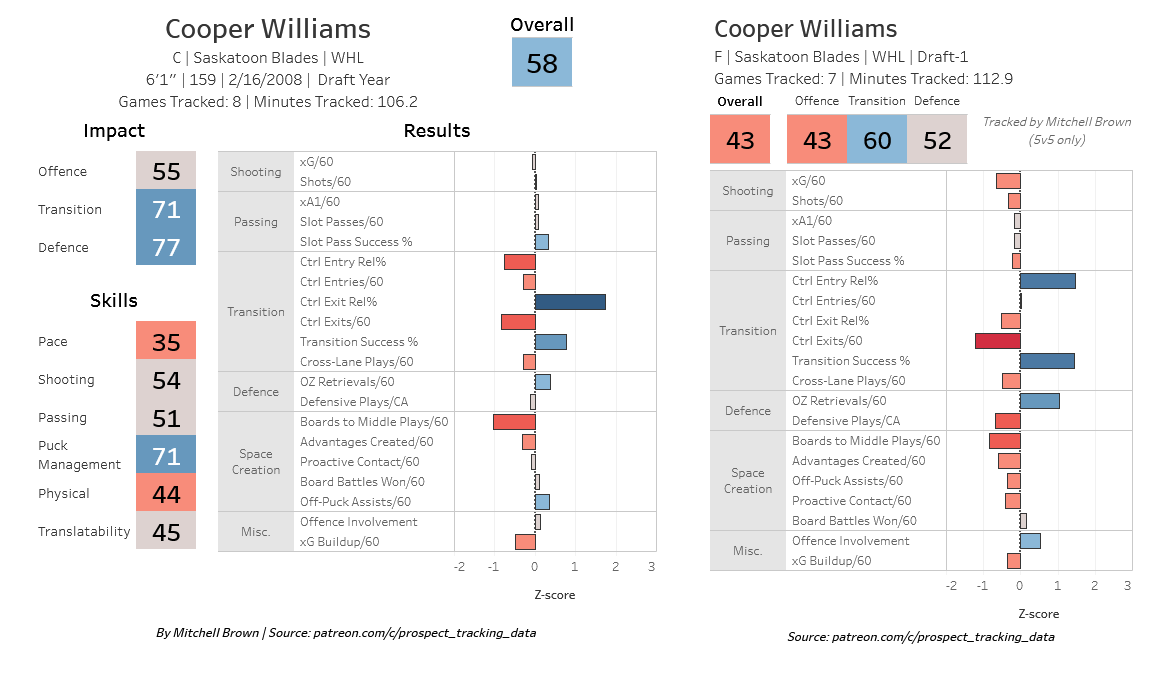
So, why might Williams still be an interesting pick? First, I generally subscribe to the idea that players don't just randomly forget how to play hockey. Maybe his Draft-1 season was overrated because some circumstance was inflating it to make it look better than it was, so this season was more to his "normal". Or maybe something explains why he didn't look as good this year. From what I've been able to tell, the latter looks to be more of the case.
This year, Williams was The Guy. He was their 1C, as a 17 year old. He was asked to take on a lot more responsibility as an all situations, two way center. To give him credit, he did that part well. Scouts now rave about his defense and responsible play, playing within a solid structure, staying above the puck, supporting his defensemen, stealing the puck, all that good stuff. The problem seems to be the offense, and in particular the play-driving, didn't seem to improve at all. Maybe he was focusing too much on the defensive side, because the offensive execution looked just fine on the powerplay when he didn't really have to focus on defense? That's what I'm wondering before I look into him with more depth this next week.
Pick #161 – Yaroslav Fedoseyev (RD)
Fedoseyev reminded me a lot Alexander Ivanov, who I wrote about in my listicle for late round defensemen. The only reason why I chose to write about him instead of Fedoseyev is because a bunch of little superficial things leaned in his favour – he is a bit bigger, he's younger, and his tracking data looked a bit better. None of those things on their own are what I put a lot of stock into, and even before the draft I considered them roughly equal.
What I liked about Fedoseyev is that he played most of this season in either the VHL or the KHL. In the VHL, he was mainly a middle pairing guy, but finished the season and the short playoff run as their most used defensman. In the KHL, he wasn't just getting dressed and barely playing, he was a bottom pairing kid but he was averaging over 12 minutes per game.
Like all the other defensemen they drafted, he's known for his skills as a puck mover and breakouts. He has a fluid mobility but, like I often say for prospects his age, he needs to get stronger and add more explosiveness to his acceleration. There are some inconsistencies in his defensive execution but it's not so bad that his team wouldn't play him above junior – to the contrary, his ice time kept rising and he kept getting called up to the next level in Russia's hockey ecosystem. He's another long-shot and long term project, but I'm looking forward to seeing what the Leafs development squad can do with him.
Pick #169 – Brody Pepoy (RW)
My favourite factoid for any player the Leafs drafted – the line Pepoy played on most regularly for Saginaw in the OHL was called, collectively, "The Weasel Boys". I just think that's delightful.
As a prospect, Pepoy is a major wild card... both literally and figuratively. He's not just a late round flyer who could be molded into something interesting as a depth winger, but his play style is also incredibly chaotic and wild. He plays with a lot of pace, mobility and energy. He has an eternal motor and definitely has an edge to his game that befits a Weasel Boy.
The issue with Pepoy is that he tries... a lot. Tries a lot of dangles and creative plays, but his execution is – well, it's wild. He is fearless in what he tries, which is both a blessing and a curse. I'll break it down in more detail once I watch him more this week, but I'll say this: there are two ways I can see Pepoy's development going in the next couple of years.
First, junior at his age is the right place for players to be creative and try things. So he'll either finally figure everything out, something clicks, and he can start pulling off more of what he tries at a higher rate. I don't begrudge a guy for trying that (though his coach may disagree). But he'll get to a certain age where, if he efficiency of his ability to execute what he tries successfully doesn't get to a certain level by a certain age, he'll need to learn to cut it out and stop trying that particular thing. The mechanical skills are good to practice over time, but once you get past junior you need to work on refining your game and making it fit the system you're playing in. This is especially true for guys who are not superstars offensively.
Second, starting right now, the Leafs' development coach already gets him to cut that stuff out and focus on the parts of his game that project well to professional hockey. That's his skating, energy, defensive play, checking, peskiness, forechecking, and so on. All those kinds of skills that can make him a useful bottom six checking line winger. Start improving in those areas to make them as refined and efficient as possible by the time you are old enough to turn pro.
Regardless, like Olsen he has a good chance of turning into a fan favourite. After all, who hates a weasel???
Thanks for reading!
I put a lot of work into my prospect articles here, both for the draft and Toronto's prospects. I do it as a fun hobby for me, and I'd probably do it in some capacity even if PPP completely ceased to exist. But if you like reading my work, some support would go a long way! I pay for a few streaming services (CHL, NCAA, USHL, the occasional TSN options for international tournaments that are broadcast) to be able to reliably watch these prospects in good quality streams. I also pay for some prospect-specific resources, such as tracking data and scouting reports from outlets like Elite Prospects, Future Considerations, McKeen's Hockey, The Athletic, and more.
Being able to get paid for this helps me dedicate more time and resources to it, rather than to second/third jobs. And whatever money I make here, a lot of I reinvest back into my prospect work through in those streaming and scouting services. Like I said, I'd be doing whatever I can afford for this anyway, so any financial help I get through this is greatly appreciated!


Comment Navigation & Markdown
Navigation
cc to focus on comments section
c next comment
x previous comment
z next unread comment
Inline Styles
Bold: **Text**
Italics: *Text*
Both: ***Text***
Strikethrough: ~~Text~~
Code: `Text` used as sarcasm font at PPP
Spoiler: !!Text!!