

It's funny the similarities that McKenna and Stenberg have, considering how different they are. They're both 6'0" and left shot wingers with late 2007 birthdays who have been considered top prospects for years already. Beyond that, however, the reasons why they're so good comes from different places. If Toronto were to take Stenberg over McKenna, or trade down to get him later, it would likely be because the team wants to go in a different direction from the high octane skill that McKenna represents.
THE BASICS: STATS AND CONTEXT
- Position: Left-shot winger
- League(s): SHL
- Height: 6'0"
- Weight: 181 lbs
- Birthdate: Sep 30, 2007
Here are his draft rankings, as of writing this:
- TSN NHL Scout Poll: 3rd
- Cam Robinson NHL Scout Poll: 1st
- Corey Pronman: 4th
- Will Scouch: 1st
- Elite Prospects: 2nd
- Scott Wheeler: 2nd
- McKeen's Hockey: 2nd
- Upside Hockey: 3rd
- NHL Central Scouting: 1st (European skaters)
Stenberg has been on the minds of scouts for a while now because, like McKenna, he's been putting up silly numbers while also playing up several age groups. When McKenna was putting up way better than a point per game as a rookie in the WHL as a 16 year old, Stenberg was doing the same in Sweden's junior leagues. As a draft-1 player, he dominated Sweden's U20 junior league with 26 goals and 53 points in just 27 games, then moved to the SHL and didn't look back. Again, this is in his D-1 season, he played in 25 regular season games and had 3 points, then played 12 playoff games and had 6 points. He was getting legitimate minutes too, close to 11 minutes per game on average.
'This year, Stenberg played nowhere but the SHL and had a combined 39 points in 49 regular season and playoff games. He had the third best scoring season in SHL history for players in their draft year, behind only Daniel and Henrik Sedin – and even then, only by 9 and 1 point respectively, while playing in 7 fewer games.
While Stenberg shoots left and has mostly been used on that side, he can play either wing. This year, he averaged a bit under 16 minutes per game playing mostly in the top six. He got regular powerplay time, and was used in important defensive situations. He didn't seem to get much time on the penalty kill in the SHL, but has often in international tournaments.
Playing at the Hlinka U18 tournament last season as a 16 year old, he dominated with 10 points in 5 games. Later the same year he played at the World Junior A Championship, an U19 tournament, as a fresh 17 year old and one upped himself with 11 points in 5 games to lead the whole tournament. He not only played for Sweden this year at the World Juniors, but also led them with 10 points in 7 games and helped them win the gold medal. He then played at the World U18s later that year against younger peers and had 8 goals and 13 points in 7 games.
One last bit to keep in mind is his age, because you're likely going to hear that and I like to put it into proper context. With a September 30th birthday, he is only a few weeks older than being eligible for LAST year's draft. That makes him one of the oldest players in this draft. However, McKenna also has a late 2007 birthday, though in December so he's a bit younger. But it's important to consider how far along his development path is, and compare his statistical performances as someone who is almost a year older in terms of draft timelines.
For example, Koblar was drafted by Toronto last year and also played mostly in the SHL this year, but he's actually only two months younger than Stenberg. But Stenberg played an even bigger role than Koblar did, and his production was far ahead. Even if he was eligible for last year's draft, he likely would have been in contention for the first overall pick with Misa and Schaefer.
THE GOOD: ELITE IQ, VISION, PUCK HANDLING, MOTOR, PUCK PROTECTION, PRO-READY STYLE
Digging into what makes Stenberg so good is where he starts to differ a lot from McKenna.
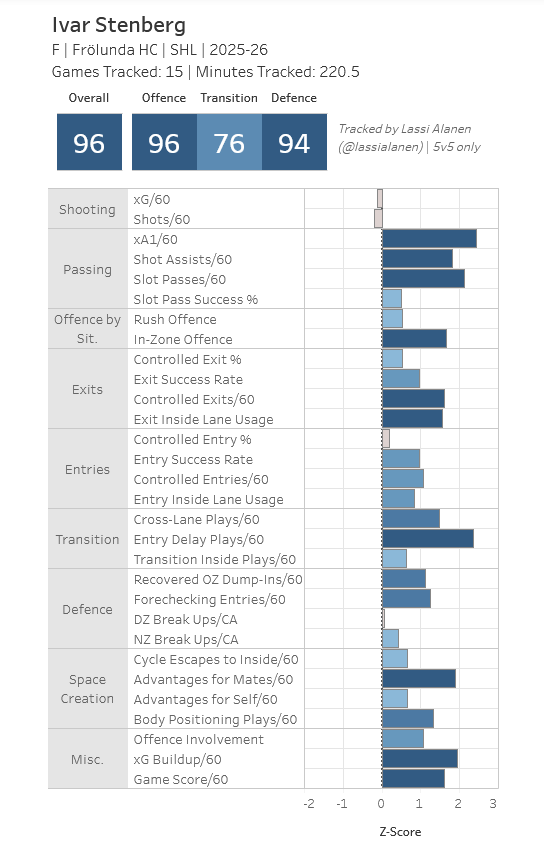
Stenberg’s biggest strength is his intelligence as a player. He has an incredible situational awareness of his surrounding and is constantly scanning to see where everyone is, where they're going, and then anticipating what might happen. So even though he isn't the fastest skater, he goes where he predicts he will need to be. He sees passing lanes and defensive vulnerabilities before they fully materialize. Seeing how things can develop helps him use pauses and delays so he can outwait defenders for a teammate to get to an open position for a cross-ice feed. In this sense, he has a pro-ready brain that makes him so dependable in game-deciding situations. He rarely makes the same mistake twice and learns how to be better next time, and just consistently makes good decisions.
Next is his puck handling, where Stenberg showcases deception and manipulation. He is able to shift a defender's positioning and momentum rather than just performing fancy dangles, so while he doesn't have the same lightning quick or flashy handles of McKenna, in some ways he's more practical and effective. What helps his hands is actually his feet. He has great edgework and body positioning to get opponents to move how he wants, so he can then attack them in a way that's easiest for him to get through or around them. Even under heavy pressure, he keeps the puck close to his feet or tucked away in his hip pocket, using slick side-step dekes and cross-body moves to evade sticks and protect the puck. This is why he's so good at driving transitions, as he can do all of this playing at his highest pace.
Now we get into the biggest differences from McKenna. Stenberg is well known for having an elite and non-stop motor that he uses in all situations, making him a potential two-way and true 200-foot player. On the forecheck, he uses his stick and takes intelligent angles to trap defenders trying to retrieve and outlet the puck create turnovers. He will often be the last forward out on ice on his shifts so he can hound opponents after a dump in, potentially giving the fresh forwards possession in the offensive zone before he changes. And on the backcheck, he will skate hard to catch his man and trail them deep into the defensive zone. He is not one of those all-skill players who lacks in the details that coaches love. He's been playing top pro hockey for two years now, in part because he already had pro-ready details that coaches love, and because he got even better at them over time and earned bigger roles. He will fight and win board battles, blocking shots, and more.
Despite not being the largest forward on the ice, Stenberg has incredible lower body strength. That gives him a sturdy base and a lower center of gravity that bigger defensemen find difficult to knock off balance or dominate physically. He is a great winger on the cycle, where he can roll off checks and protect the puck one-handed. He can absorb massive hits along the boards to make a play and still keep possession of the puck. This ability to maintain possession in tight, high-traffic areas is what allows his high-end skill to shine against more physically mature professional players.
Finally, Stenberg has developed a dangerous shot that defenders are forced to respect. He will make a sharp cut toward the middle of the ice, using the defender as a screen to snap a quick-release wrister far-side. This is something you'll often see NHL stars do as well. He also has a solid one-timer, often dropping to one knee to increase his shooting angle and power to score even from distance. Because he can pass through layers just as easily as he can rip a puck through traffic, making him a dual-threat offensively with the puck. Defenders can't sell out to defend his shot or his passing, because he can do both at a high level.
THE FLAWS: TOP SPEED, CONSISTENT PASSING, TOP-LEVEL ELITE SKILL
Unlike McKenna, while Stenberg does have some flaws he can work on, there are none that are as worrisome. The thing I'd want to fix the most is his explosiveness and his high end speed. He's already above average in those areas, but it would help his game transitioning to the NHL a lot. He just isn't as speedy as other top prospects like McKenna. If there's a worry, it's that he would struggle to create separation from elite, mobile defenders on the rush. While his speed generated from crossovers in the neutral zone is effective for transitions, adding extra power and top speed will help him create and maintain separation so he has even more space to work with.
A smaller issue that is preventing me from saying that Stenberg is already an elite two-way forward is that, after the backcheck when he's in the defensive zone for an opponent's sustained possession, he can be too passive. He will sometimes float and wait for an opportunity to pick off a pass rather than using his motor to chase down and harass the puck carrier and force a turnover. When he moves, he's dangerous without the puck, but that passivity can cause him to be flat footed when he could have otherwise prevented a play from developing for the other team. I would still project him to be a solid if not elite two-way winger, however. He's too hard a worker and a bulldog in every other area for me to think he won't improve on this.
Otherwise, the only thing I can nitpick is that – like many 17/18 year old prospects, even the elite ones – Stenberg can be overconfident in his skill at times. He can try to make too many moves, try for far too ambitious passes, and create turnovers instead of making simpler and less flashy plays that are more effective. Again, this is something all teenage prospects learn to some extent, and he's not so bad at it now that it makes him a major liability. If it was, he wouldn't have spent so many games in the SHL with so much ice time.
OVERALL ASSESSMENT
So, I've looked at the strengths, weaknesses, stats and context for both McKenna and Stenberg. More than a few people have asked me what I would do if I were the Leafs – would I pick one or the other at first overall?
My short answer is that I honestly don't know. Personally, I like the kind of player Stenberg is more than I like the kind of player McKenna is. But I can also logically say that McKenna has the chance to become a much more impactful player. So let me talk myself through this here in a stream of consciousness.
McKenna is the obvious choice, but he is not the safe choice. He has more skill but bigger flaws. He's a much higher risk with a much higher reward. Stenberg is safer because he's so solid all-around in his game, while still being skilled. He's just not as skilled as McKenna. That's what I meant at the start when I said that choosing one or the other for the Leafs is choosing a direction they want to take as a team.
If their priority is to fix their offense, they should go McKenna. In a lot of ways, it will re-establish the dynamic the team had in their core four when their offense was among the best in the league. But I'm genuinely curious if the Leafs will want that or not. After all, didn't that dynamic fail to get them to the second round only twice under that core, and not past the second round at all? Weren't they wanting to lean into building a team that can win "playoff hockey" more? We may roll our eyes at those talking points, but that's a clear direction the Leafs as an organization – from above even Treliving and Berube – wanted to take. Technically, that trend started even when Dubas was still here.
What Pelley said he wanted the organization to do, including the executives he was going to hire that turned into Chayka and Sundin, was create a smarter organization. One that didn't ignore analytics, but used them as tools in their decision making. Not to make decisions purely by spreadsheets or AI, but use them to gain insights for how to make the team better.
So does McKenna or Stenberg make the Leafs better? Again, I honestly don't know. I think McKenna will not be as good in the NHL right away, because he has more to work on – including physically. Stenberg is more used to pro hockey, he's already made adjustments that make him more pro-ready.
The other thing that may be a factor in their decision making is what player they think will help convince Matthews to stick around more than the other. To that hypothetical, I would think McKenna is the answer. He fills the Marner role (offensively) that Matthews seemed to like. While Stenberg would be more like Zach Hyman... except the peak Zach Hyman that ran shotgun with McDavid in Edmonton who was scoring 30-50 goals and 80ish points in back-to-back years.
Honestly, this uncertainty is the main reason why I wasn't jumping out of my seat excited when I saw the Leafs won the lottery. It made their decision a lot more complicated than if it was 5th overall. What makes it complicated is that the Leafs could really use both players. They need more offensive skill, especially if it helps Matthews become more dangerous offensively. But they also need more guys like Stenberg who are good in those little things at a high level. They also need to improve their blueline at both their defensive and puck moving ability, and find a high end center who can help move Tavares to the wing. Neither Stenberg nor McKenna solve any of that.
This is why the boldest but maybe the most correct choice would actually be to trade down. I don't know if any of the teams below them but still in (or close to) the top 5 would seriously consider making a trade with Toronto for the first overall pick that would give them extra value in those other areas.
Would Vancouver want to trade up so Toronto can take Stenberg (if San Jose goes with Reid like has already been rumoured) or Malhotra and then a higher end defensemen either with another pick they get, or get a young high end prospect already in the NHL like Willander or Buium? Would Chicago trade us the 4th overall pick along with the 34th and/or 37th overall picks, plus one of their young high end defensemen like Korchinski or Rinzel? Could Toronto make a much bigger package with Knies and get other pieces, since Chicago has been rumoured to really want Knies for like three years now?
If that kind of trade is there, that would honestly probably be the choice I would personally make. It would have to be a good enough offer, which is why I don't think it will happen. One of those teams would have to REALLY think that the guy they want (likely McKenna) will be much better than I think.
Thanks for reading!
I put a lot of work into my prospect articles here, both for the draft and Toronto's prospects. I do it as a fun hobby for me, and I'd probably do it in some capacity even if PPP completely ceased to exist. But if you like reading my work, some support would go a long way! I pay for a few streaming services (CHL, NCAA, USHL, the occasional TSN options for international tournaments that are broadcast) to be able to reliably watch these prospects in good quality streams. I also pay for some prospect-specific resources, such as tracking data and scouting reports from outlets like Elite Prospects, Future Considerations, McKeen's Hockey, The Athletic, and more.
Being able to get paid for this helps me dedicate more time and resources to it, rather than to second/third jobs. And whatever money I make here, a lot of I reinvest back into my prospect work through in those streaming and scouting services. Like I said, I'd be doing whatever I can afford for this anyway, so any financial help I get through this is greatly appreciated!


Comment Navigation & Markdown
Navigation
cc to focus on comments section
c next comment
x previous comment
z next unread comment
Inline Styles
Bold: **Text**
Italics: *Text*
Both: ***Text***
Strikethrough: ~~Text~~
Code: `Text` used as sarcasm font at PPP
Spoiler: !!Text!!