
It's funny how I find coincidental similarities between some of the various prospects I chose to profile that I didn't know (or notice) until after I chose them. On Saturday I wrote about Ryder Cali and I talked about how he didn't even play in the OHL until this season, but he was the top offensive producer in the GOJHL in his D-1 season for his age group.
Well wouldn't you know, Jaxon Cover also didn't play in the OHL until this year (not counting three games last season). He was in the Canadian high school system at St. Andrew's College instead of the GOJHL.
THE BASICS: STATS AND CONTEXT
- Position: Left-shot winger
- League(s): OHL
- Height: 6'2"
- Weight: 183 lbs
- Birthdate: Feb 13, 2008
Here are his draft rankings, as of writing this:
- TSN NHL Scout Poll: Not ranked
- Cam Robinson NHL Scout Poll: 29th
- Corey Pronman: Not ranked
- Will Scouch: 34th
- Elite Prospects: 24th
- Scott Wheeler: 49th
- McKeen's Hockey: 29th
- Upside Hockey: 52nd
- NHL Central Scouting: 29th (North American skaters)
Cover has a fascinating background. He was born in Miami, Florida to parents who met at the University of Michigan, but they moved to the Cayman Islands shortly after his birth. He didn't play competitive ice hockey until he was 14 years old, but he had been playing roller hockey since he was only three. He was considered a top player for his age group, even playing in a professional division of the North American Roller Hockey Championships.
Cover moved to Canada when he was 12 years old so he could attend St. Andrew's College, but he didn't actually start playing ice hockey for them for another two years. At the time, he mentioned he was baffled by the rules because in roller hockey there was no 'icing' or even offsides. So he had to adjust to the different rules and play style from what he was used to.
After playing for St. Andrew's College for two years, Cover was drafted to the OHL in the fourth round by the London Knights. He wouldn't really play for them (outside of three games last year) until this year, both because he was still young but mostly because London was busy being the OHL powerhouse going to three straight OHL finals, winning the final two of them with their remarkable core that anyone following Easton Cowan in those years will remember.
So last season, in his final year for St. Andrew's, Cover had 40 points in 55 games, which was the most on his team for players his age and 11th in the league. St Andrew's also played in the Prep Hockey Conference tournament, among other North American high school powerhouses like Shattuck St Mary's, and had the 5th most points for U17 players.
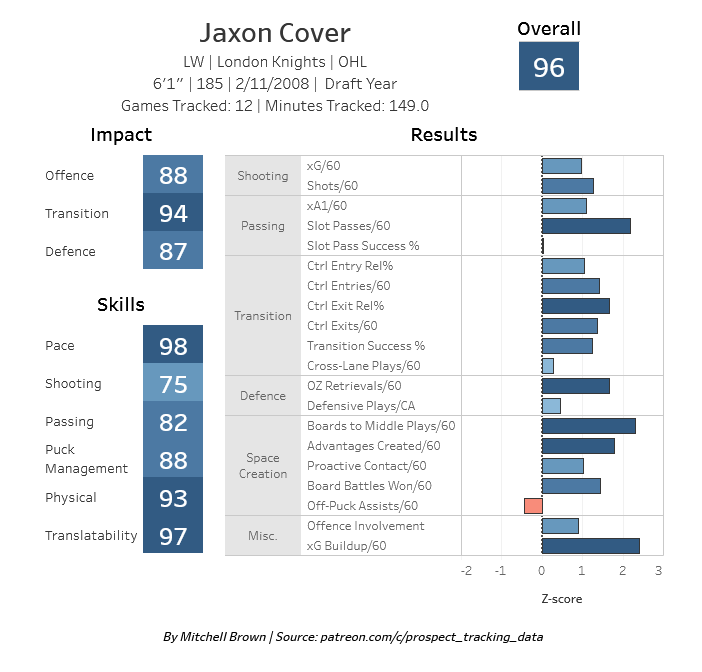
This past season, Cover played his first full year in the OHL. He joined the London Knights, coming off their second straight OHL championship and a Memorial Cup championship with their deep core featuring the likes of Cowan, Dickinson, Bonk and Barkey. It's not a major surprise that a 16 year old Cover couldn't crack that lineup, especially on a London organization that is well known for bringing their prospects along slower than most. So on the now young and rebuilding London team, Cover was second in points with 52 in 67 games. He would have been further down, but London wound up trading away most of their older players still remaining from the previous season.
Cover actually started the year more in the bottom six and didn't get much time on special teams. He played very well, which you can see from his tracking data above that has been consistent all season, and was slowly gaining more of a role for the first half of the season. Once the OHL trade deadline passed and London off-loaded those veterans who were occupying spots in their top six, Cover got the bump up to the top line for the rest of the season with their remaining veterans. He also finally got regular powerplay time, but still only finished with 13 powerplay points on the season. He was also increasingly used in a defensive role, including the penalty kill. He got good reviews for having an active stick in disrupting passes.
Perhaps to return to where his parents met, Cover has an NCAA commitment to Penn State for the 2027/28 season. He will wind up being a bit of a project to smooth out the kinks of his game that come from not being as experienced in ice hockey as others, so honestly I view that only as a good thing.
THE GOOD: ELITE SKATING, PLAYMAKING, TRANSITION DRIVER, MOTOR, SKILL AT PACE
The foundation for Cover's strengths as a prospect is his skating. His speed is borderline elite, and he is quite agile as well. Most importantly he is able to use his skill while he is playing at a high pace. That combination is pretty rare from what I've seen. It's what makes McDavid so special, and while Cover is obviously nowhere near as skilled it is still a valuable ability to have.
Cover shows this combination the most on transitions. He has the explosiveness and speed to make defenders respect his ability to evade their initial attempts to check him and then blow past them with his speed, so they tend to stay further back to avoid giving up a breakaway. But Cover is smart, and knows how to change speeds to shift down and give himself bigger pockets of space to work with. He is a one man transition machine, one that defenses in junior can't cope with.
Cover's first OHL goal below is a good example of this in action – slowing down to get the defender flat-footed, then use his explosive acceleration to blow by them and get a partial breakaway. And this happened from the blueline to the net, there wasn't a lot of room to create that chance like that.
As for his skill, Cover is a very capable playmaker thanks to solid vision and an awareness of space. That skating, changes of speed, as well as his puck handling helps him manipulate defenders, buy time, and create passing lanes for his teammates. He can handle the puck well in close but shines most when he's at speed and has a defender right in front of him. layering delays, head fakes, and body deceptions to open up tightly guarded passing seams. He is a creative problem solver both handling the puck and passing the puck. He can pull off difficult cross-seam passes by saucering them over stick blades or between defenders' feet.
Other than those skills, the other significant characteristic of Cover's game is his energy and motor. He is very competitive, and he is a battler. He is definitely proactive and aggressive rather than being passive and letting the game come to him. He is relentless on pursuits, the forecheck and the backcheck. He works hard to force turnovers and cause panic through constant pressure. He will willingly take a hit to make a play, and will often initiate contact so it's easier to absorb while maintaining possession.
THE FLAWS: STRENGTH, BALANCE, DEFENSIVE CONSISTENCY, RISKY DECISION MAKING
I'll be honest, Cover is more of a 'jack of all trades' kind of guy who doesn't have any glaring weakness even if he also doesn't have an elite, standout strength. However, the three main things I've seen scouts call out is his strength in physical play, his defensive consistency, and his aggression coming with some questionable decision making.
For the strength issue, it's not that Cover is too small or skinny and doesn't have muscle. I've seen some scouts say as much but the dude is 6'1" feet and 185 lbs... yeah he could and likely will get bigger as he physically matures but the dude isn't small or weak by any means. The issue is more that he isn't as strong on his feet yet. Some of this may be his relative inexperience in competitive ice hockey, but despite not at all being small for junior he can still have difficulty winning board battles or physical collisions at times. I'm not an expert, but I think the issue is more about his balance, lower body strength, and his mechanics being too upright in these situations instead of having a wider and lower base to be sturdier.
Then there's Cover's defensive consistency and his decision making being risky, which honestly is also a consistency issue. Without the puck, he skates and works hard but his aggression can cause the bad kind of chaos when it goes too far. He needs to refine his decision making so he knows when to pick his spots better, when staying back and in control is the better decision. This is something that was a bigger problem earlier in the season, and it's easier to see come up in his scouting reports from those games at the start of the year.
Cover's issue with riskier plays with the puck is of a similar nature. He has a good amount of skill, but right now he operates mostly on instinct. At times he'll try and dangle too much or force a rush through multiple defenders, which creates turnovers. He's high risk, high reward... but that works a lot better in junior than it does at the pro level. Again, some of this can be a common issue for junior players – anyone else remember the growing pains Cowan had two years ago? – that can be resolved with time, experience and wisdom, but there's no guarantee it fully goes away. There are plenty of players in the past who never grow out of this kind of play when they get to pro hockey.
OVERALL ASSESSMENT
The good news is that both London and top college programs in the NCAA, like Penn State has become, are good teams with good coaches and systems to help teach players to play within that system than to just go out and play purely on their instinct. Cowan may have had similar problems, but he worked on it a lot in his last year in the OHL.
The other good news is that Cover has already made a lot of improvements over this one season alone. Those callouts for his physical and defensive issues all but disappeared by the end of the season, when he was playing a top line role and leading the team in offense while being focused on by the other team's best defenders. He looked much more mature in his habits by the end of the season, and was making better decisions more consistently even when under pressure.
Especially on the defensive side, he became a high level 200-foot player in the OHL. There's some good interviews with Cover and London's coaches about how he worked hard to improve on playing within the structural details of the team. Even when he wasn't producing points, he was doing more of the right things more often. He was using diligent defensive tracking so he could anticipate a play that he could proactively interrupt. He developed better habits scanning the ice, shoulder-checking, and keeping on eye on opposing defensemen in case they activated into the play for high danger chances in the slot. This is also when he started being used more on penalty kills.
Along with his already existing strengths, it's really Cover's improvements he made to his play over this season that have me so high on him. He seems like he could turn into a valuable supporting player in the top six who can pitch in and have positive impacts on transitions, on defense, and at generating offense through his playmaking. If he keeps developing his penalty kill, he could become a good power-killer who can use his skating and skill in open ice to be an offensive threat against only one defender and the fourth forward.
Thanks for reading!
I put a lot of work into my prospect articles here, both for the draft and Toronto's prospects. I do it as a fun hobby for me, and I'd probably do it in some capacity even if PPP completely ceased to exist. But if you like reading my work, some support would go a long way! I pay for a few streaming services (CHL, NCAA, USHL, the occasional TSN options for international tournaments that are broadcast) to be able to reliably watch these prospects in good quality streams. I also pay for some prospect-specific resources, such as tracking data and scouting reports from outlets like Elite Prospects, Future Considerations, McKeen's Hockey, The Athletic, and more.
Being able to get paid for this helps me dedicate more time and resources to it, rather than to second/third jobs. And whatever money I make here, a lot of I reinvest back into my prospect work through in those streaming and scouting services. Like I said, I'd be doing whatever I can afford for this anyway, so any financial help I get through this is greatly appreciated!


Comment Navigation & Markdown
Navigation
cc to focus on comments section
c next comment
x previous comment
z next unread comment
Inline Styles
Bold: **Text**
Italics: *Text*
Both: ***Text***
Strikethrough: ~~Text~~
Code: `Text` used as sarcasm font at PPP
Spoiler: !!Text!!