

THE BASICS: STATS AND CONTEXT
- Position: Left-shot centre
- League(s): WHL
- Height: 6'1"
- Weight: 198 lbs
- Birthdate: Jul 31, 2008
Here are his draft rankings, as of writing this:
- TSN NHL Scout Poll: Not ranked
- Cam Robinson NHL Scout Poll: Not ranked
- Corey Pronman: Not ranked
- Will Scouch: Not ranked
- Elite Prospects: Not ranked
- Scott Wheeler: Honourable Mention
- McKeen's Hockey: Not ranked
- Upside Hockey: Not ranked
- NHL Central Scouting: 98th (North American skaters)
I've been watching Murnieks since last season. He was a glitter guy that I noticed both when he was playing in the USHL for Sioux City, and when he played for Latvia at the World Juniors as one of their top players despite being 16 years old. He was on that Latvian team that had the infamous upset over Team Canada in the shootout. Even then, at that age, he was their top line center and played just under 19 minutes. He wound up having 4 points in 5 games for Latvia in that tournament, which is a very strong performance for someone so young at such a high level.
Murnieks even made Latvia's roster for the World Championships! He's one of the very draft eligible players playing this year, alongside more known top picks like Ivar Stenberg, Viggo Björck, or countryman Alberts Smits. Murnieks hasn't played nearly as much as those guys, but just being included is noteworthy.
This year, Murnieks moved from the USHL to the QMJHL. He was taken as an import player (6th overall in the CHL import draft) by Saint John while he waited for Boston College to be ready for him in the NCAA. He only played in 31 games for them, partly due to a shoulder injury that caused him to miss a big section of the first half of the season and again later in March, and partly because he was again playing in a lot of international tournaments for Latvia.
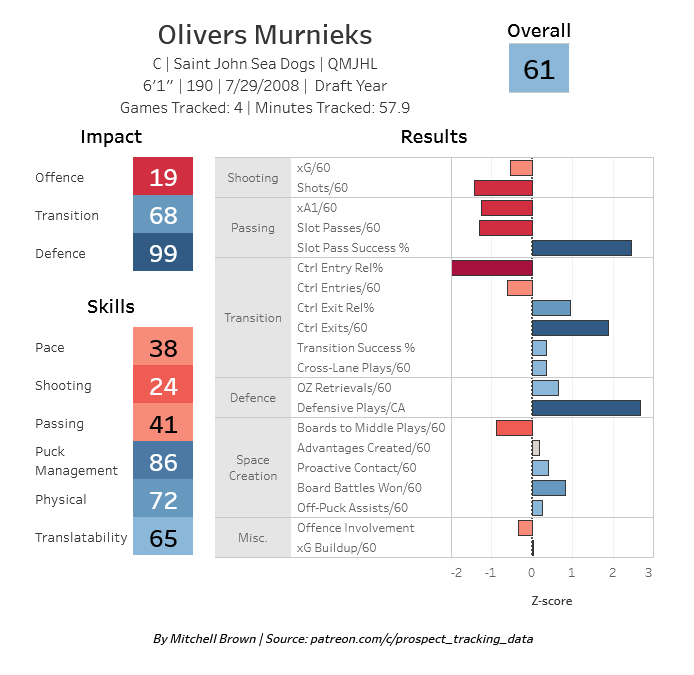
In the QMJHL, you may look at Murnieks' 20 points in 31 games and be disappointed. But pure point production was never the important part of his game, plus it's something that seems to come out more for him in big moments if that's something you believe is repeatable. He was a lock in the Saint John top six and was heavily used defensively. He did get a good amount of powerplay time, usually playing in the high slot as a bumper role thanks to his strength as a quck-read passer. This was true both in Quebec and on Latvia. He was also the top penalty killer on any team he played for. If his team needed to hold a lead late, needed to win an important faceoff, or needed to keep the other team's top line in check, Murnieks is who the coach sent over the boards most often.
On the international stage, his role and usage was along the same lines but amplified. Latvia plays a good, structured game but they lack the horses to keep up with most of the traditional powerhouses, so when they have a guy that's good enough to be an NHL draft pick they will be relied upon heavily in their role and ice time. For example, he played at the World Juniors again this year, and again had 4 points in 5 games. Despite having a below average age again, he was below he was Latvia's top center, used in all situations heavily, and averaged around 19-20 minutes.
Murnieks also played at the World U18s this past April-May. He had 6 points in 7 games, which was tied for the team lead. It was also tied for 8th most in the tournament. He played 20+ minutes in every game but one, an 8-1 win where he still played 19:36. He had 2 assists in their upset win over Team USA where he played 23:41. He was a workhorse that they rode hard, and he helped get them to the semi finals and bronze medal game which they narrowly lost 1-0 to Slovakia.
THE GOOD: ELITE DEFENSIVE CENTER, RELENTLESS WORK ETHIC, OFF-PUCK SUPPORT, PLAYMAKING POTENTIAL
The reason why I like Murnieks is that, even aside from the big strengths he offers as a defensive center, I see some utility beyond that as someone who helps push play in the right direction. He has an impact offensively by driving more time with offensive possessions, because he can defensively shut the other team down and limit time spent in his own zone. That requires some skill aside from what is traditionally thought of as purely 'defensive' skills when you don't have the puck.
For example, I've talked about how I increasingly value a defenseman's ability to skate or pass the puck out of his own end with control as a 'defensive' skill. That holds true for forwards too, especially defensive-minded ones. Murnieks may not be a flashy or dynamic playmaker, but he is a capable passer with flashes of high-end passing abilities and instincts. He can thread passes cross-ice through traffic, make softer one-touch or saucer passes (mostly seen on the powerplay), and has even broken out a behind the back pass on occasion to get it around a defender who sells out to the front he's facing. When it comes to offensive skills, he's definitely strongest as a passer or playmaker.
When Murniek's doesn't have the puck, he is both a very smart and smartly physical off-puck supporting player for his team's offense. He has good timing with his routes where he times his arrivals to certain areas of the ice precisely. He can recognize soft spots in coverage and settle into them to receive a pass with more space. He knows how to dip out of the play above it then sneak back into it in behind defenses that lost him in their coverage for a back door pass or to tap in a rebound.
Murnieks is also a menace in close quarters. 6'1" is just on the high end of average, but he's already just under 200 lbs and is like a tank on his feet. He can make himself immovable in front of the net, fighting for deflections and rebounds. He can be overpowering along the boards in battles during the cycle to do the harsher dirty work for his more skilled wingers. He is built to be a reliable bottom six center, especially if the team that drafts him is able to work with him and unlock more of his offensive skills – not to improve his point production, but to help him be a more direct, positive impact on the offense his line can create.
BC commit Olivers Murnieks had a great performance today at the #U18MensWorlds, posting one goal and two assists.
— Anthony Smith (@anthony_smith80) April 26, 2026
Plenty of great moments today including this strong forecheck... pic.twitter.com/sE98wrrSh4
Then there's all the great stuff Murnieks does as a hard-working defensive center. He is praised by most scouts as one of the best two-way, 200-foot, defensive specialist or whatever else you want to call it forwards in this draft. He has played a mature style of game beyond his years, at least since he was 16 that I can say but probably before that too. His tracking data shows elite rates at breaking up passes and breakouts, cutting off passing lanes, poking pucks away, blocking shots, supporting his defensemen, staying in the right position and not losing his man or leaving a dangerous area of the ice unguarded.
What helps Murnieks achieve all that is his relentless work ethic. He does not stop working hard when he's on the ice. He will not shy away from the tough areas on the ice, and in junior is absolutely overwhelming physically – on the forecheck, the backcheck, on battles along the boards, when securing inside positioning in front of the net (his own and the other team's). He's not a guy who throws big hits, he's just physically suffocating.
THE FLAWS: SLUGGISH MOBILITY, PUCK HANDLING, SHOT, PLAY DRIVING
The biggest flaw Murnieks has that worries me most is around his mobility. His skating is not something I personally thought was a major issue. He is no Noah Chadwick or William Villeneuve in that regard, but that isn't to say he doesn't have things that he would need to improve. His speed is pretty good, but he lacks the explosiveness or acceleration that he will need beyond junior.
Murnieks is also not the most nimble or agile, which would help him a lot when carrying the puck and create better chances for his playmaking to shine. According to some scouts who actually know about skating mechanics (I sure don't), he doesn't get a lot of flexion in his lower body and tends to hunch over as he skates. That does affect not only his ability to generate power for his acceleration but also can affect his balance and strength on his feet. So that's definitely something he needs to improve.
The rest is all variations of "man I wish X offensive skill was better". As a puck handler he's rigid and lacks creativity. He gets through defenses by passing through it rather than carrying it through it. This does affect his ability to be more efficient in driving transitions, and for him it specifically shows up in his inability to create zone entries at an effective level. So his playmaking is typically simple and low-risk, deferring to his linemates to carry the load in that regard.
The same kind of thing is said about Murnieks' shooting. He flashes a good wrist shot and one-timer, but his shot selection isn't the best. He works best as a passer and then cleanup guy in front who looks for back door passes, deflections, rebounds, things like that. His inability to get good shots outside of in close, despite having a decent shot, is mostly because of his lack of puck handling. Again, if that's something he can improve to at least an average level, he can be a more impactful bottom six depth center than just a pure defensive specialist like a Kampf.
OVERALL ASSESSMENT
So the reason why I like the idea of taking a chance on Murnieks (outside of the second round, mind you) is because his defensive value is already so good that anything else he can improve to round out the rest of the game is gravy. As long as the skating doesn't remain a problem and he can improve in those areas as he develops, he seems a reasonably safe bet to get to the NHL in a depth role and PK specialist.
There are reasons to think Murnieks can improve in those areas. He showed a lot of improvement by the end of this season at protecting the puck. Instead of passing it off as soon as he could to a teammate, he started showing he could pull the puck to his backhand and use his body to keep defenders at bay. He started showing a bit of deception and creativity too, just to manipulate defenders a little bit so he had a better pass to make.
The way Murnieks' offense improved the most was mainly on the tactical side, rather than in pure skill. He made better decisions with the puck, his ability to process play as it unfolded in front of him improved not just defensively but also when the puck was on his stick. That's where his strengths with his support, off-puck offense came from. He has a bit of a Knies-like gravitational pull to him when he doesn't have the puck, in that he uses the imposing physical pressure to draw more defenders to him when they're worried he can just have free reign in front of the net.
Another area of his tactical adjustments that helped his offensive game is in what he started to do when he was in front of the net. He wasn't just parking himself in front then turning the key and pulling the parking brake. He would read the play better and was quick to leave the net-front area to soft areas of coverage for a quick pass reception with an instant catch-and-release with very good timing. He'd also be quick to pounce on loose pucks and chase rebounds that went into the corners so he could get on them first and continue their possession.
So with the foundation built around his ability to play a smart, physically imposing and highly efficient 200-foot game, the question is if you believe that Murnieks can develop enough of an offensive game to go from being a Kampf (or not even that) to being more like an Adam Lowry, JT Compher, Phillip Danault, Nick Bjugstad... someone in that third line center range.
Magnuss Avotins took a feed from Olivers Murnieks and it's 1-0 Latvia. #U18MensWorlds pic.twitter.com/fPUpTl6gxc
— Steven Ellis (@SEllisHockey) April 26, 2026
Thanks for reading!
I put a lot of work into my prospect articles here, both for the draft and Toronto's prospects. I do it as a fun hobby for me, and I'd probably do it in some capacity even if PPP completely ceased to exist. But if you like reading my work, some support would go a long way! I pay for a few streaming services (CHL, NCAA, USHL, the occasional TSN options for international tournaments that are broadcast) to be able to reliably watch these prospects in good quality streams. I also pay for some prospect-specific resources, such as tracking data and scouting reports from outlets like Elite Prospects, Future Considerations, McKeen's Hockey, The Athletic, and more.
Being able to get paid for this helps me dedicate more time and resources to it, rather than to second/third jobs. And whatever money I make here, a lot of I reinvest back into my prospect work through in those streaming and scouting services. Like I said, I'd be doing whatever I can afford for this anyway, so any financial help I get through this is greatly appreciated!




Comment Navigation & Markdown
Navigation
cc to focus on comments section
c next comment
x previous comment
z next unread comment
Inline Styles
Bold: **Text**
Italics: *Text*
Both: ***Text***
Strikethrough: ~~Text~~
Code: `Text` used as sarcasm font at PPP
Spoiler: !!Text!!