

Sign Up to PPP Today
You have to be a member to comment at PPP. Membership is free and requires only an email address.
Become a MemberAlready have an account? Sign in
It's that time again! The Top 25 Under 25 is here and it's going to be exciting this year. Well, compared to recent years, anyway.
To start us off, a review of how this works. The players eligible listed below must be 25 or younger as of July 1 of this year. They must be on an NHL contract with the Leafs, be a drafted prospect of the Leafs or in some other way be a player whose rights are held by the team, usually because they are an unsigned RFA.
Who doesn't count? Anyone on an AHL contract who is not otherwise a prospect of the Maple Leafs. Timofei Obvintsev is a handy example of this distinction. He is an unsigned draft prospect so he's on the list. He's on the Marlies on an AHL contract, so he is paid a salary by a company owned by MLSE, but that does not make him eligible – his draft rights do.
Last year, we encountered some edge cases with draft rights, and this has continued on this year. Various sources conflict on who is or is not is still a person the Leafs have exclusive rights to. These players are all former prospects who returned to Europe, sometimes after having an ELC, such as Roni Hirvonen, or after spending time in the NCAA. The Leafs just never mentioned these RFAs this year at the QO deadline, and for these legacy players nearing the age limit, I've decided to drop them from the list. As usual any NCAA player whose rights expire in mid-August who will not be signed by the team is also left off.
Russian players drafted have indefinite rights since there is no transfer agreement with Russia. In these cases, I am keeping them on the list until they age off.
Voting
There are two votes, the "official" vote, which is the masthead writers and invited guest voters, which usually amounts to 10 or so people, and then the community vote which is open to everyone. I like to look on these two votes like the difference between an election, where the large numbers wash out weird choices, and a city council (of a reasonable size, not the Toronto monstrosity) where the weird opinions become magnified and are the point.
Someone is bound to say: This one guy on the social media, he does tiers and then he makes a pyramid and this is way better, it's more realistic and you should do that and why don't you do that? Invent a way to combine 10 pyramids into one big pyramid and totally change this thing you've been doing for 15 years!
No.
And also no again, because this is actually how most people come up with their votes, sometimes quite literally. The illusion of each ranking place having the same stair-step difference to the next from 25 on up to 1 needs to be busted. Beyond the arguing about players, there are many lessons in this exercise about how we think about things, and this is a big one.
But also no again, because forcing a decision between two or ten players who are all pretty much equal is a useful thing to do. Putting us in the position teams are in all the time – at the draft, when they issue QOs, when they sign players – can be a nice eye-opener. You have to find reasons to choose. And in this year after all the real and manufactured discussion about Gavin McKenna vs someone else, well, it should be interesting to do it with less fraught examples.
Last year's list had 38 names on it, and this year's has 39 but has a lot of turnover. More on who is gone and who is new in coming days, but for now, here they are:
| Player | Position | Nationality | Age | Draft Year | Draft # | NHL GP | 2025 Rank |
|---|---|---|---|---|---|---|---|
| Artur Akhtyamov | G | Russia | 24.7 | 2020 | 106 | 3 | 16 |
| Ryan Tverberg | C | Canada | 24.4 | 2020 | 213 | 2 | Unranked |
| Jacob Quillan | C | Canada | 24.4 | Undrafted | 24 | 13 | |
| Emil Andrae | LD | Sweden | 24.4 | 2020 | 54 | 107 | N/A |
| William Villeneuve | RD | Canada | 24.3 | 2020 | 122 | 3 | 17 |
| Brandon Buhr | RW | Canada | 24.0 | Undrafted | N/A | ||
| Matthew Knies | LW | USA | 23.7 | 2021 | 57 | 161 | 1 |
| Luke Haymes | C | Canada | 22.9 | Undrafted | 4 | 15 | |
| Vinny Borgesi | RD | USA | 22.3 | Undrafted | N/A | ||
| Borya Valis | RW | USA | 22.2 | Undrafted | 14 | ||
| Hudson Malinoski | C | Canada | 22.1 | 2023 | 153 | Unranked | |
| Nicholas Moldenhauer | RW/C | Canada | 22.1 | 2022 | 95 | 22 | |
| Landon Sim | LW | Canada | 22.0 | 2022 | 184 | N/A | |
| Blake Smith | D | Canada | 21.8 | Undrafted | Unranked | ||
| Timofei Obvintsev | G | Russia | 21.5 | 2024 | 157 | Unranked | |
| Hayes Hundley | RD | USA | 21.3 | Undrafted | N/A | ||
| Noah Chadwick | LD | Canada | 21.2 | 2023 | 185 | 12 | |
| Easton Cowan | C | Canada | 21.1 | 2023 | 28 | 66 | 2 |
| Sam McCue | LW | Canada | 20.8 | 2024 | 216 | 20 | |
| Miroslav Holinka | C | Czechia | 20.7 | 2024 | 151 | 11 | |
| Ben Danford | RD | Canada | 20.4 | 2024 | 31 | 4 | |
| Victor Johansson | LD | Sweden | 20.2 | 2024 | 120 | 10 | |
| Matthew Lahey | LD | Canada | 20.0 | 2024 | 200 | Unranked | |
| Alexander Plesovskikh | LW | Russia | 19.9 | 2024 | 152 | 23 | |
| Ethan MacKenzie | LD | Canada | 19.8 | 2026 | 69 | N/A | |
| William Belle | RW | USA | 19.5 | 2025 | 137 | Unranked | |
| Tyler Hopkins | C | Canada | 19.4 | 2025 | 86 | 9 | |
| Rylan Fellinger | RD | Canada | 19.1 | 2025 | 185 | Unranked | |
| Tinus Luc Koblar | C | Norway | 19.0 | 2025 | 64 | 6 | |
| Harry Nansi | LW | Canada | 18.8 | 2025 | 153 | 19 | |
| Yaroslav Fedoseyev | RD | Russia | 18.7 | 2026 | 161 | N/A | |
| Gavin McKenna | LW | Canada | 18.5 | 2026 | 1 | N/A | |
| Patriks Plumins | G | Latvia | 18.5 | 2026 | 114 | N/A | |
| Cooper Williams | C | Canada | 18.4 | 2026 | 158 | N/A | |
| Zac Olsen | RW | Canada | 18.3 | 2026 | 73 | N/A | |
| Juuso Ainasto | G | Finland | 18.3 | 2026 | 85 | N/A | |
| Alexander Bilecki | LD | Canada | 18.2 | 2026 | 60 | N/A | |
| Brody Pepoy | RW | USA | 18.1 | 2026 | 169 | N/A | |
| Måns Gudmundsson | RD | Sweden | 18.1 | 2026 | 76 | N/A |
I frequently see someone say something along the lines of there being a 25% chance of a draft prospect making the NHL, so the Leafs should have x out of y NHLers on the list. But that's too simple because it ignores the very skewed distribution of those probabilities by draft position. Every team, in other words, has a whole lot more very low probability picks than high, but some teams have a clutch of high-quality prospects all at once. Team cycles are naturally feast or famine, not some imaginary middle ground.
To start us off in thinking about probability in a better way, I went back to Jokke Nevalainen's draft pick probability post where he simplified the concepts down. I think Nevalainen stuck too close to the false draft-round boundaries when he simplified his probabilities. Naturally so, it's how people think about draft picks and kicking against that takes effort.
First his overall results, the same basic shape as every other graph of this type:
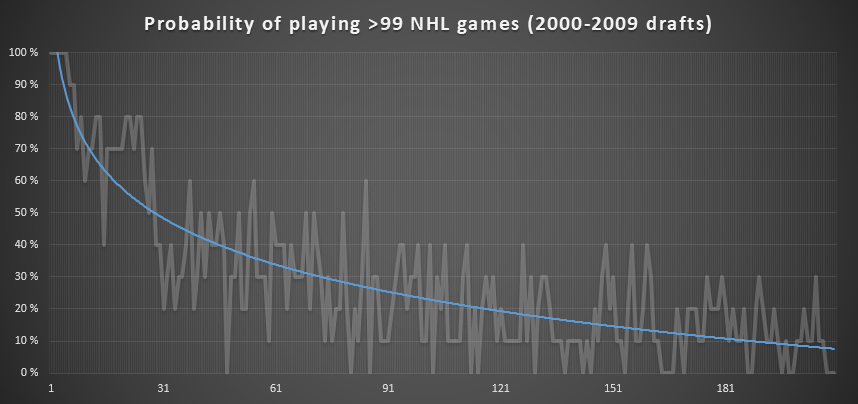
Below, I redid the set of pick ranges with their mean probabilities heavily rounded off that appears in his post, and I added two other very hazy and subjective measures. The standard 100 NHL games played is the Freddy Gauthier line. That's not a successful use of the pick because you can trade for a player like that with a pick less likely to get you one the hard way. A career NHLer is the next level of success, and that's the Calle Järnkrok line. That sort of player is harder to find when young, but it's still possible to just cycle through some free agents of 30 or so, and never draft a guy who fits this category.
An impact player is what you want. That term covers everything from a scoring winger to a playmaking centre to a top-pairing defender all the way to the very small handful of truly elite players – everyone from Matt Knies to Darren Raddysh to William Nylander and beyond. They make up around 1/4 to 1/3 of the 700 or so NHLers in any given year who have passed the Gauthier line. If the probability of getting a Gauthier with a pick is 50% then it's around 15% you get Raddysh, and the rest of the 50% is a mix of Gauthiers and Järnkroks.
Why is this all done in hazy vague terms and not real stats? Well, it's been done to some degree of usefulness statistically, but the very hard part is coming up with a single measure of value. NHL games played captures injuries and GM bias, points ignores defence, and on and on. Most of the sophisticated analysis ends up with a curve nearly identical to all other draft value curves. Divvying up the NHL into guys, better guys and best guys and just taking into consideration how they are distributed is good enough to illustrate what reasonable expectations of the draft are. More specifically what reasonable expectations of the Leafs prospects are, and why that's not 25% of the guys on that list.
| Pick Number Range | Probability of Playing 100 NHL Games | Probability of Career NHLer | Probaility of Impact Player | Number of Leafs Prospects Drafted in Range |
|---|---|---|---|---|
| 1-5 | 100% | Extremely High | High | 1 |
| 6-10 | 75% | High | Medium | 0 |
| 11-15 | 70% | Medium | Low | 0 |
| 15-25 | 65% | Lower | Low | 0 |
| 26-50 | 50% | Low | Very Low | 2 |
| 51-100 | 30% | Rare | Extremely Rare | 10 |
| 101-150 | 20% | Extremely Rare | Extremely Rare | 5 |
| 151-final selection | 10% | Extremely Rare | Extremely Rare | 14 |
Do a little math with those numbers and you get a very sobering probability of getting seven players who can hit 100 games out of the 39 names. When you whittle that down, you should pick three names not McKenna, Knies, Cowan or Andrae and maybe throw in one of the undrafted guys just for fun. And then consider how many of them will hit the impact player line.
This dreary stuff totally lacking in the sunny and unrealistic optimism that is often expected of prospect talk is the framework for expectations, not a prediction. You can't math your way to a true view of the future of a person. They don't develop due to some magic formula, they make choices, they experience life, and as always in hockey, shit happens. It really is supposed to be about the journey, though, not the destination. The development journey is where the fun is. Watching that journey is where we learn more about hockey and its players.
PPP Runs on Your Support
If you enjoy the T25U25 every year, and want to see it continue, please consider becomming a paid subscriber. We want to keep all our content open to all users, but to become a sustainable site, we need more support from paid members.
Subscribe Now



Comment Navigation & Markdown
Navigation
cc to focus on comments section
c next comment
x previous comment
z next unread comment
Inline Styles
Bold: **Text**
Italics: *Text*
Both: ***Text***
Strikethrough: ~~Text~~
Code: `Text` used as sarcasm font at PPP
Spoiler: !!Text!!