

It's been a long time since I wrote a profile of a top prospect in the NHL Draft. It's been a long time since I even did one for the 15th or lower pick. I really liked Ryan Poehling, though, I remember that. This is not a draft profile of the sort where I tell you about their skating and their shot and how they play. The last time I did that I'd watched hours of Auston Matthews, Patrik Laine and Jesse Puljujärvi.
At the HALO conference this spring, one of the team managers made the comment that the great players are easy to see, it's the finer distinctions that are harder and need more analytical analysis. And that's usually true for adults. One of the ancient bits of analytical knowledge from major league baseball, and from long before Billy Beane quit playing, is that drafting college players gets you more success than drafting high school players. It just makes sense that older players in harder leagues can be more readily evaluated correctly. The NHL draft is set up to force choices in the grey area between teenage junior and college capable man. Even at the top of the draft prospects' lists, the teenage factor confounds evaluation.
Puljujärvi looked overwhelmingly good in Finnish men's hockey revealing another confounding problem of NHL drafting. In the intervening years the truism that Finland was producing more and more better and better players has been proven false, and our Top 25s of years past are littered with the ones not quite good enough out of the surge in drafting Finns. The Leafs record of drafting out of the US has been better, and is likely driven by some form of bias that keeps American trained prospects available later than they should be. Most of that does not apply at the top end, however.
Top ranked players come in a variety of types, though. They aren't all Auston Matthews or Matthew Schaefer or Connor McDavid or Macklin Celebrini. They're only rarely not NHLers at all, but they will eventually fall into a range of outcomes from the very top to replacement level. Disappointment that this year's first overall is not McDavid level is not player evaluation, it's complaining.
I'm looking here today to profile players in respect to their public personas, the buzz, the narratives. I'll leave the heavy lifting of abilities and all those ceilings and floors I don't really believe in to others. To get started on this topic where my ignorance is vast, I went to Elite Prospects and clicked through every draft ranking they have. There is a lot more disagreement than usual. Many have Ivar Stenberg first, Craig Button shows how much of a maverick he is by having him fourth. A few have one of the defenders in the top three with Keaton Verhoeff a popular choice. But the consensus ranking is Gavin McKenna first and Stenberg second. So I'll profile them as if I know nothing about them. Not a hard task as I pretty much have no idea beyond the vaguest of recollections of them at the WJC.
Both of these players are left-shooting left wingers and I don't care how tall they are or what they weigh.
Gavin McKenna
McKenna is 18 (not a given for draft prospects) and his birthday is in December which means he is actually older than most of the players in the draft. There's nine players on Elite Prospect's list of draft prospects who are older. One of whom I'm going to talk about in a moment.
MeKenna is from Whitehorse, Yukon which inevitably means that he left home very young to play competitive hockey in the south. He started out in the local system, but he shows up on a team in Kelowna, BC in 2020, however that season was cancelled. He was 13 at the time.
McKenna got to play the next season for Rink Hockey Academy Kelowna U18 Prep. Elite Prospects links to a site called My Hockey Ratings, and they say this about themselves:
MYHockey's ratings are computed mathematically, with no subjective weighting. MYHockey computes an average performance rating for each team based upon how well they play against other teams and how good those teams are. There are two real inputs to this rating, they are "AGD" or average goal differential and "SCHED" or strength of schedule.
They rate that team at 97.92. The team plays in a league called the Canadian Sport School Hockey League which is what it sounds like, a league for students at schools with high-level hockey programs. They have divisions below U18, so it's notable that even in the league that's elite, McKenna was playing over his own age group. Tij Iginla was his teammate that year. McKenna outdid him on points by virtue of his assists, something I think will drive the buzz around him possibly forever.
McKenna's time in Kelowna was spent billeting with the team's skills coach Byron Ritchie. Ritchie is also McKenna's family advisor as he works in player development for CAA under head of hockey Pat Brisson. Family advisor is the term of art for a player's agent before they are allowed to have an agent. CAA's Matt Williams has been acting for him in public lately. In other words, he was so good at that age that his final destination as an NHLer was never in doubt and he was already under the wing of a top agency.
In the next season beginning in 2022, McKenna changed to SAHA U18 Prep in the same league. This school is right outside Medicine Hat, or Med Hat, as I've heard McKenna call it in an interview. He had been drafted by the Medicine Hat Tigers of the WHL first overall in 2022. He played 26 games at SAHA, led the team in points by 29 over his next closest teammate and also played 16 games for the Tigers and four playoff games. He was over a point per game in his WHL regular season debut after just turning 16. I assume he would have played the whole season with the Tigers if the WHL had granted him exceptional status.
He spent two more years with the Tigers, dominating in points to the point you'd start to worry this was all too easy for him. Medicine Hat won the WHL championship last year, and if you watched the Memorial Cup for Easton Cowan, you know that the Tigers beat the London Knights in the round robin, but not when it counted most.
He'd done almost all he could as a junior, and he was in exactly the same place Cowan had been in the year prior, not quite getting the Cup, facing another junior year where maybe he could go for it. But McKenna hit that point at a younger age and in a world of changing opportunities. He could stay with the Tigers or in the WHL if they weren't contending again, or he could move to the NCAA and play what many think is a harder level of hockey. He went south again to face the challenge, and not incidentally collect some serious money.
McKenna chose Penn State and played the full season that started before he turned 18. He led his team in points, with an emphasis on assists. Yeah, that's what the buzz will be all about. Six of his teammates have already been drafted or signed by NHL teams, most of them late round picks except Jackson Smith, who went 14th overall last year. What separates McKenna from them cannot be seen in points. Points tell you he played a lot with good teammates, likely on the power play and he has offensive talent to some degree. The rest is a blank page to write a story on.
It is more meaningful that McKenna is doing this at 17/18 than it is that he scored what he scored. Smith is only six months older, and they were the only regulars that young. McKenna started slow, and the buzz turned on him, and most of the talk about him is a blend of character assessment mixed in with stories about points.
In a sign a little reminiscent of Auston Matthews trajectory, McKenna was seriously offered a spot on Team Canada for Men's Worlds this year. He has said he decided to stay focused on the Combine and in an interview held at the Draft Lottery... well, watch it, you'll see.

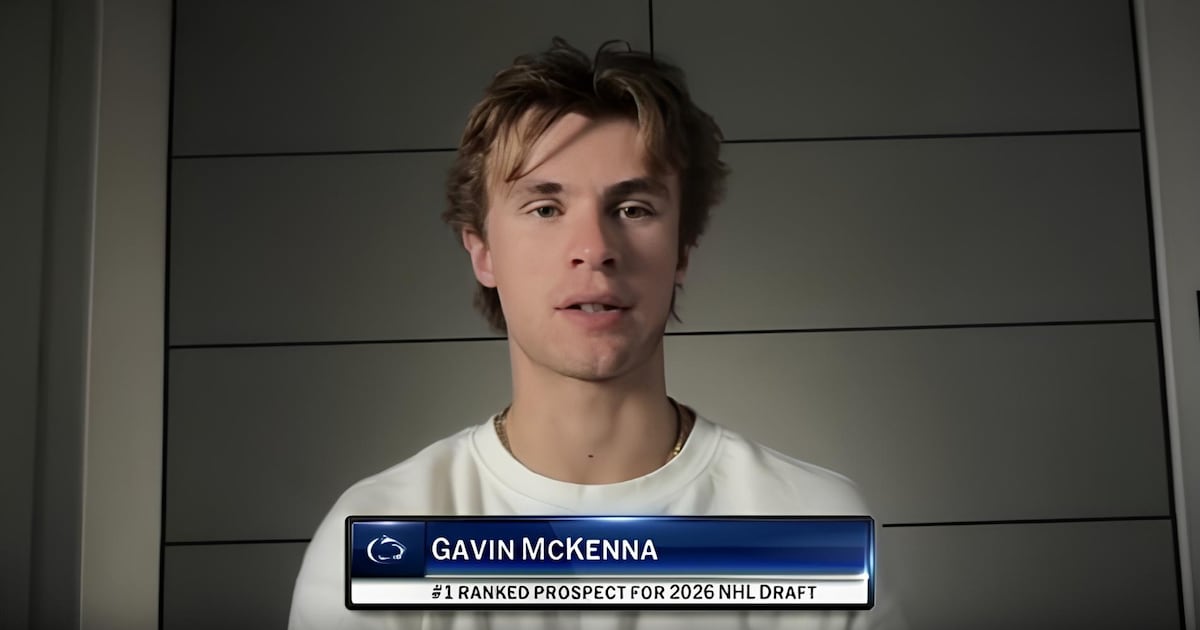
The conversation quickly turned to "adversity" and the spotlight on him. So that's the other thing that will be the buzz about McKenna. With the talk about him through the season that he wasn't as good as he should be, and similar things said during the WJC the tall poppy was in danger. As far as I recall, his game at the WJC won over Dale Hunter who put his line out on the ice with Ben Danford and his D partner whenever he'd really had enough of the other guys being junior hockey players doing junior hockey things. But I only had eyes for Danford, I'm no judge of McKenna's game.
The adversity tag is also code for an off-ice incident that happened in February. McKenna had been to a bar with friends and family after a Penn State game, and was later arrested for punching another man in the face in a nearby parking garage. He was originally charged with aggravated assault and some other lesser charges. Within days the one serious charge was dropped. The court process on the misdemeanor assault charge is ongoing, and is at the stage where some kind of negotiated end to the case can occur. It was just announced that Krystal McKenna, his mother, has been charged with furnishing liquor to minors. According to the Penn State website, this offence carries a mandated fine and can include jail time.
If life were a movie, McKenna, heading into the Combine interviews in a few weeks, would meet with John Chayka and Mats Sundin and the conversation they'd have about scandal and adversity, your reputation and how you see yourself, and what you can do when the two don't match would be the underpinning of the first act and set the tone for the glorious climax of redemption for everyone.
I don't doubt those two men know exactly how McKenna feels. So does Auston Matthews. The B plot in this move is the similarities between these two players. The early years in a place without elite competition, the move away at a young age to a dramatically different place, the family, the sacrifices, the long hard slog, the search for a challenge when it was all too easy at 17. And the arrest. And the scrutiny. And the reputation that can't be fixed except, absurdly, by winning at hockey.
Life isn't a movie, though. And Chayka and Sundin will talk to a lot of other players. But it's a hell of a story.
Ivar Stenberg
Ivar Stenberg is a couple of months older than McKenna, missing last year's draft by two weeks on his birthdate. He is from Stenungsund Sweden and played in his hometown club as a child until he finished the 2020-2021 season. He was 14 and moved to a greater challenge in a bigger club that had an SHL team at its head. This is exactly the same move McKenna tried to make at 12/13, but had to wait a year.
Stenungsund is a small town up at the far end of what looks like a fjord to me. It's not as remote as McKenna's birthplace, but it is interesting to consider just how much they have in common off the ice. They are not city boys. When Stenberg went south, it was a lot easier, a one-hour straight shot down the highway to Göteborg, more commonly known in English as Gothenburg, which is Sweden's second-largest city.
Stenberg joined Frölunda HC and immediately began playing U16 hockey at the regional level. The next season, 2022-2023, he moved to J18 at the regional and national level. As is typical for Swedish prospects, he has seasons where he played for five teams. This frustrates people who want to see rankings on league tables for points, but the club focus on development vs the desire to win championships is balanced differently in Sweden to Canada.
Stenberg climbed the age rankings at Frölunda until 2024-2025 where he split his season between the J20 team and the SHL team. He was 17, and moving up a year earlier than McKenna. Stenberg was a full time SHLer last season and played on the national team at the WJC for the first time, winning gold. Frölunda did not go deep in the playoffs, so he only got in six games.
In the SHL, he averaged 15 minutes per game and was fifth on the team for points. That is impressive usage. The SHL gives some on-ice Corsi stats that are hard to find much meaning in, but there are some clues to usage there. Overall the team had a high Corsi %, and Stenberg led the team. This is most strongly an indication of a coach using his offensively gifted teenager in a very offensively-defined role. He also had the second-highest ice time per game on the power play, so he clearly played the first unit.
The buzz about Stenberg seems to be primarily that he's the forward in the top five who isn't McKenna so he is portrayed as his opposite in all ways. He's not exclusively getting points by tilting towards assists, but his seasons where he scores goals to match are rare. His full season on the J20 team in 2024-2025 saw him shoot at 16%, and the buzz that creates never seems to include the caveat on how unrepeatable it is.
Stenberg's movie is the Star is Born remake number five thousand. He is the plucky young (forget he's a titch older) fresh-faced up-and-comer with no character blemishes that are public. He won the Gold at the WJC, and that's the first act plot point that tells us he is here to supplant the other guy, the one we've known long enough and well enough to have seen his flaws.
Only two Swedes have been drafted first overall: Mats Sundin and Gabriel Landeskog. Landeskog gets an asterisk for actually playing in the OHL, so only one Swedish trained player went first overall. Movie logic says Mats gets to draft the player he sees as himself reborn, and I've seen some buzz about that.
Stenberg, however, is not a big, tough two-way centre. Both of these players are left-wingers with some marked similarities in their offensive games, and some big differences as well. Beware the buzz because it follows the logic of time-worn narratives. My early take on these two is very much a desire to have them both. That's a different movie, though, and requires some machinations we haven't seen since 1999.
Over the next seven weeks we'll all become more expert on these two and some radical other choices, but as you learn things about them, notice how they fit the time-worn narratives and be at least a little skeptical of the conclusions.


Comment Navigation & Markdown
Navigation
cc to focus on comments section
c next comment
x previous comment
z next unread comment
Inline Styles
Bold: **Text**
Italics: *Text*
Both: ***Text***
Strikethrough: ~~Text~~
Code: `Text` used as sarcasm font at PPP
Spoiler: !!Text!!