

Some players get a reputation thrust upon them, usually based on points, and some hazy ill-defined ideas about the right way to play the game. Once it's there it usually sticks.
When Brad Treliving traded for Dakota Joshua who carried the contract the now-defunct Vancouver management team had given him off a shooting heater year, he was placed squarely in the box of bad player who just hits and can't skate. He's slow, he's old and then the word "snot" got repeated a thousand more times.
Yuck.
Nick Robertson, on the other hand, has a long history of devotion for his made for a Hallmark Channel movie backstory and his good attributes of youth and speed. No matter where he goes with that speed or what he does with his energy, it's good. "He just needs a chance," is the slogan he toils away under.
What these two players have in common, aside from being drafted by the Toronto Maple Leafs and playing a lot of hockey in Michigan and playing a lot of AHL games and spending years making very little money, is that on a Leafs team spiralling into the emotional abyss last season, they both worked their asses off every game. In very different ways.
Nick Robertson was fourth on the Leafs for even strength goals with 14 while being seventh in total ice time for forwards. Joshua was one down the list at eighth most used forward with 10 goals. Ten goals is elite fourth-liner territory. Every so often you get that from someone playing very little minutes, but not often. Joshua was not a fourth liner, however.
By now you should be asking yourself what the hell am I doing looking at goal numbers? Leading you up the garden path is the answer. One day I was looking at shots and shooting percentages – some other quest for a little understanding in how someone else plays – and this is when I noticed it.
Joshua had a higher goals rate at even-strength than anyone on the team save William Nylander and Auston Matthews. But the guy right behind him, an insignificant scrap of nothing behind him, was Nick Robertson. If Joshua, who lost some time with a terrible injury from taking a hit, had played as many games as Robertson, he would have had exactly 14 goals at his scoring rate.
How they got them was very different.
Robertson, third on the team in rate of shots (all shots, or Corsi) behind Auston Matthews and Bobby McMann, shoots like this:
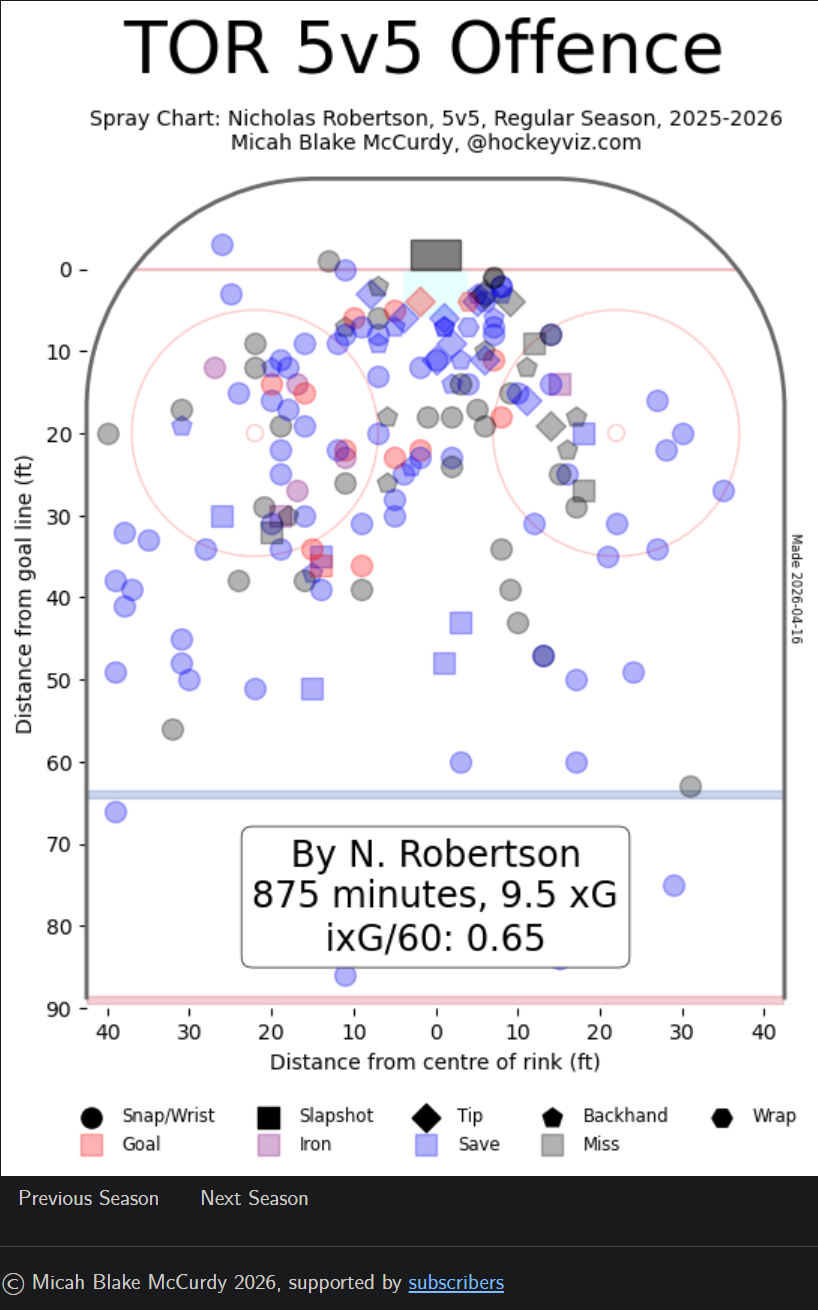
And before you form the name Berube in your mind, his shooting pattern is identical every year. He is who he is, he's not a kid, not developing, doesn't have some runway, and isn't going to change.
Evolving Hockey's xG model rates him a little higher, but that's just differences in how the weightings for the shots are applied.
Joshua shoots at such a low rate in terms of raw volume only Calle Järnkrok was lower. But this is how he shoots:
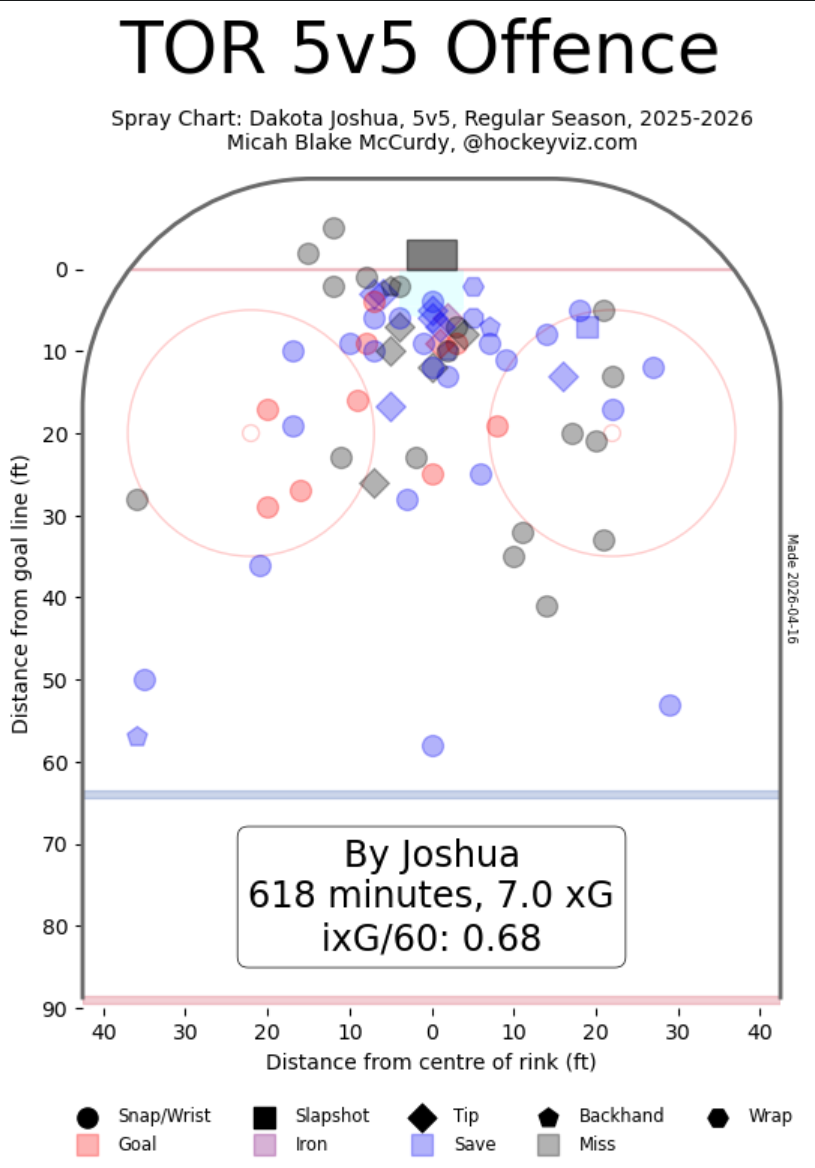
Joshua's career shooting pattern, like the overwhelming majority of the hundreds of players I've looked at over the years, is static as well, although his low shot rate took a very small dip on the Leafs last season as did Robertson's, which should not surprise anyone.
Joshua, we know, is an immovable object in front of the net. That's his role, like speed and rush chances are Robertson's. Joshua uses that position to shoot extremely high danger shots from in tight, often in situations where the goalie isn't set because he personally has upset him.
Joshua has a markedly higher Expected Shooting % because he only shoots at very high danger. Even if he doesn't exceed that expected %, which he sometimes does and sometimes does not (like most players, as consistent scoring over expected is rare), he is going to score some goals near the rate he and Robertson did this year because of how he plays the game.
Robertson has a lower Expected Shooting % because of the location for his big volume of shots. If he has linemates that can capitalize on loose pucks in the offensive zone, that can be a good thing. He's going to exceed his expected % some of the time and sometimes not, but as long as he generates the volume, he'll get some gaols because of how he plays the game.
Two paths same result.
Now for the tricky question. How does their high-volume vs selective net-front shooting affect the other aspects of the game beyond the results of the shots themselves?
That is a very difficult question to answer and the reason is the Leafs were outstandingly awful in the season under consideration, but we are discussing today two players who successfully rose above all that and played their games to the best of their ability.
Robertson is easier to peg down, because he has history on the same team with the same-ish linemates. What he has is no history of positive impacts on offence overall. Beyond his own personally generated scoring chances, he does not raise or lower the amount of offence the Leafs create in any meaningful way. He is a small, not very surprising or significant, drain on defence, and in the range of totally acceptable for a winger.
Mention his name and someone will say, "but he's not good defensively," largely, I think because he doesn't check. He has speed to move the puck up ice, which he personally benefits from, but no one else seems to.
Joshua, however, was used in an extreme way on the Leafs last year, with heavy defensive zone usage, and the only meaningful offensive zone time was what his line created for themselves. He played mostly with Nic Roy and a rotating cast of wingers who rarely, but not never, included Robertson.
And by any model you like, he was an offence creating machine with extremely good results defensively. And... well... I don't buy it. Not completely. I'll buy a player blossoming at age 29 when they get on a team that puts them in a more suitable role to some extent, but not this extreme.
I looked at his most recent year in Vancouver, and what I saw was chaos. If there is a player who knows from confused coaches, messy systems and constantly churning lines, it's him. No wonder he calmly approached the Leafs Season in Hell and succeeded where few did. It was an improvement.
But what I believe went on is that Joshua and Roy were used defensively a lot and were good at it. The only good defence on the Leafs happened around them. The causal direction here could well be that they were used in situations more often where it was possible to succeed or that they created the success, or in the messy reality of the real world, possibly both. Aided and abetted by the defenders they tended to play with shouldn't be overlooked. I don't think isolation models are perfect, in other words, but they paint the broad strokes of a player's effectiveness of lack of it.
As for Joshua's offensive creation numbers, I buy them a little more. Only a little. Two things have to be considered. This was the Leafs:
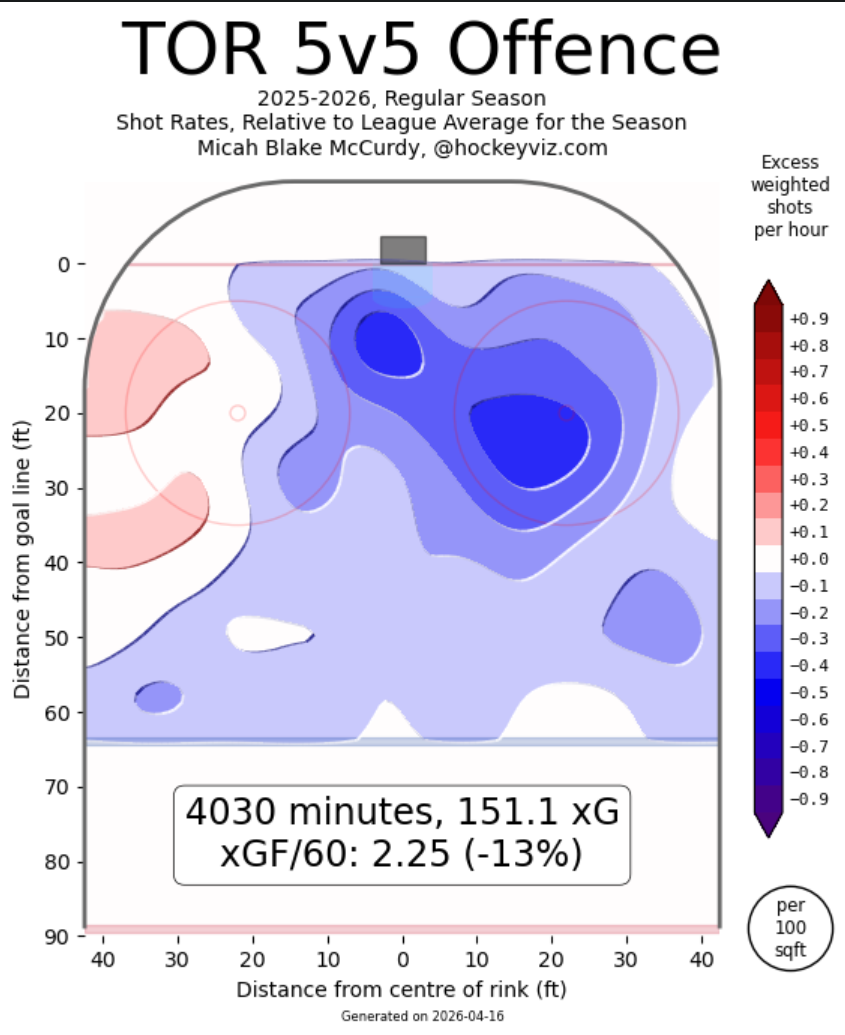
This is very bad, and yet even with this, the team scored enough goals prior to the Olympics that if they had played some plausible defence and had average goaltending, they could have been a squeak into the playoffs team. What I believe, and many other people have discussed at length and in detail, is that the pivot point that led to failure was zone exits, which led to time spend defending, which nullified the overall amount of offence, but also the effectiveness of individual offensive zone shifts no matter who was taking them – dump it in and get off became the norm.
Joshua, who this Hockey Viz model credits with some modest offence creation, was on the ice for a very bad, just not as bad as that up there, -9% xG For (relative to league average). Which could simply mean that because of his defensive success, he was one of the few players who had some opportunity to do anything positive offensively. Auston Matthews, for reference, experienced with his various linemates, a heady -4% relative to league average.
And it is clear that Joshua's "immovable object who will shoot the puck from three inches from the crease and score" style of game worked. In order for that to work, a lot of people have to be fanned out between him and the blueline doing sensible things. But those things can be done by depth players with simple approaches to offence. His line with Roy plus anyone else were good in some way. He had outstanding results in on-ice xG in very limited minutes with Max Domi. The only other person who can claim that is Auston Matthews.
Meanwhile, for Robertson's speed and scattershot approach to work for anyone but him, he has to have linemates who defend, who can keep up with his speed, who can retrieve the puck, who can pass it or shoot it themselves, and at that point, he's been outclassed by his support staff and can just sit down, no difference made to game outcomes.
There is no need to pick between these two players. This isn't some false exercise in one-or-the-other. It's propaganda about why goal stats don't tell you anything you need to know. But also about how reducing players to archetypes is just as unhelpful. Combining the two magnifies the problem. Player analysis should not be a branding exercise.
Joshua, who these models say had a career year, is not likely suddenly an amazing player, but I think with a little more sensible structure he can flourish at what he does. Slowly, to be sure. Robertson is another question. One I wouldn't pay to get the answer to if I were the Leafs. He's almost 25, and a player his age wants some term and stability. I don't see much benefit to the Leafs to doing that.
With arbitration, Robertson is likely to get a contract in excess of Joshua's $3.25 million. The Leafs right now appear to be awash in cap space, but they need forwards better than these two guys. And they're going to cost more than that. So that's the calculation to be made right now.





Comment Navigation & Markdown
Navigation
cc to focus on comments section
c next comment
x previous comment
z next unread comment
Inline Styles
Bold: **Text**
Italics: *Text*
Both: ***Text***
Strikethrough: ~~Text~~
Code: `Text` used as sarcasm font at PPP
Spoiler: !!Text!!