
Ladies and gentlemen of Leafs Nation, allow me to introduce you to Ethan MacKenzie.
Ethan MacKenzie, allow me to introduce you to the doomiest doomers in doom town.
THE BASICS: STATS AND CONTEXT
Position: Left-shot defenseman
League: WHL
Height: 6'1"
Weight: 190 lbs
Birth date: Sep 2, 2006
It's not often you'll see me say you should be excited about a player drafted after going undrafted to the NHL – twice! But MacKenzie has a number of legitimate reasons why he went undrafted. In fact, if you've seen me cite some reasons why a prospect may have either gone undrafted or been undervalued in the past, MacKenzie checked pretty much all of the boxes.
- Was he small? Check. When he was drafted to the WHL in 2021, he was listed as 5'8" and 145 lbs.
- Did he have no hype going into his draft year? Check. He was only a 4th round draft pick to the WHL, and wasn't mentioned on any early season rankings for the NHL in his draft year.
- Did he get injured his draft year? Check. He suffered a broken wrist and only played 26 games, missing from November 15th and only returning for the final 7 games of the season in March with no playoff games to juice his value. He only had 6 points in 26 games and his tracking data didn't look great.
- Was he very young for the draft? Check. His September 2nd, 2006 birthday means he's only 15 months older than Gavin McKenna despite being separated by two drafts.
- Was he a late bloomer both physically and skill wise? Check (probably). I was able to pull some draft guides from the 2024 draft, and I can't see any of them ranking him. A couple of them mentioned his name and liked his defense but that was it. He was listed as 6'0" and 170 lbs, which is nice and average but for a guy with very little points, not great tracking data (see below), who missed most of the season from an injury when he didn't have much hype to begin with, and who only had noteworthy defense when he's just average sized? It's not much of a surprise he went undrafted.
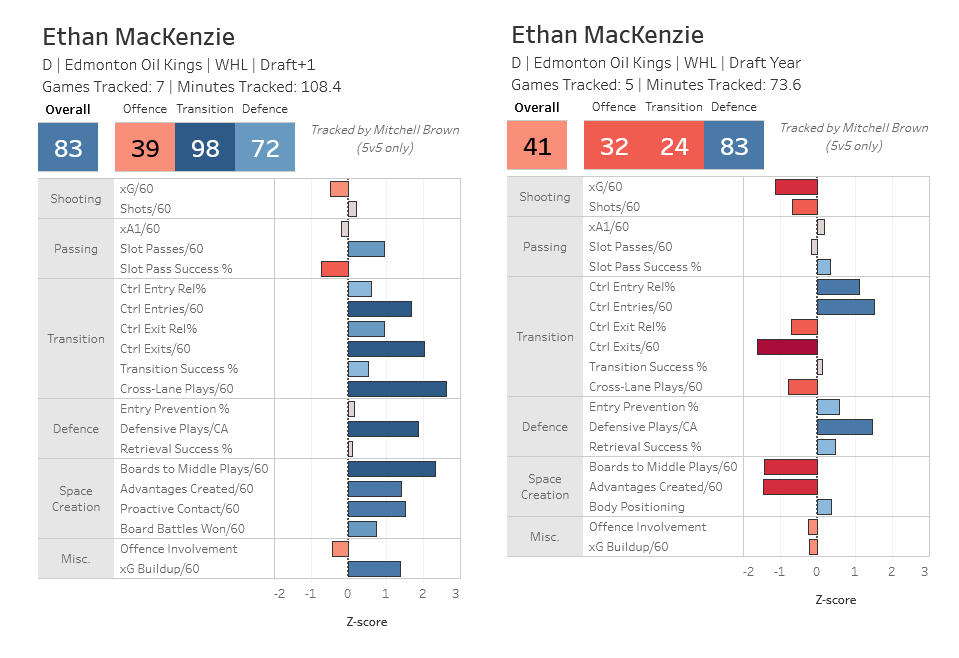
Last year, MacKenzie played in more games, was more physically mature, and took a big leap in his development. The aggressive defense for which he got good reviews in his draft year stayed there, but he got a lot better at moving the puck. He went from a below average transition driver to one of the very best in the WHL. He played in 59 games and his points jumped to 32 for the year. I wound up writing about him as a re-entry option even for the 2025 draft. I noted that he was very mobile, physically engaged, a good transition driver, solid defensively but had some decision making issues that led to him being turnover prone and getting caught out of position due to over aggression. Despite that, he went undrafted again.
 Brian S
This year, MacKenzie made another significant leap in his overall development. His point per game rate doubled for the second year in a row, and he finished with 22 goals and 58 points in 59 games. After only 11 points on the powerplay the previous season (which did lead the team), he finished with 26 points on the powerplay this year – a noteworthy improvement in his offensive impact. He wore an "A" for Edmonton as they finished as one of the better regular season teams in the league. He made Team Canada's roster for the World Juniors, a remarkable achievement on its own for an undrafted player. And he played a decent amount too – playing between 11 and 13 minutes for most games, with two noteworthy games hitting over 15 and 19 minutes respectively.
You can see the improvements across the board in his tracking data, too:
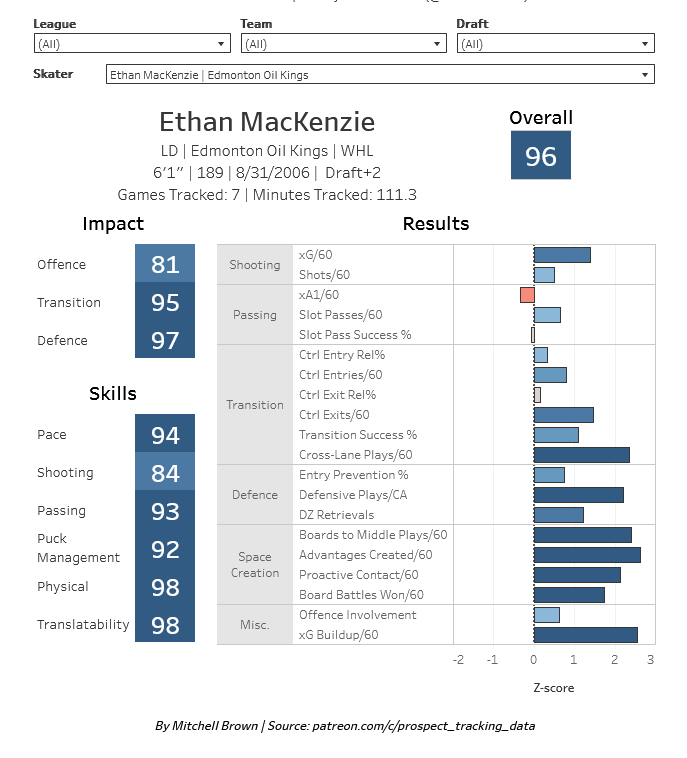
The biggest area of improvement definitely came on the offensive side of the puck, not just on the powerplay but at even strength too. His point generation increased by a large around, but his impacts did too. A lot of the little things you can do with and without the puck in the offensive zone to help facilitate offense are things he was starting to execute on a consistent basis. He still wasn't at an elite level offensively, even for a 20 year old in his final junior year, but he became much better at having a consistently positive impact on the offensive side of the game.
The funny thing is that, if MacKenzie does wind up defying the odds once again and making the NHL, it will not be as an offensive defenseman who quarterbacks a powerplay. It will be more on the strength of his defense, but him also having real ability to move the puck and chip in offensively now and then will only help his chances. His potential may not be considered very high, due to his age at this point, but what potential he does have is very versatile with all around impacts.
THE GOOD: MOBILITY, MOTOR, TRANSITIONS AND TWO-WAY PLAY
Now we get to the fun part. What has driven MacKenzie's success – what has always driven MacKenzie's success from even before his draft year – is his skating and his defense. Even though he wasn't the biggest player for most of his hockey career to that point, it's always been the core part of his game.
Mobility
Starting with his mobility, MacKenzie's skating at this point is at a very mature and very high level. You know how I often say that 17 year olds in their draft year could afford to add more explosiveness and smooth out some mechanics? MacKenzie's had two other years to do that. He's already explosive, his mechanics are fluid, and he is highly agile. He uses that in all three zones. Defensively, he uses it to maintain a very aggressive gap on puck carriers and prevent zone entries, then to get to dump ins before the forecheckers, then to evade the forecheckers and start the transition, then to carry it through the neutral zone, then to activate into the offense to generate scoring chances.
Defense
Defensively, MacKenzie has always been solid at making plays in his own end. If you look at the defense sections in all three of the tracking data visuals I shared you can see that's the one area that was one of his best skills all three seasons. His defensive style is hyper-aggressive, and his impacts there improved overall over time as he got older, more experienced, and continued to grow physically. His draft year scouting reports noted he was doing the right things but lacked the strength in physical battles to win them more often than he was losing them. However, in various articles it's clear he really dedicated himself to an off-ice strength program, which is how he's been able to put on 20 lbs the past two years. Now his coaches call him "strong as a bull" and uses this greater strength to overpower even bigger opponents them him in board battles. Now listed as 6'1" and 190 lbs, he's at the very border of average to above average sized players. The size and strength gives a greater effective edge to his style of aggressive and physical defense.
MacKenzie's hip checks, board checks to pin opponents against the boards, and shoves to clear opponents from the front of the net are now much more effective even against bigger players. He has a good sense of positioning to box out his man in front of the net to prevent them from setting a screen, getting a deflection, or getting to rebounds. This sounds weird but it's something I've seen now that I've watched him in focused detail, but scouts raved about his "free hand technique" with how he uses his non-stick hand. He will use it to spin opponents around to get them off balance or to delay them as they try to recover their desired direction, and to help him pin them against the boards as they try to escape him. What I'll note is that he's very sneaky and smart with it, he doesn't often take a lot of minor penalties for interference as a result of it.
What improved the most over the past two seasons was MacKenzie's retrievals and defending zone entries. He learned how to achieve a more controlled aggression, thanks in large part to his improved mobility over time, to not over-commit on his gap control but to maintain a tight gap constantly. He acts quickly to get in front of a rush as soon as he can to take away space, then forces them to slow down or run into him. Even if they manage to successfully pivot and try to get by him on the wide side, he matches their pace thanks to that explosive and agile skating and maintains that narrow gap as he steers them into the boards to take away their escape.
The thing that's driven MacKenzie's defense isn't really his physical play or strength, or even his skating. Those are the tools that allow him to execute the things he mentally decides to do. What directs him is his brain – how he reads the play, anticipates what might happen next, positions himself proactively, and then act when he thinks it's time to strike. He reads the cycle very well, especially when passes come from high to down low, so he can jump into the passing lane to pick them off for the steal. He has a great sense of timing with his poke checks and body checks. While he definitely plays with a physical edge, he has a good stick as well for poking away the puck, disrupting their puck handling, and herding them to the outside. That anticipation also helps him pivot and get to loose pucks on retrievals first, read how the forecheckers are attacking him, how he can absorb contact if he can't avoid it, and then where his outlets are to pass or skate it into controlled safety.
Offense
The best to describe what MacKenzie has evolved into as an offensive defenseman is – to steal some jargon from the scouting world – he is an advantage creator. He creates advantages by making precise passes to his teammates, across seams through defenders. He pushes an aggressive pace offensively, using his skating to force defenses to react quickly and create chaos in their coverage. So he will rarely stay still at the point. He is constantly shifting his position, side to side along the blueline or creeping in from the point and back again, trying to present the best option to receive a pass back to the point. Where he sees a chance, he'll jump way off the point and into the home plate area for a more dangerous shot attempt.
The important area of improvement for MacKenzie's offensive game is just that he physically caught up to his brain. He was a chaotic mess handling the puck in his draft year, trying to stick handle or deke too quickly and losing the handle. It got better last year, and by the end of this season and undergone a truly incredible level of improvement. He also improved his decision making to avoid trying things that are beyond his skill... most of the time, anyway. Now he's also learned how to manipulate defenders with his feet and handling to lure them in a direction that helps him open a passing lane. Not at an elite level, but the fact that he can do it is helpful to his projection as a playmaker.
Ethan MacKenzie (#47) - Passing Highlights
A quick interjection on MacKenzie's shot. Where it was originally not seen as much of a weapon, this past season he appears to have improved it to the point it was considered by scouts to be a legitimate weapon. Scoring 22 goals as a defenseman will do that. His wrist shot is quick but has velocity, and the combination of that with his activations from the point help him take those shots from more dangerous locations where it's more likely he'll score. Personally, while it's nice to have, I famously don't care much about shots by defensemen, and I don't think his activation-heavy style is something that projects as well to the NHL as I may have a few years ago – except for on the powerplay, giving him an outside chance of becoming a PP2 guy or someone who can fill in for someone in that role in a pinch. But it does speak to the wide array of improvements he made to his game across the board.
Ethan MacKenzie (#47) - Shooting Highlights
THE FLAWS: TOO CHAOTIC, OVERLY AGGRESSIVE, LACK OF PRECISION
So that all sounds great, it almost sounds like MacKenzie could become an all situations minutes eater that could anchor a second pairing – maybe even a first pair! But now I have to cool those jets to anchor how you're picturing him in a more realistic place.
First, while that over aggression and those chaotic elements of MacKenzie's game – both on offense and defense – were things he learned to harness for the greater good, those issues haven't gone away completely. He still has some messy elements to his play, trying to do too much, too quickly, and leading to the occasional moment of un-good chaos. He'll bobble the puck, lose the handle, over commit on a hit, create an unforced turnover, chase his man way too far out of position to leave his area of the ice undefended and making him and his whole line scramble to recover. His skating only helps recover so much. He has a similar issue with the puck, while his playmaking, deception and passing have improved a lot he will at times be stubborn in trying to force a more complicated cross-ice pass that has no business being successful.
Second, there's the limits to consider on how much better MacKenzie can get at this point. It's a great story that he's improved by a lot in so many areas, but at some point he will stop making so many significant leaps in his development. It will be more about smoothing the edges and creating some shine and polish on the finished product. He's turning 20 in September. He will play at least this coming season in the NCAA for a greater challenge, and the chance to play in a better program and system than you'd see in junior. He'll have to adapt to that and the better competition. I'll be curious just how much better he can get.
Third, and related to that, is that MacKenzie's also very unlikely to grow much more in a physical sense. He's already grown an inch since his draft year, and put on 20 lbs of muscle and added strength. But he's not going to grow another 1-2 inches and, while it's possible, is also unlikely to put on another 20 lbs of muscle. I'll gladly eat those words if it happens, but my point is more that he's going to have to learn to make his current physique and level of strength work in the future as the level of difficulty increases by a lot. Because there likely won't be much more of a physical advantage he can add for himself between now and when he could hypothetically make the jump to the NHL.
That's why I'm more certain in giving MacKenzie a firm projection oh his future compared to guys who are still 17 in their draft year. They have two more years to make the same significant improvements and physical growth that he did. MacKenzie, on the other hand, is (probably) more or less as good, big, and strong as he'll ever be outside of some smaller improvements over the next few years.
OVERALL ASSESSMENT
However, what MacKenzie also has is more certainty. I am more certain that MacKenzie will make the NHL in some capacity than, say, Mans Gudmundsson even tough the latter is bigger and younger and has more time to make his own big developmental leaps. Because there's also a chance that Gudmundsson doesn't make any big leaps, and only improves a little over time. That's just what happens with prospects, not everyone is guaranteed to have huge improvements.
But for a third round pick, being able to have more certainty that MacKenzie will be a versatile third pairing defender who can move the puck, defend well, kill penalties and maybe run a secondary powerplay unit is not a bad thing. Bilecki, only taken nine spots ahead of him, is your lottery ticket. He's the guy who is younger and has greater tools to potentially turn into something much more valuable.
Honestly I usually have longer concluding sections to wrap up what I've said and think about a player I profile, but with MacKenzie I don't think there's much else that needs to be said. He's had a remarkable story of perseverance, taken two huge steps in his development, and gone from a guy very few people thought much of (if at all) to being a draft+2 guy taken barely outside of the second round. He'll be a fan favourite, I think, both for his play style but also for the attitude and work ethic that got him here, and the underdog story he represents.
Welcome to the Maple Leafs family, Ethan!
Thanks for reading!
I put a lot of work into my prospect articles here, both for the draft and Toronto's prospects. I do it as a fun hobby for me, and I'd probably do it in some capacity even if PPP completely ceased to exist. But if you like reading my work, some support would go a long way! I pay for a few streaming services (CHL, NCAA, USHL, the occasional TSN options for international tournaments that are broadcast) to be able to reliably watch these prospects in good quality streams. I also pay for some prospect-specific resources, such as tracking data and scouting reports from outlets like Elite Prospects, Future Considerations, McKeen's Hockey, The Athletic, and more.
Being able to get paid for this helps me dedicate more time and resources to it, rather than to second/third jobs. And whatever money I make here, a lot of I reinvest back into my prospect work through in those streaming and scouting services. Like I said, I'd be doing whatever I can afford for this anyway, so any financial help I get through this is greatly appreciated!





Comment Navigation & Markdown
Navigation
cc to focus on comments section
c next comment
x previous comment
z next unread comment
Inline Styles
Bold: **Text**
Italics: *Text*
Both: ***Text***
Strikethrough: ~~Text~~
Code: `Text` used as sarcasm font at PPP
Spoiler: !!Text!!