

Introduction!
Okay introduction over.
THE BASICS: STATS AND CONTEXT
Position: Right-shot defenseman
League: MHL / VHL / KHL
Height: 6'1"
Weight: 187 lbs
Birth date: Nov 5, 2007
Fedoseyev is an interesting case to consider because he played in three different leagues/levels this season, split pretty evenly as well. So he didn't have the benefit of playing in the same level all year with more time to adjust to the same competition for a full season. He is on the older side for this draft class with an October 2007 birthday, but you can even look at his previous season and compare him to Russian defensemen taken last year.
Last season, Fedoseyev played 33 games in the MHL. He had 17 points in 33 games, which U18 defensemen at that level was at the very tops for point per game rate. He was ahead Kurban Limatov (3rd round pick by Carolina), Nikita Tyurin (5th round pick by Detroit), and Maxim Agafonov (5th round pick by Seattle) who were the ones that finished behind him. Not only that, but he also got his first taste of the next levels in Russia's hockey system with three games in the VHL.
This season, Fedoseyev began again in the MHL but bounced around all season. His sequence of games looks like this, from the start of the year to the end:
- 11 games in the MHL
- 6 games in the VHL
- 6 games in the KHL
- 3 games in the VHL
- 3 games in the MHL
- 1 game in the VHL
- 3 games in the MHL
- 1 game in the VHL
- 7 games in the MHL
- 14 games in the VHL
- 8 games in the KHL (only 6 games with any ice time)
- 2 games in the VHL
- 2 games in the MHL
I have no basis to think this is a fact, but I can't help but think that changing levels like that so much made things harder on Fedoseyev when adjusting to the higher levels. As for the outcomes of this bouncing around, here's a quick breakdown of his relevant totals by each league he played in:
- MHL = 24 games, 13 points (2nd most per game for the draft class), 22:41 TOI (led the team), up to 23:55 in two playoff games.
- VHL = 25 games, 6 points (2nd most again), 16:09 TOI that bumped up to 25:55 in his two playoff games.
- KHL = 9 games (most for defensemen in draft class), 1 point (most), 12:41 TOI in regular season and 7:11 in two playoff games.
Only in the MHL did Fedoseyev see a lot of special teams time, on both the powerplay (1:38 per game per Neutral Zone) and the penalty kill (1:23). In the VHL and especially the KHL, his deployment was mostly at even strength. Although by the end of the season, he was leaned on a lot more heavily in the VHL.
Otherwise, I'll just pull this quote directly from Neutral Zone because it cites a bunch of various metrics rapid-fire style:
[Fedoseyev's] puck battle success rate of 62% is particularly impressive and I feel is an essential trait for projecting to the NHL level. He also shows strong puck management ability with an 86% pass completion rate while contributing nearly one pre-shot pass per game (0.87). He is clearly capable of moving the puck efficiently and supporting offensive play without overhandling. Defensively and physically he is already playing a pro-style game. His 1.4 hits per game and willingness to engage physically show that he uses his size effectively, while his puck retrieval and defensive engagement numbers demonstrate that he is comfortable playing in high-traffic areas.
Thankfully, I can use Will Scouch's tracking data from his website scouching.ca where I can compare Fedoseyev to other Russian defensemen, and European defensemen playing in pro leagues. Those are the most comparable to his situation and usage, where it's tough to compare him against those playing in Canadian or even European junior.
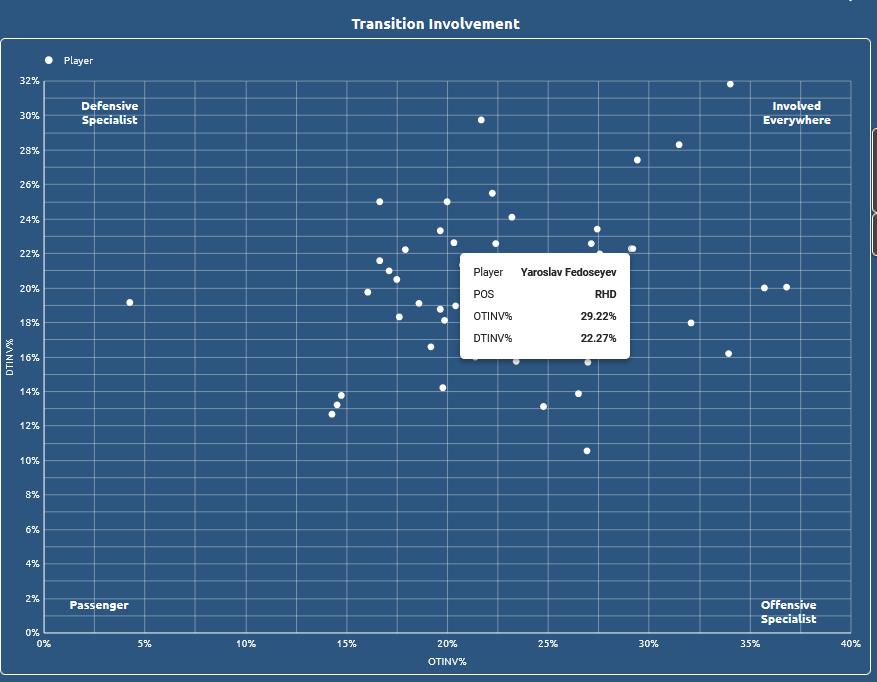
First, this graph plots how involved defensemen from this draft class are in transitions. The Y axis shows the percentage of defensive transitions the player is involved with, and the X axis shows the same for offensive transitions. Fedoseyev's dot is on the upper right corner of the player card shown in the screenshot below. Relative to his draft class, he rates out as above average but not among the very best in terms of being involved in both offensive and defensive transitions. However, it's most relevant to compare him to other top defensemen in this draft class who played in European pro leagues. Other defensemen who are in the same area as him include Alberts Smits (5th overall pick by New York) and Samu Alalauri (3rd round pick by Chicago).
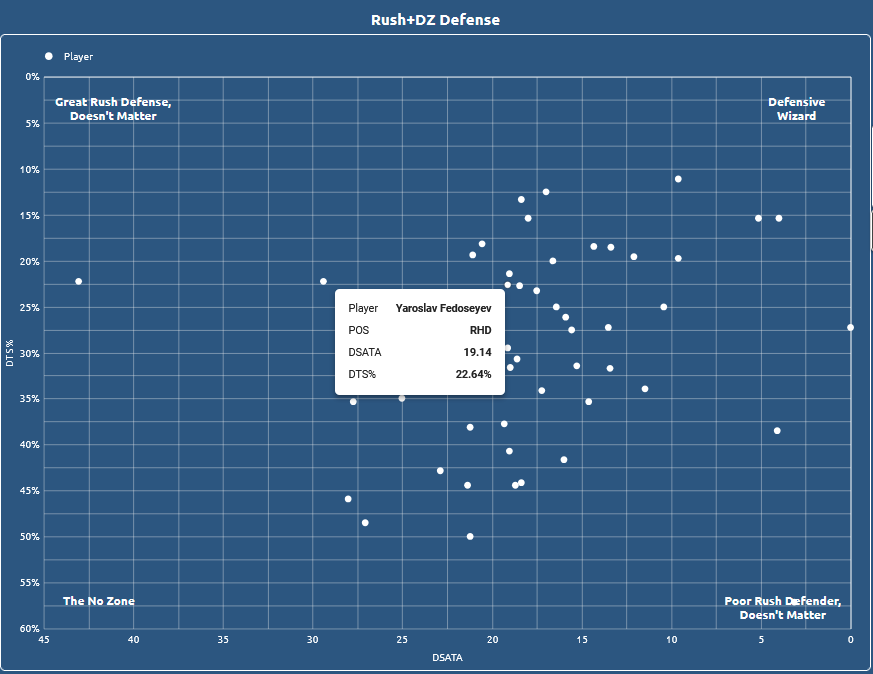
This next graph plots how effective Fedoseyev was at defending against the rush. The Y axis measures the success rate of defensive transitions against him, and the X axis measures the number of dangerous shot attempts against. Again, his dot is the one at the very top right corner above the player card. He may be pretty much in the middle/average, but again in that same cluster includes a lot of the other top defense prospects who played in European pro leagues: Malte Gustafsson (sigh... 13th overall), Juho Piiparinen (29th overall), Adam Goljer (49th overall), and William Hakansson (51st overall). So when it comes to rush defense, he rates out similarly to other top defensive prospects who played against a similar level of professional competition.
In this final graph, the X axis shows how many cycles Fedoseyev had to defend against, and the Y axis shows how many of those cycles he broke up successfully. So for him, he faced around 16 cycles and broke up roughly 5 of them. His dot is in the same quadrant as the likes of Alberts Smits (5th overall), Alexander Ivanov (7th round pick), and Vsevolod Matveyev (undrafted).
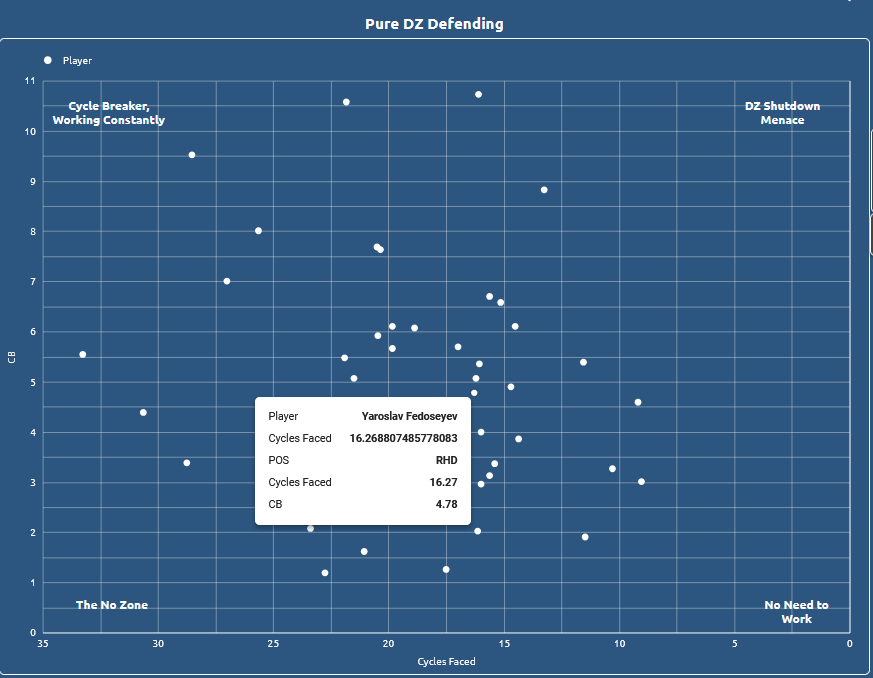
Rather than spending time placing too much importance on the specific numbers coming up in these graphs and ranking where Fedoseyev places relative to all the prospects, I take this general conclusion: when measured against other top defense prospects in this draft class who played in European professional leagues, Fedoseyev's defensive metrics appear very similar. Depending on the specific metric, that includes two elite defense prospects in Alberts Smits and Malte Gustafsson.
THE GOOD: MOBILITY, DEFENSE, PUCK MOVEMENT, PHYSICALITY
Fedoseyev fits the same mold as Gudmundsson and even MacKenzie. In different ways, they are all: mobile, defense-first, and capable puck movers. So let's talk about how Fedoseyev goes about his business.
I'll start with his mobility, since skating is a foundational tool that affects every other skill. His four-way mobility is very high end, maybe even elite – I've seen some scouts say it's elite but I'm not fully sold on it being quite that good overall just yet. I would say his agility is elite as he has very strong edges and is able to shift directions quickly without losing balance. He is able to use weight shifts along the blueline in the offensive zone and on retrievals, and to quickly switch between forward and backward skating with minimal loss of speed.
Yaroslav Fedoseyev - Shooting Highlights
The most important area Fedoseyev's mobility comes into play is his ability to move the puck on transitions. On breakouts, despite being a very good skater he is an overwhelmingly pass-first guy. The skating comes in by helping him buy time and create space from forecheckers so he can make a good first pass. His pass completion rate is 86% per Neutral Zone, and his mobility helps make his life a lot easier with that. He'll use cutbacks, fakes, and looking in the direction of one teammate to get defenders to move one way before passing it another direction. He'll sometimes try a long-distance stretch passes and succeeds on them at a good rate from what I saw.
Offensively, Fedoseyev doesn't project to be a high level offensive driver, but he's shown some flashes in junior at having more than zero skill. He was a PP1 defenseman in the MHL, and that mobility helped him walk the blue line and make plays to keep the puck in when pressured by an opponent. He uses the shiftiness and quick changes of direction to get them off balance so he can skate by them into open space, then make a play with the puck. He doesn't have a great shot – or rather, he flashes a decent one but only seems to use it rarely – and his passing, while accurate, isn't something I'd call high level playmaking. But he can make good passes when they're there for him, and his elusive skating and a decent pair of hands help him create some good chances for a shot or a pass.
Yaroslav Fedoseyev - Passing Highlights
Last but certainly not least, arguably Fedoseyev's biggest strength is his defense – both against the rush, and in his own end. I'll start with his rush defense because I think that, as of right now, it's more consistent for him. Because of his mobility and good anticipation, he is very strong at maintaining a narrow gap when defending. With his lateral agility, he can handle even more skilled forwards trying to deke past him by matching their footwork and continuing to angle them outside and into the boards for a check. He doesn't throw big, crushing hits very often, but he'll punish dudes into the boards to erase their momentum and separate them from the puck. He has good stick work to go with his mobility and physical play. By the end of the season, one of the reasons why he got so much more ice time in the VHL playoffs was not just because he got more time on special teams (though that helped) but also because his rush defense had improved by a lot. At the start of the year he was more chaotic and took risks with his aggressiveness, but he calmed that down and became more efficient and consistent.
Fedoseyev's defense in his own zone is of a similar style, but with more chaos. When he's at his best he is a dominant, physically suffocating defender that stops the cycle dead. He tends to look more 'mean' with his physicality in his own end, and has a 62% win rate on low-cycle board battles for possessing the puck per Neutral Zone. He'll be even more mean dealing with forwards in front of his own net, and will absolutely play on the line when it comes to dishing out punishment just short of taking a penalty... or that's the goal, anyway. In the earliest games in the VHL and especially the KHL, his defense broke down more often because he couldn't mentally keep up with the pace. His decision making with the puck and on defense got chaotic and he was prone to sloppy mistakes. But by the end of the year, once he had time to adapt, his ability to execute on defense at the higher paces improved by a lot. Once he could deal with the pace, that's when his mean streak started to appear more often than it even did in junior.
THE FLAWS: IN-ZONE LAPSES, INCONSISTENT TURNOVERS, ADJUSTMENTS TO PACE
Honestly, I can only think of two... maybe three kinds of weaknesses in Fedoseyev's game. The first and most concerning is that his game noticeably breaks down at times when he is facing more intense and high paced pressure. I just touched on this, and while it is something he did improve on a lot this past season, it didn't go away completely. When his decision making has to speed up past a certain point, you can see him panic and make poor decisions you wouldn't normally see him make – on both sides of the puck. That's where his game gets chaotic, and it's not the good kind of chaos.
The second and less concerning issue is that Fedoseyev's skating mechanics can be improved. Even if he already has very strong mobility in every sense (speed, agility, acceleration) none of it is at an elite level. I'd say the fact that it's all very good makes his overall mobility borderline elite, because it's rare to be so good across the board like that. But he has some awkward posture in his skating stride that affects his ability to extend his reach, and limits his high end speed and acceleration. It's not a major problem, but smoothing that out would make his mobility even better.
The possible third issue, and it's more nit picky, is that while there are many elements of his game that I really like and he seems like a very strong all-around defenseman, he doesn't have a big standout strength. He's not the best or an elite shutdown defenseman, nor a transition defenseman, nor an offensive defenseman, nor as a special teams specialist. He is very toolsy that has good instincts but could use some refinement, and he can do a good job on either special teams units and at even strength in all three zones. But that does limit his upside to, at the very very best with a very low chance of reaching this level, a solid second pairing guy like a Jake McCabe. More realistically, he could be a solid third pairing guy who kills penalties and maybe fills in on a secondary PP unit if needed. And there's still a realistic possibility that he becomes a "AAAA" guy who can be a solid pro in the KHL and AHL but just doesn't quite have the level needed to play in the NHL. That would happen if he can't make those needed improvements.
OVERALL ASSESSMENT
I'm glad I didn't quite finish writing this by the time that the Leafs had their development camp scrimmage. Fedoseyev played on the top pair for one of the teams alongside Bilecki. I came away from the scrimmage thinking that Fedoseyev was the most consistent and consistently good defenseman on the ice. Other guys maybe had better quality highlights but he's the only one I kept noticing in all three periods of the game. He was making strong defensive plays, making good first passes on transitions, making good pinches in the offensive zone, jumped into the rush a couple of times, and set up a good scoring chance after knocking down a clearing attempt and making a quick pass to set up a one timer.
I already liked him from what I knew of him before this draft, he wasn't a final cut for me when I was finalizing my list of players to profile but I did consider him for a bit. I started liking him even more after starting to look into him in as much detail as I could find for this full profile. But after the scrimmage, I started to love him even as I try not to put too much stock in one inter-squad scrimmage. If he's still around for the Rookie Tournament (which he may not be if it clashes with the pre-season camps for the VHL/KHL) I will be very much looking forward to seeing how he fares against the top prospects of other teams.
But I don't think it's unreasonable to think Fedoseyev could wind up as a steal. The Leafs drafted him 161st overall, but there were plenty of scouts and outlets who ranked him a round or two earlier than that.
- Ryan Ma from Tape2Tape Prospects - 54th
- Jason Bukala with Sportsnet – 74th
- Dobber Prospects – 85th
- Scott Wheeler – 89th
- Smaht Scouting – 96th
- McKeen's Hockey – 106th
- Corey Pronman – 109th
- NHL Central Scouting – 30th among international skaters
That doesn't mean every scout or outlet had Fedoseyev ranked at all, or ranked before a reasonable range that would include 161st overall. This isn't a guy taken out of nowhere because no one thought he could be better than a 6th rounder. This kind of thing is a lot more common for defensemen, I've found, considering how differently many people think about what makes a good defenseman.
My point is that going into this draft, Fedoseyev had plenty of believers. And now I'm one of them.
Thanks for reading!
I put a lot of work into my prospect articles here, both for the draft and Toronto's prospects. I do it as a fun hobby for me, and I'd probably do it in some capacity even if PPP completely ceased to exist. But if you like reading my work, some support would go a long way! I pay for a few streaming services (CHL, NCAA, USHL, the occasional TSN options for international tournaments that are broadcast) to be able to reliably watch these prospects in good quality streams. I also pay for some prospect-specific resources, such as tracking data and scouting reports from outlets like Elite Prospects, Future Considerations, McKeen's Hockey, The Athletic, and more.
Being able to get paid for this helps me dedicate more time and resources to it, rather than to second/third jobs. And whatever money I make here, a lot of I reinvest back into my prospect work through in those streaming and scouting services. Like I said, I'd be doing whatever I can afford for this anyway, so any financial help I get through this is greatly appreciated!



Comment Navigation & Markdown
Navigation
cc to focus on comments section
c next comment
x previous comment
z next unread comment
Inline Styles
Bold: **Text**
Italics: *Text*
Both: ***Text***
Strikethrough: ~~Text~~
Code: `Text` used as sarcasm font at PPP
Spoiler: !!Text!!