

I wanted to see if what I think about how defence and offence in players holds up under scrutiny. So I asked Evolving Hockey to give me all the players with 3,000 minutes played since 2017 at even-strength. I wanted to weed out most of the bottom half of the lineup players or one or two season wonders or rookies who haven't established themselves yet.
Who Does What in the NHL?
I got 681 players. I used 2017 as the start date because I know that's the season when shotrates in the NHL began to climb. The game changed significantly in a way that drew little attention. But the NHL in the "Matthews era" is very different from the NHL he grew up watching.
For this exercise in checking my assumptions, I used the RAPM information EH produces. This is a foundational part of their GAR model, and is a numerical measure of a player's isolated impact on the given metric. I stuck exclusively to Excpected Goals per 60 in total (which is expressed at a plus/minus) and in its component parts.
We out here in the world are limited in what we can know about how players get to xGF and xGA. We have to settle for the RAPM version which attempts to isolate out teammates, so resist the impulse to do that yourself on top of what the model has already done. Does xGA give the complete picture of player defence? No. But it draws a sketch of it. Shadows on the cave wall.
I consider everything that contributes to xGA to be, broadly, doing defence. So limiting shots against, limiting quality of shots against, exiting the zone cleanly, denying entry – all those things are defending. So is in-zone defence. That is the actions taken without the puck to prevent goals before the puck gets to the goalie.
I consider control of the puck in the neutral zone to be the start of offence. So zone entries, and all that happens within the offensive zone as well as puck retrievals in the neutral zone to stop transition against are offence. There is clearly a grey area here, and when we're just philosophizing we can agree that offence and defence don't have a fence between them.
I made some charts to look at the data for all these defenders, but I find them busy and they require study to return useful information. I think this time just mostly numbers will give the story.
The first thing to understand is that the measure of overall value in RAPM xG is xG+/-. All values are per 60 minutes, and I'm just going to stop typing that part every time. That plus minus is the xGF figure, where positive numbers are good, and negative bad, with the xGA number subtracted (because negative are good here and positive bad).
The next thing to understand is that offence, as measured by xGF, is distributed very differently by position. (In this set of big minute players, not in all players over time, but that would be fun to examine.)
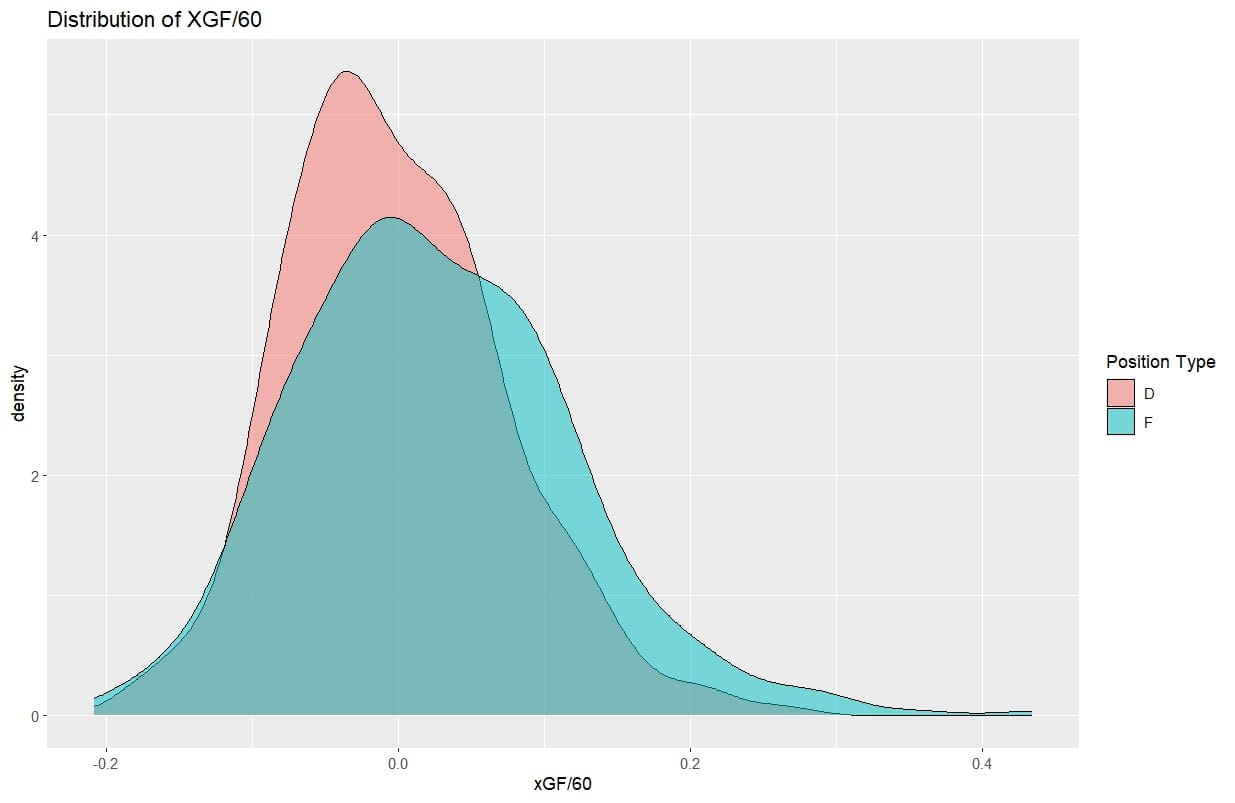
And the other side of the coin?
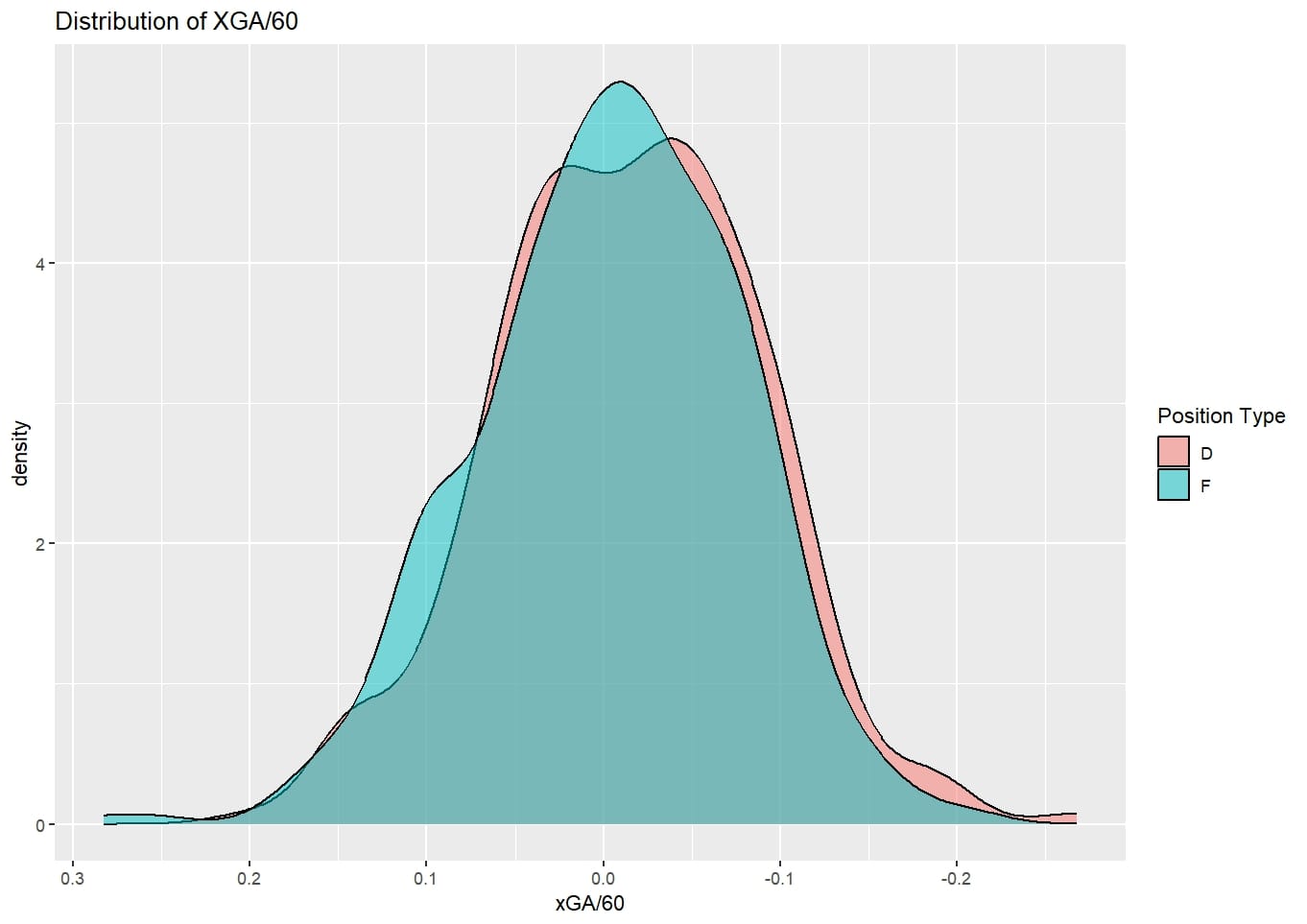
There are not many defenders better than all forwards at defending, but there is a larger group of forwards better at offence than all defenders, and the scale of the heights these forwards reached offensively is higher than the defenders. Today I'll spend no more time on the easier to understand forwards; rather, let's take a closer look at these defenders.
247 Big-Minute Defenders
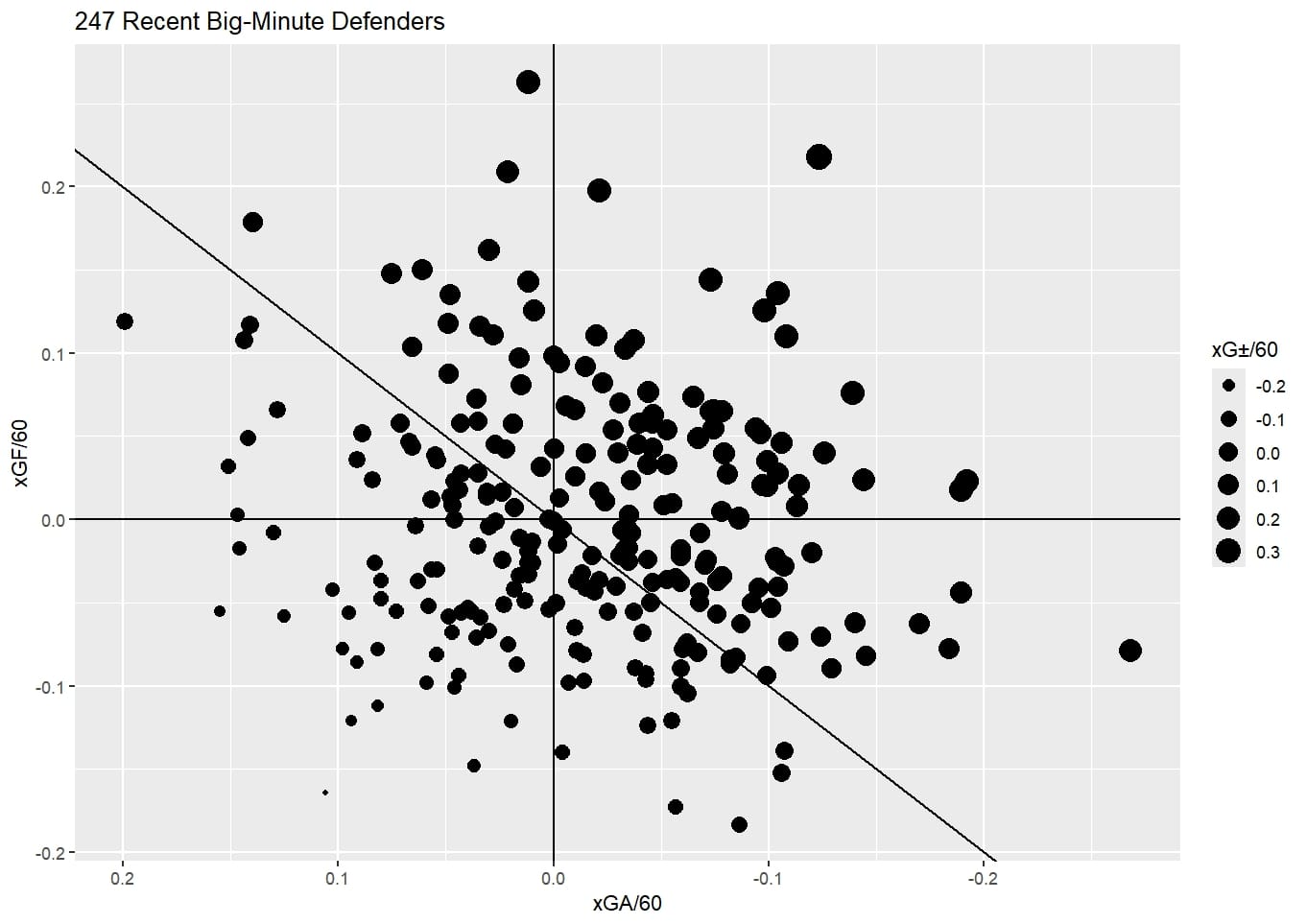
One of the confounding problems with this look into what these players have done over a lot of games played is that there are a lot of really bad defencemen in this list (the smallest dots in the bottom left). In a very general sense, the NHL curates its players well. Most of the players who play a lot are worth playing a lot. And while I'm not trying to say the RAPM xGA portions of the +/- is the perfect measure of defensive impact, there sure is a collection of defenders in this set who are actively making the in-zone situation worse at both ends. I think we just need to accept that the NHL in general thinks that guys like this are useful in some way. I mean, here's the names of the worst ones, so you'll know what "some way" means.
- Simon Benoit
- Jack Johnson
- Mason Lohrei
- Erik Gudbranson
- Jay Bouwmeester
- Deryk Engelland
- Arber Xhekaj
- Josh Brown
- Tyson Barrie (Wait, what? Okay there's more than one way to be bad...)
- Nathan Beaulieu
- Ben Chiarot
- Johnny Boychuk
You get the picture. We're not learning anything new here that there are guys like this having massive negative impacts on the team and playing every night, sometimes on top pairs. They also seem to have long careers, so they got on this list that way too. This might be a big reason why, in this set of people, defenders aren't defending any better than forwards.
How do all of these players break out by value? There are 129 defenders with their xG +/- zero or better and 118 below water (the water line is the diagonal line on the chart).
Of the 118 "bad D" there are 28 with at least zero or better xGF and 38 with zero or better for xGA (good xGA is to the right here).
That leaves 52 in total out of those bad defencemen who are bad at both offence and defence. That is a lot. Now most of these guys are clustered really close to zero on both sides of the line because there area mostly replacement level players in the NHL, and even limiting my set of players to big minute guys over a career, I will get replacement level defenders in there.
I'll digress here for a second to jump on my hobby horse (well, one of them, anyway). We sort defenders by top-four and bottom pair, which is broadly true of their ice time, but is not how the talent is distributed. There are not twice as many above replacement level defenders in the NHL. The talent distribution gives us less than 32 elite defenders, less than 64 top-pairing defenders, and a lot more than 128 bottom four defenders. By default, "do no harm" zero rated defenders will play big minutes. By bad team construction and poor GM choices, genuinely harmful players play big minutes as well.
Of the bad overall defenders, that list of the worst are not representative. Most of the "bad" ones are at least good at defence and are not killing the team with offensive nullification.
But what about the other bunch, the glass cannons? Now that we now know that defenders can't reach the same dizzying heights of offensive impact as forwards, is the glass cannon trope real? That is, are there defenders so good at offensive impact they wipe out their defensive badness?
Before I answer that, it's important to know just how many of these players we're calling bad at defence are actually good overall, and I'm setting the bar really low here, this is what percentage of these players are at zero xG +/- or more?
Out of the 118 defenders considered here who are bad overall by the plus/minus metric, the highest xGF any of them have is 0.119. That's so high up, that there's only 13 defenders at or above that of any defensive ability. Tony Deangelo happens to be the best offensive defender that still lands underwater overall. Morgan Rielly is right behind him, and in fact, I'd call their offensive stats here functionally identical. But their defensive badness is markedly different. Rielly is trying very hard to hug the zero line (John Klingberg is the overlapping dot) and Deangelo is the worst guy on the list defensively.
This is the full list of defenders better than those two offensively who actually manage to be above water by the plus/minus from best to worst:
- Lane Hutson
- Adam Fox
- Evan Bouchard
- Dougie Hamilton
- Erik Karlsson
- Thomas Harley
- Zach Werenski
- John Carlson
- Mattias Ekholm
- Shea Theodore
- Jordan Spence
- Thomas Chabot
- Charlie McAvoy
xGA is a limited measurement. Some of these gifted offensive players, like the best one, Lane Hutson, might be terrible at some aspects of in-zone defending. But if their transition skills or zone entry denial skills or puck control skills are really good, they can get this big impact on xGA in other ways. When they are also that offensively gifted, no one should care if they have some defensive deficiencies, but there is a very good reason why Deangelo is too brittle a form of glass to have any value. But the number of players here that are in that category is very small.
- Deangelo
- Pavel Mintyukov
- Luke Hughes
- Torey Krug
- Jamie Drysdale
- Alex Goligoski
To summarize what you get in the NHL at even-strength today:
Getting genuinely positive offensive impacts from defenders at even-strength is difficult, since most defenders can't do that. The ones who can, don't add much value. Of the ones who add any value, they're more likely to net out as negative rather than positive. Overall negative impact defenders can have very high levels of offensive impact. The number of meaningfully valuable offensive impact defenders is very small and only about four of them are remarkable enough to rank in with the best forwards.
Mitigating the Glass Cannon
I ignored the power play stats here for two reasons – even-strength impacts are much more important to the overall chance of a team winning more games than the other teams. The second is that actual defender impacts on the power play are a lot smaller than most people mentally model it, in no small part because people will insist on calling the defender the quarterback.
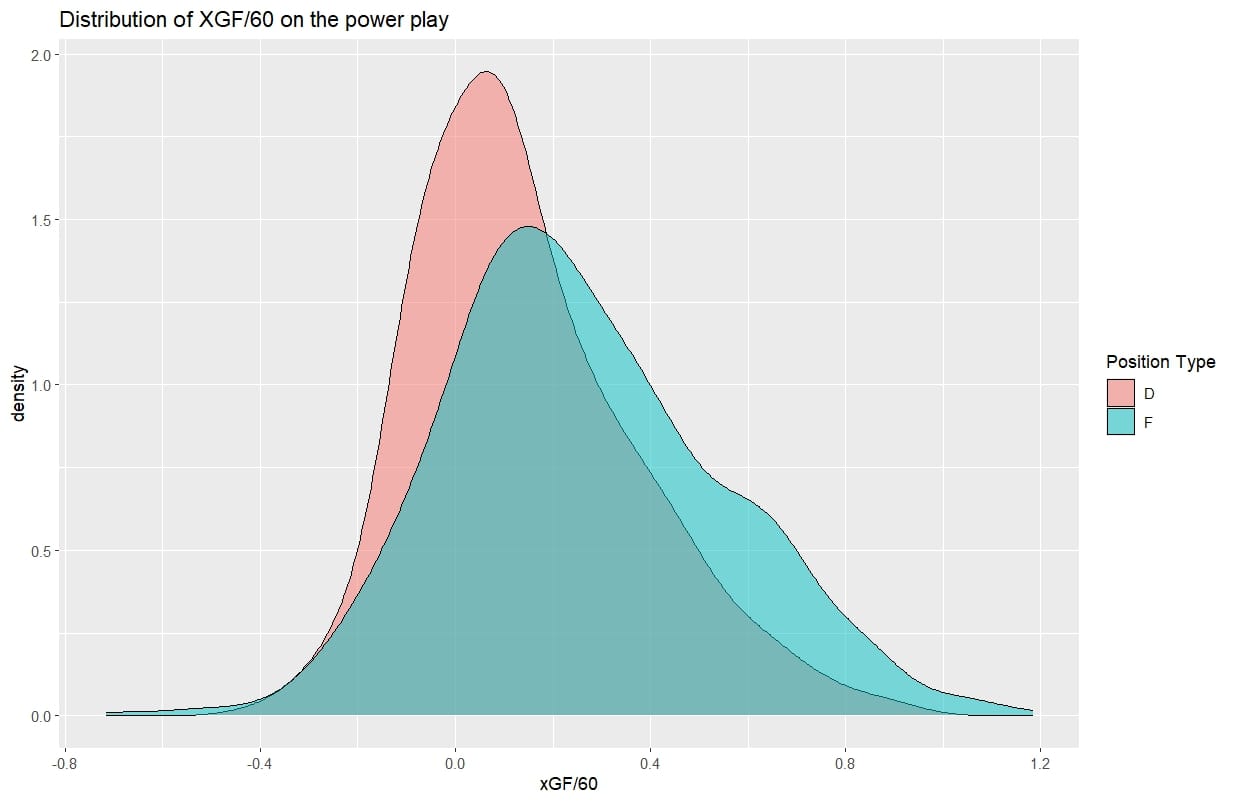
At the bleeding edge of power play value in defenders, their impact there can put them over the water line in some cases. Morgan Rielly ends up an overall value add player of an extremely small amount if you consider his power play value (over this period of time, I make no assertions about this recent season). Quinn Hughes and Lane Hutson, Adam Fox and Evan Bouchard become superstars when you add in their PP value.
But for the true glass cannon defenders with very poor defending stats, the power play isn't enough to make them a truly valuable player, not anywhere near what they tend to get paid, and that's largely because there just aren't that many power play minutes and even-strength play really does matter a great deal more.
Reputation of players is often really skewed from reality, however. Any small-bodied agile defender with puck skills is assumed to be offensively tilted. Cale Makar is a very good example of a player whose defence is better than his offence by this measure. There are 77 of the 129 defenders whose overall impact is at or above zero who have better defensive impacts than offensive.
How is this actionable?
What this means for the draft, and for prospect evaluation in general is this: if you're looking at a defenceman whose primary skills are offence creation or support, and whose defence is very poor to just okay, you have to believe this is an ultra elite offensive player who is also ultra elite on the power play before you have a valuable player.
These players are very uncommon. There aren't going to be four or five in every draft, and most of the defenders who are paying their way up the draft rankings with points in junior leagues are going to be Luke Hughes not Quinn Hughes. (Luke Hughes is well below water even after considering his power play contributions.)
Here's the conundrum: if you want an elite impact defender, he's going to need very good offence, but he can't be a glass cannon. No one is so good offensively they actually make up for very bad defence enough to even get to very good. The worst defensive defender who is above water on that chart is Niklas Hjalmarsson, whose offence was elite. He's the lone dot left of the 0.1 line that nets out as good without the PP to get him there. Note, this period covers his late career on the Coyotes, not his prime.
Most of the famous offensive defenders are very, very good at defence, sometimes better than they are at their sparkly offence like Adam Fox or Makar. Some of the most outstanding defensive defenders in the league like Mattias Ekholm are actually as good at offence creation as someone like Luke Hughes or Rielly.
The perception of the actual glass cannon is skewed towards the fun stuff and ignores the very hard to see transition and in-zone defending that crashes their xGA and their value. They aren't worth it.
Our Glass Cannon Now and in the Future
But what of Morgan Rielly? That's the other side of this problem. Offensive defenders are useful, and every team needs one good power play defender, and two is better, but players perceived as defensive cost less, and if you need offence, you'll get more out of a forward most of the time. Players like Luke Hughes and Rielly shouldn't be your minute munching top pairing player either. It isn't Rielly's fault that the Leafs kept leaving him hung out to dry as the most-used defender most of the time for the last 10 years. He's paid like he's the backbone of the team, or he was before the cap inflated, but that's actually one of the biggest problems with the team. He's just okay overall. And when the team struggles, suddenly his okayness is revealed as a liability. Not quite as extreme a liability as his recent "I saw a mistake" detractors would have you believe, and not actually the problem on the power play, but not adding much value.
If glass cannon is the worst case scenario or "floor" of a prospect at the draft, then I say walk on by. Elite offence from a forward can be double the offence from an elite offensive defender. Defensive deficiencies in a forward are easier to work around. It's a bad bargain because offence costs more in salary no matter the other side of the equation.
Offensive deficiencies in a defender are easier to work around than defensive because placing a partner defender with the opposite skew of skills works a treat in a "positionless hockey" offensive cycle, but no defensive defender is so gifted he can teleport over to where his hapless partner is getting taken advantage of again in front of the net.
Matthew Schaefer is a rare jewel. Quinn Hughes is another. But every draft, and in every prospect pool there is a clutch of shiny glass baubles beguiling with their offensive ability, their points, and the story is always the same – well, his defending is okay, it's getting better, you can teach defence, he's got some runway, he can learn in the AHL. You better be absolutely sure that's not a fairy tale before you buy in on that.




Comment Navigation & Markdown
Navigation
cc to focus on comments section
c next comment
x previous comment
z next unread comment
Inline Styles
Bold: **Text**
Italics: *Text*
Both: ***Text***
Strikethrough: ~~Text~~
Code: `Text` used as sarcasm font at PPP
Spoiler: !!Text!!