

I'm not going to lie, when I saw that the Leafs won the lottery I was not jumping up and down excited. I laughed, because it was hilarious, but I think I honestly would have been happier if they just kept their 5th overall pick. It's not that I think the players who they could draft there are better than whoever they decide on at 1st overall, it's mainly because I had some hangups about both McKenna and Stenberg and I liked the idea of being able to allow the four teams ahead of the Leafs to make the decision for them by who they leave available.
So before I get into this article, I am going to say one thing right away. I think McKenna is inarguably the most skilled offensive player in this draft, and is very likely to turn out being the best player as we look back at this several years from now. He is an elite, elite player. I don't think he'll turn into any kind of generational star like McDavid or even Celebrini, but probably more comparable to how Bedard's career has gone so far. A very good star, but probably not ever in the discussions for best player in the league.
To explain why I think all of this, I have to be critical of McKenna. It might seem like I'm describing him as a bad player, but that will not be true. I just think that the gap between him and Stenberg, or even him and the guys who will be taken in the rest of the top 5, is not as wide as it usually is in most drafts for the first overall players taken. None of that means I don't like him or think he's bad.
Okay? Okay.
THE BASICS: STATS AND CONTEXT
- Position: Left-shot winger
- League(s): USHL / NCAA
- Height: 6'0"
- Weight: 170 lbs
- Birthdate: Dec 20, 2007
Here are his draft rankings, as of writing this:
- TSN NHL Scout Poll: 1st
- Cam Robinson NHL Scout Poll: 2nd
- Corey Pronman: 2nd
- Will Scouch: 2nd
- Elite Prospects: 1st
- Scott Wheeler: 1st
- McKeen's Hockey: 1st
- Upside Hockey: 1st
- NHL Central Scouting: 1st (North American skaters)
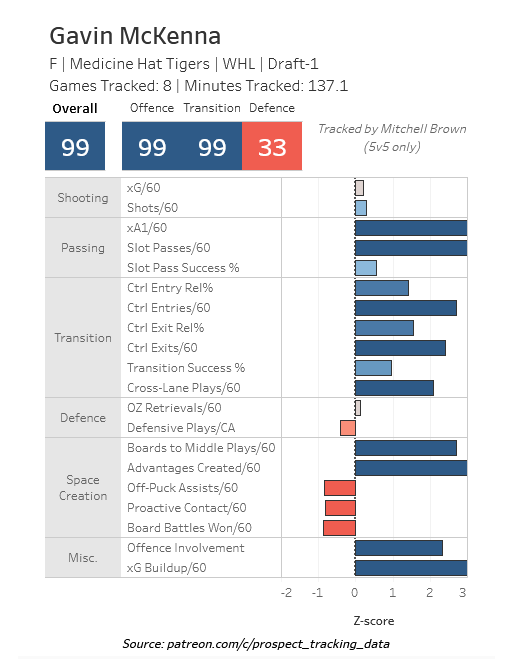
McKenna has been the forecasted first overall pick for the 2026 NHL draft for the past three years. He was in consideration to be given exceptional status to play in the WHL early, but was surprisingly not granted it. He played his first games in the WHL as a 15 year old and had 18 points in 16 games. In his first full season he had 97 points in 61 games as a 16 year old. He followed that with 129 points in 56 games last year, and then 38 points in 17 games as they won the WHL playoffs and lost in the Memorial Cup finals. By comparison, in his comparable D-1 season Mitch Marner had 59 points in 64 games.
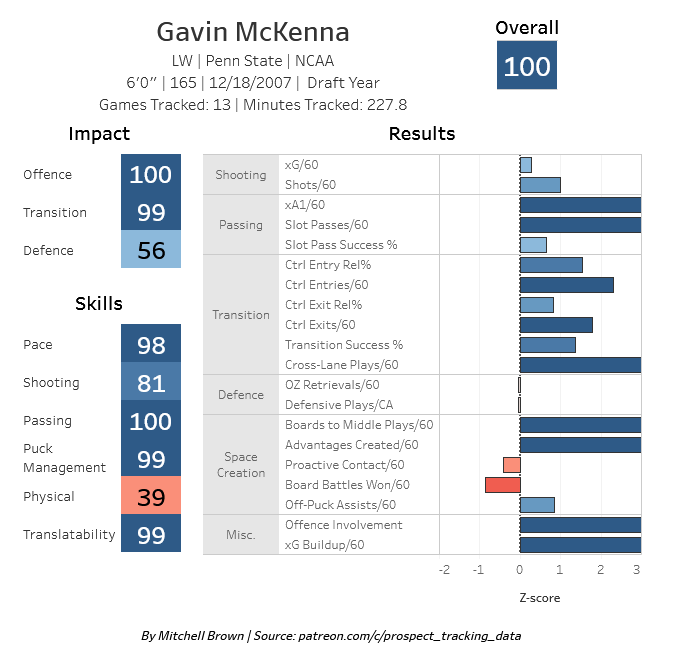
This season, McKenna was the headline star who made the jump to the NCAA under the new rules and committed to Penn State where he put up 51 points in 35 games. In five of those games, McKenna played over 20 minutes, and he had six games where he played more than 25 minutes in a single game. That was good for 5th in the entire NCAA, which is tops for freshmen and almost double the next closest player (Valentini with 27 points).
For reference, here are some of the top prospects drafted out of the NCAA the past few years:
- James Hagens (7th OA) - 47 points in 37 games.
- Macklin Celebrini (1st OA) - 64 points in 38 games.
- Adam Fantilli (3rd OA) - 65 points in 36 games.
- Will Smith (4th OA) - 71 points in 41 games.
- Matty Beniers (2nd OA) - 24 points in 24 games.
- Kent Johnson (5th OA) - 27 points in 26 games.
You can see a range of the types of players they've turned into, and how effective they've been transitioning to the NHL. Only two of them (Celebrini and Fantilli) immediately joined the NHL after being drafted.
For McKenna, leading into the World Juniors is the peak period when people were more seriously questioning if he was actually the best and top ranked prospect in this year's draft, while Stenberg was winning gold with Sweden at the World Juniors and looking great playing against pros in the SHL. But this stretch to finish the NCAA season is when McKenna locked that spot back up. He turned into an utter demon as a dominant offensive force after the World Juniors:
- Pre-World Juniors – 4 goals, 18 points, 3.7 shots per game in 16 games.
- Post-World Juniors – 11 goals, 33 points, 4.9 shots per game in 19 games.
On the international side of things, McKenna played in his first major tournament for Canada at the end of the 2023/24 season when he led Canada at the World U18s championship with 10 goals and 20 points in just 7 games as a 15 year old. Next season, only a few months after that actually, he played at the Hlinka Gretzky and wore an "A" and had 6 points in 5 games. Later that same season he was at the World Juniors for the first time, but had only 1 point (a goal) in 5 games as a 16 year old. This past season, he made the World Juniors roster again and had 14 points in just 7 games.
Suffice to say, McKenna has been a top prospect for years by now.
Aside from all of his on-ice stuff, he's had an interesting journey off the ice to get where he is as a member of the Trʼondëk Hwëchʼin First Nation in the Yukon. Rather than write a lot of words on it, I'll share this nice video:
THE GOOD: ELITE PLAYMAKING, PROCESSING, PUCK HANDLING, SKATING, TRANSITIONS
This section can almost be made very short because there's not much point writing so many words to describe how incredible he is at the things he's best at.
The thing that gets lauded the most about him is his elite, elite, elite (get ready for me to say this word a lot) ability to process the game in front of him at a ridiculously fast speed. I've said before that being able to play at a high pace isn't just about being able to skate fast, it's just as much about how quickly you can process things and make quick decisions. McKenna is the perfect example of this, because he's elite at both. It allows him to identify lanes to attack with his skating or passing and execute high-difficulty plays that only real top prospects can complete with consistency. It helps him a lot as a playmaker, where his elite vision allows him to make a perfect pass for high-danger scoring chances.
What also helps McKenna's playmaking is his ability to handle the puck at an elite level. In tight quarters, he has lightning-quick hands and can control the puck like a wizard to elude defenders, manipulate their reactions, and create space and time for himself. He baits defenders into reaching for the puck with a poke or sweep check before immediately accelerating wide past them, or toe-dragging it past them and into the middle of the ice. That level of deceptive skill, combined with his elite skating and edges work, made him a nightmare to defend in one-on-one scenarios in junior and in college.
Without the puck, McKenna is still an elite threat. That processing he has and his intelligence in general helps him have an instinctive feel for where he should be on the ice, find soft areas in coverage where he can get open in dangerous spots. He times his movements and routes to sneak in behind defenders the moment their backs are turned so he's ready to accept a pass for a great scoring chance. His ability to recognize when his teammates are running out of space and time and where he can position himself to offer an outlet to relieve the pressure and continue the possession is something that surpasses a lot of NHL players, honestly.
Lastly, there's McKenna's ability as an elite transition driver. That processing, skating, puck handling and playmaking makes him a nightmare for defenders in open ice to try and contain him or force a dump in. He attacks with speed, changes his pace, uses fakes and look-offs to keep defenders on their heels because they're afraid of being burned, and then he has the luxury of taking what they give him. If they give him space, he uses it to skate further. If they try and step up on him, he can pass or dangle it past them. His transition execution is highly efficient as a result of all of this.
THE FLAWS: PHYSICALITY, STRENGTH, PERIMETER, JUNIOR-MINDED
Now, let's talk about the flaws, because there are flaws. And not "oh we're just going to nitpick about about how a top elite player only has a 99th percentile shot and not a 100th percentile shot" flaws. Not career sinking flaws either, mind you, just things that did legitimately concern more than a few scouts this season.
The first and most obvious is that McKenna has a real lack of physical strength, and has a real tendency to avoid getting hit. That can make him shy away from board battles or the front of the net – not all the time, but often enough that it's been noted. When he is in the thick of an in-close scrum, he'll engage passively with his stick rather than using his body to seal off opponents and give them an easy way out if they control the puck. This lack of strength caps his ability to create and turn defensive wins into offensive transitions.
Until McKenna builds more muscle and weight, and gains a greater mental willingness necessary to withstand heavy contact, he will remain reliant on others to do the heavy lifting in the corners and be more of a perimeter player. In the NHL that could ruin his ability to be a scoring threat despite having a good shot, since most of them will be coming from further away from being a high danger scoring chance against the best goalies in the world. At its worst this season, he would hunt for space along the outside of the offensive zone, waiting for a lane to open up rather than driving the middle to force the issue himself. He has the skating and puck handling to get to the middle of the ice, it's a question of whether he can do it at a consistent level in the NHL. It's also the one thing that would make me think it's still better for him to return for one more year of NCAA before coming to the NHL, so he has that time to add more muscle and work on driving to those dangerous areas.
This is why a lot of scouts have referred to him as having a "junior mindset" during play this season. Things like flying the zone early to cheat for offense, being flat footed and falling behind on defensive transitions, trying to rely solely on his skill to beat defenses on his own, things like that. It will drive some coaches crazy until he fixes it. Now, the one thing I will say is that a lot of those same scouts will all agree that he was a lot better with this kind of thing after the World Juniors, when he returned to the NCAA on a mission with greater motivation and commitment to taking his game to another level. It still wasn't all perfect, but it was a definite improvement.
OVERALL ASSESSMENT
Okay, one note I want to make is that we need to make "Whitehorse Wizard" a nickname that sticks because that's awesome.
So the big debate around McKenna all season has been that tension between his obvious skill and the concern about his lack of pro habits and how that could hurt his projection. For all that elite processing, play making, skill, transitions, and all that great stuff, there was a question of whether or not it would still be elite once he got to the NHL, considering those flaws I mentioned. And if you're worried about that, would you really want to take him first overall? Wouldn't you want more of a sure thing?
Well, there's two issues with that. First, that's just the nature of the top of this year's draft. He may have his flaws, but so does Stenberg or anyone else you may have seen talk about being a potential first overall prospect in their place. Second, McKenna really did work hard and showed an improved level of defensive engagement, commitment to not being such a perimeter player, etc. He has transitioned from a player who occasionally cheated for offense like he still carried an infection from junior hockey, to one who actively gets back hard on the backcheck and use his procession and hands to be disruptive.
Do I still have some concerns? Yes, I do. But I do still think he is by far the most purely skilled player in the draft this year, and will likely be considered the overall best player after a few years. But since a lot of this is going to come down to people debating between McKenna and Stenberg, I'll share this video that someone else posted in a recent FTB that makes for an interesting discussion:
Thanks for reading!
I put a lot of work into my prospect articles here, both for the draft and Toronto's prospects. I do it as a fun hobby for me, and I'd probably do it in some capacity even if PPP completely ceased to exist. But if you like reading my work, some support would go a long way! I pay for a few streaming services (CHL, NCAA, USHL, the occasional TSN options for international tournaments that are broadcast) to be able to reliably watch these prospects in good quality streams. I also pay for some prospect-specific resources, such as tracking data and scouting reports from outlets like Elite Prospects, Future Considerations, McKeen's Hockey, The Athletic, and more.
Being able to get paid for this helps me dedicate more time and resources to it, rather than to second/third jobs. And whatever money I make here, a lot of I reinvest back into my prospect work through in those streaming and scouting services. Like I said, I'd be doing whatever I can afford for this anyway, so any financial help I get through this is greatly appreciated!


Comment Navigation & Markdown
Navigation
cc to focus on comments section
c next comment
x previous comment
z next unread comment
Inline Styles
Bold: **Text**
Italics: *Text*
Both: ***Text***
Strikethrough: ~~Text~~
Code: `Text` used as sarcasm font at PPP
Spoiler: !!Text!!