

Ryabykin might be the most "out there" player I'm writing a full profile on. When I was picking the final defenseman to get the full write up treatment, I also debated guys like Luke Schairer from the US NTDP, the 6'8" monster Maksim Sokolovskii who played on the London Knights, the Norwegian Axel Brøngel-Larsson playing in Sweden, and Ben Macbeath from Calgary in the WHL. All of them have more hype going for them for different reasons.
Instead, I'm picking a young Russian who wasn't even listed by NHL Central Scouting, and they include hundreds of players. In fact, only three public scouting outlets that I've seen have ranked him at all.
THE BASICS: STATS AND CONTEXT
- Position: Left-shot defenseman
- League(s): MHL
- Height: 6'1"
- Weight: 181 lbs
- Birthdate: Jul 8, 2008
Here are his draft rankings, as of writing this:
- TSN NHL Scout Poll: Not ranked
- Cam Robinson NHL Scout Poll: Not ranked
- Corey Pronman: Not ranked
- Will Scouch: 64th
- Elite Prospects: 93rd
- Scott Wheeler: Not ranked
- McKeen's Hockey: 89th
- Upside Hockey: Not ranked
- NHL Central Scouting: Not ranked
Ryabykin is at the high end of average in terms of size, and has a younger birthday in July. He played on a very good Dynamo Moskva team that had the second best record in the regular season. They were particularly deep on defense, with two 19 year old, 6'4" defensemen drafted by Carolina in back-to-back years who both played 23+ minutes per game.
Ryabkin, on the other hand, was 2-3 years younger than the two, but he averaged the third highest ice time per game at 19:34 in the regular season, and then 20:11 in the playoffs. On a weird roster that had ONLY left-shot defensemen out of the 13 total defenders who were on their roster at any point last season, Ryabykin wound up getting used a good amount – including the playoffs – on the right side.
In terms of his production, Ryabykin's 19 points in 48 games was tied for the third most in the MHL for U18 defensemen. He was also third on the team's defense in points, behind the two aforementioned NHL draft picks (Kurban Limatov and Timur Kol). He was deployed as an all situations minutes-eater with solid two-way impacts for the league. He got occasional time on the powerplay for their second unit during periods when either Kol or Limatov were not in the lineup. He got a lot more time on the penalty kill as a regular on their top two units.
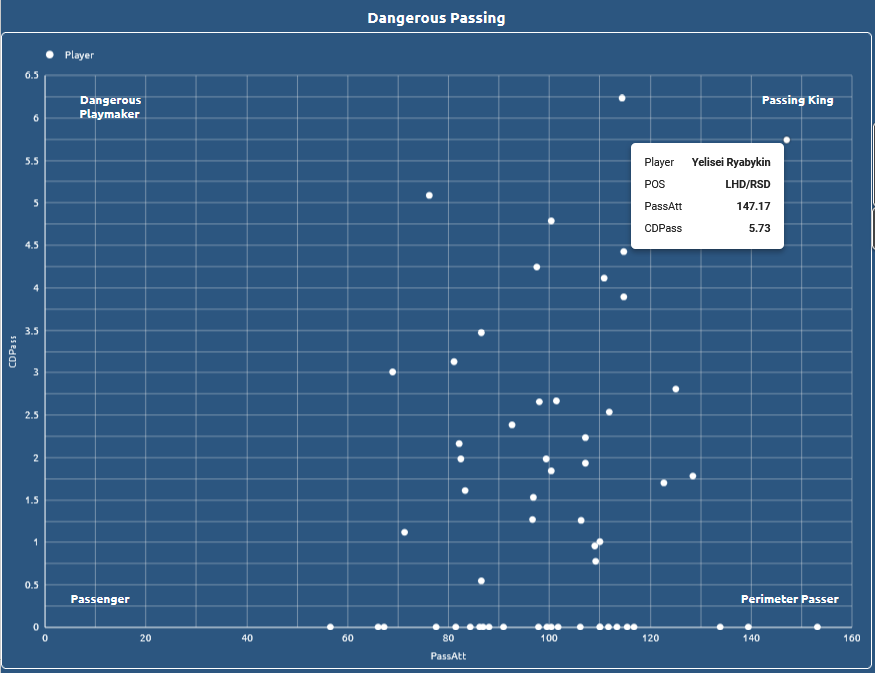
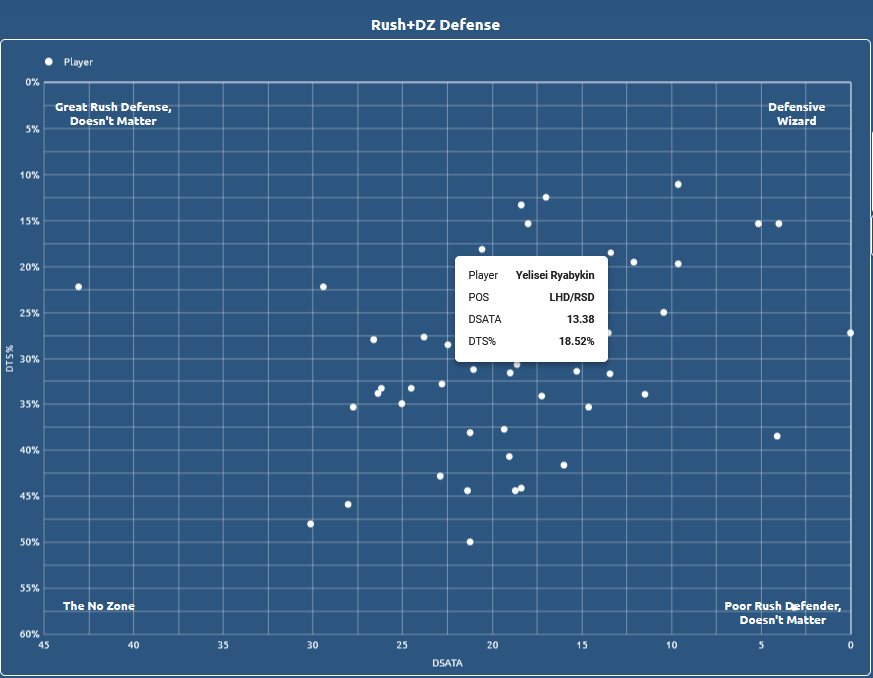
Ryabykin's tracking data also rates out as very strong, whether I look at it from Will Scouch, Neutral Zone, or Elite Prospects. You can see some visualizations I shared from Scouching, where he rates out as one of the top tracked defensemen in terms of his passing ability (attempted and completed dangerous passes) and his combined rush and in-zone defense. Per Neutral Zone, he completes 91% of all his passes and wins 66% of the puck battles he engaged in, though again keep in mind that's all against Russian junior competition.
THE GOOD: MOBILITY, MOTOR, DRIVING OFFENSIVE AND DEFENSIVE TRANSITIONS
That tracking data touches on the strengths of Ryabykin's game. Honestly, he's one of those jack-of-all-trades, but master of none kind of guys. He has a solid mix of decent size (though he can hopefully grow both taller and fill out stronger), puck moving ability, defensive efficiency, and high-level of mobility and relentless motor.
What excites me the most about Ryabykin is his abilities as a puck mover, and a mover in general. He is a highly efficient passer and is a high level puck retriever on dump ins. He uses shifty skating and feints to elude forecheckers and makes good and quick passes to move it up the ice at a high pace. He's a capable passer not just from his forehand, but can make deft slip and saucer passes from his backhand as well. He's reliable while handling the puck too, doing a good job of protecting it and not turning it over very often.
As a mover in general, Ryabykin plays with endless energy, which he needs to play so much in all situations. His feet are always moving and he is relentless in battling along the boards, shutting down transitions to defend his blueline, and pursuing dump ins so he can transition the puck back up the ice. He isn't really an elite skater in terms of his mobility, but he's at a good level with his motor providing the rest.
Defensively, Ryabykin is good at both defending the rush and defending in his own end against sustained possessions. He has a good stick for deflecting passes, poking it away to create a turnover, and luring puck carriers to the outside. His mobility and aggression allows him to maintain an aggressive gap to shut down puck carriers before they can cross the blue line, and he is one of the more efficient defenders in the draft in terms of succeeding in forcing a turnover or dump in. And when it is dumped in behind him, he's one of the more efficient defenders in successfully retrieving it and transitioning it back out of his own end.
Yelisei Ryabykin (#16 in white and blue) - Highlights
THE FLAWS: OFFENSIVE DECISION MAKING, STRENGTH, POSITIONAL CONSISTENCY
As a kind of jack of all trades guy with no glaring weakness, Ryabykin's biggest flaw is that he doesn't have a real major strength. He's not elite offensively, even if he's an efficient passer and puck mover. He's more of a facilitator, which I honestly tend to like as much as a defenseman who can turn his skills with the puck into more points.
Offensively I can see some potential, and Ryabykin sure does like to activate from the point or jump into a rush. But his success rate and overall impact in these attempts is inconsistent. I tend to like his plays made along the blueline to keep the puck moving from there better, considering his dangerous pass rate is pretty good.
My issue is that the style of play Ryabykin has offensively isn't something that you see in the NHL very much, whether because of a stylistic choice by coaches or because it just doesn't succeed at that the top level I can't say. I tend to not mind very much if a guy tries more risky things in junior at this age to learn what they can and cannot get away with, and it helps them practice skill plays during actual games against real-time pressure and space. The problem for him in this area is that he doesn't have a lot of high level skill to pull off most of his attempts, at least not yet.
Otherwise, the things Ryabykin needs to work on the most is to refine his decision making more. Right now he plays a very high risk style with and without the puck, and that works for him with a good success rate in the MHL. The problem is... it's the MHL, so all that tells me is he has enough skill to make it work in a weaker league.
OVERALL ASSESSMENT
All of that said, one thing I've started doing more in these profiles is talking about how much a player improved over the season. At this age, any player who takes big leaps is someone I value more than someone who started about as good as they finished, even if they wound up roughly as good. In Ryabykin's case, he made some very important improvements that, if taken as hints for how he will develop further in the future, are meaningful to me.
Ryabykin's biggest area of improvement is cutting down on turnovers when dealing with pressure from the forecheck. By the end of the season he dealt with it more calmly and executed his dekes and/or passes to complete a successful zone exit with efficiency. In fact, he improved a lot in his transition game as a whole. He was much better at making himself aware of people's positions by scanning and shoulder checking to plan his moves, then made quick touch passes with efficient accuracy. As coaches love to say, the puck can be passed faster than a player can carry it themselves. Considering how much I value this specifically as a skill I want defensemen to be good at, that's a great sign for me.
The other areas Ryabykin improved the most are in his edges and explosiveness, and how those specific elements of mobility helped unlock his passing game. They helped him create more time and space for himself so he could avoid pressure and have an easier time making a play. He could better elude checkers and create separation with the explosiveness in his acceleration. And being more mobile is never a bad thing, especially for defensemen.
The final area for Ryabykin's improvement was in his more offensive playmaking and both the volume and efficiency of scoring chances he helped generate. He was more of an offensive non-factor to start the year, but by the end he was completing passes into the slot for dangerous scoring chances at one of the highest rates of any defenseman in this year's draft class (with the caveat of the league he played in).
If a defenseman is going to be good offensively in a way that I will care about, it's doing exactly this. I don't care about defensemen who have a big shot or who score a lot of goals in junior by activating off the point and scoring in close with pure skill, those are the very last things I would care about having in a defenseman. I'm thinking of what Cathy has been preaching for a while about how good offensive forwards are simply much better at being offensively skilled than good offensive defensemen. So what I want for a good offensive defenseman is a guy who can get those skilled forwards the puck in dangerous areas so they have more and better opportunities to do damage.
So, overall, what we're looking at Ryabykin is a young defensemen who is raw but has no glaring weaknesses. He shows a lot of promise as a potential two-way defenseman who can potentially do a good job on both special teams and eat minutes reliably at even strength. The ceiling on his skill means he may not be an NHLer at all, and if he does it would likely be in more of a depth role. But for me, considering the area of the draft where he is likely to be available (mid to late rounds), I see him as one of the more interesting players you could take.
Thanks for reading!
I put a lot of work into my prospect articles here, both for the draft and Toronto's prospects. I do it as a fun hobby for me, and I'd probably do it in some capacity even if PPP completely ceased to exist. But if you like reading my work, some support would go a long way! I pay for a few streaming services (CHL, NCAA, USHL, the occasional TSN options for international tournaments that are broadcast) to be able to reliably watch these prospects in good quality streams. I also pay for some prospect-specific resources, such as tracking data and scouting reports from outlets like Elite Prospects, Future Considerations, McKeen's Hockey, The Athletic, and more.
Being able to get paid for this helps me dedicate more time and resources to it, rather than to second/third jobs. And whatever money I make here, a lot of I reinvest back into my prospect work through in those streaming and scouting services. Like I said, I'd be doing whatever I can afford for this anyway, so any financial help I get through this is greatly appreciated!


Comment Navigation & Markdown
Navigation
cc to focus on comments section
c next comment
x previous comment
z next unread comment
Inline Styles
Bold: **Text**
Italics: *Text*
Both: ***Text***
Strikethrough: ~~Text~~
Code: `Text` used as sarcasm font at PPP
Spoiler: !!Text!!