

So... Brek Liske.
THE BASICS: STATS AND CONTEXT
- Position: Right-shot defenseman
- League(s): WHL
- Height: 6'1"
- Weight: 190 lbs
- Birthdate: Jan 9, 2008
Here are his draft rankings, as of writing this:
- TSN NHL Scout Poll: Not ranked
- Cam Robinson NHL Scout Poll: Not ranked
- Corey Pronman: 78th
- Will Scouch: 41st
- Elite Prospects: 45th
- Scott Wheeler: 82nd
- McKeen's Hockey: Not ranked
- Upside Hockey: 90th
- NHL Central Scouting: 44th (North American skaters)
Liske was a 10th overall pick back in the 2023 WHL draft by Everett, who have been one of the best junior programs in the CHL in that time. He was playing in a top league that had several of the top defensemen coming out of the WHL this and next year: Daxon Rudolph, Keaton Verhoeff, Ryan Lin, Gioros Pantelas, Carson Carels, Ben Macbeath, and Landon Dupont. Among all of those, Liske was tied for 9th in points by defensemen – that was behind all of those (some only narrowly) except for Carels.
The next season, Liske played in an U18 program for prospects that had been drafted but weren't old enough to play a full season in the WHL yet. Among that same group of defensemen, he finished 7th in points this time tied with Ryan Lin and ahead of Keaton Verhoeff, Giorgos Pantelas, and Ben Macbeath. So as a defense prospect, Liske was in a group of top defense prospects when it came to point production – that's about as much insight as I can find for that age group in those leagues.
This season, Liske was mostly used on their second pair with next to no time on the powerplay. Like Alexander Bilecki, who I profiled earlier, he played on the best team in the league who won the WHL championship and was runner up in the Memorial Cup to the Kitchener Rangers. On that Everett team was Tarin Smith (20 year old 3rd round pick by Anaheim in 2024) and uber prospect Landon DuPont who was given exceptional status, has two point per game seasons under his belt before he turned 17, and is the consensus favourite to be the first overall pick next year. So whatever point production (24 in 52 games) and impacts Liske had came ethically sourced at even strength and on the penalty kill.
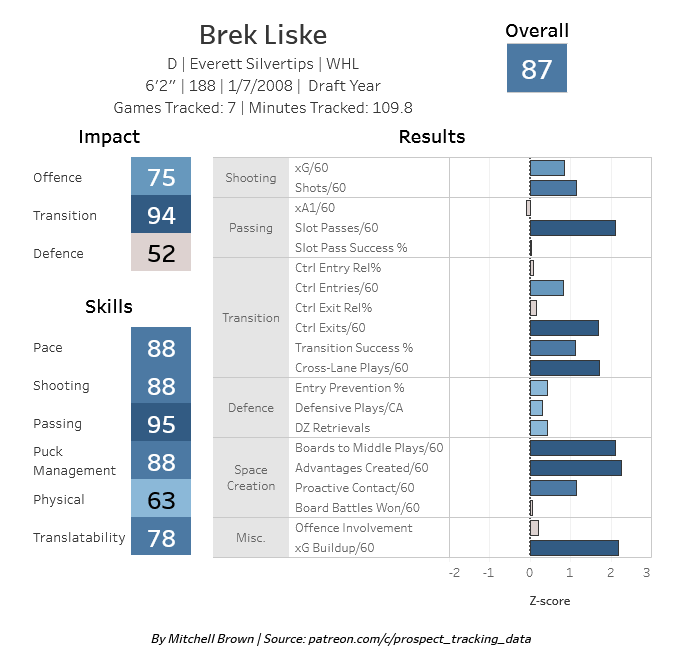
That is, until the playoffs came around. After only four games, Tarin Smith went down with an injury and his season was over. Liske got the bump up to the top pairing with Landon DuPont, and did get a big of secondary powerplay time as well. On their run to the WHL championship, Liske finished only behind DuPont in points – he had 17 in 18 games, and led the team in plus-minus with a +25. Only two of his 17 points were on the powerplay. At the Memorial Cup, Liske was held pointless in their 5 games but was third among the defensemen in plus-minus at +3 which also led his team.
The funny thing is, despite Liske's point totals in the playoff run when given a bigger opportunity, and what his tracking data above looks like, the fact of the matter is that his projected potential is more about his defense and two-way impact.
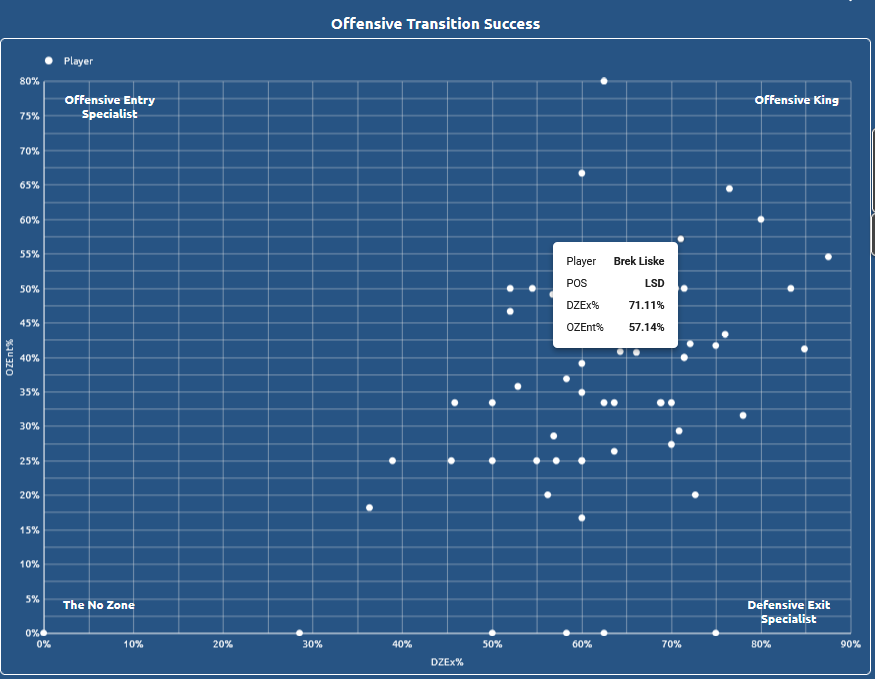
THE GOOD: RETRIEVALS, DEFENSIVE INTELLIGENCE, TWO-WAY POTENTIAL
I should be known by now for being... shall we say, apathetic towards point production by defensemen. But that doesn't mean I don't like defensemen who can have a good impact on the offense. I just don't think that points are a very good way to measure 'good offensive impact'. I like the kinds of things that Liske seems to be good (but not elite) at.
It starts with his impact on transitions. I count it as a defensive skill, but it has an undeniable impact on the offense as well. Liske is very calm when retrieving dump ins, even when dealing with aggressive and heavy forechecking. He has a good awareness of where people are on the ice as he skates back to get to the puck first, so he knows where his relief valves are and where and how fast the forecheckers are coming from. He then uses a mix of feints, fakes, pivots and dekes to escape pressure and get enough time and space to make the first pass to a teammate to exit the zone and kick start the rush. He isn't an elite puck handler, or an elite skater, but he is elusive and smart enough to be a highly effective transition driver.
When in the offensive zone, Liske is not a play finisher that will be a big point producer at the pro level. What he is good at is being an offensive support, a general or quarterback at the blueline. He creeps down to the top of the faceoff circle to become a closer threat. He sneaks into open space on the weak side as a cross-ice passing option, and if no one picks him up he times creeping in further to be a back door target. Above all, he is an intelligent and capable passer and puck mover. He knows where to position himself to be the best possible passing target to relieve the forwards if they're facing heavy defensive pressure on the cycle.
OH THAT’S PRETTY! 😮💨#NHLDraft eligible prospect Brek Liske puts on the moves and nets his 3rd of the postseason! @WHLsilvertips | #WHLPlayoffs | #FeedingTheFuture
— Western Hockey League (@TheWHL) April 16, 2026
📺| @victoryplustv
🔗| https://t.co/ejuFny1mnK pic.twitter.com/QF9P5hG99B
When it comes to Liske's defense, he is more of a cerebral and mobile defenseman who relies on elite positioning and suffocating gap control to suppress the offense. He gets rave reviews for having a very high 'hockey IQ' with proactive scanning habits and high awareness, allowing him to read plays before they develop and position himself where he needs to be. When defending the rush, Liske is a smooth backwards skater and uses good positioning to angle the puck carrier so take away the middle of the ice. Once he has them cornered towards the boards, he can time his good stick to poke the puck away or and force predictable dump-ins he or his partner can then retrieve to start the transition to offense.
When he's defending in his own end, Liske has a good size at 6'2" and 190 lbs and plays with a good, consistent motor along the boards and other dirty areas on the ice. His mobility and keeping his feet moving allows him to match his man step for step, and leverage his size to pin them against the boards to shut down their ability to create any offensive chances. In front of his own net, he is surprisingly aggressively at protecting the front of the crease to push away potential screeners, but also has well timed stick lifts and pokes to prevent any pass into the slot from turning into a dangerous shot.
Brek Liske unleashes the spin cycle for the game winning goal! 🏆
— Western Hockey League (@TheWHL) May 16, 2026
Remember that name 😤@whlsilvertips | #WHLChampionship | #FeedingTheFuture | #WHLHoN | #NHLDraft pic.twitter.com/n3NsVs7sZt
THE FLAWS: LACK OF EXPLOSIVENESS, QUESTIONABLE CEILING
The biggest problem that Liske has as a prospect is that he doesn't have any major, elite standout-tool. That's why I bumped him down from originally writing him as a second round option. He projects as a solid all-around defenseman, but the lack of really high end tools make me question his projection more than some of the other defensemen I profiled for the second or third round.
For me, the biggest limitation that Liske has is in his athleticism – specifically, his lack of explosive acceleration and high end, north-south speed. They make me concerned that he wouldn't be able to keep pace with the opposition he'll face in the pro levels as well as he does in junior. His positioning and anticipation help him play against higher paces than he can manage with his athletic mobility alone, but that's in junior and he can already get beat by elite-speed. He'll need to work on improving those areas over the next few years. Thankfully, I think it's something that's relatively easy for a guy his age to do up to a certain point.
Liske has a similar issue when it comes to his offensive and transition skills. He is not an elite puck handler or skater, though when it comes to mobility his biggest strength is definitely his agility and elusiveness. He has some mechanical issues in handling the puck in terms of his posture and hand positioning. I don't care about this in the offensive zone, but it does matter a lot more to me when it comes to being able to elude pro level forecheckers so he can drive high rates and efficiency levels of zone exits.
Otherwise, while Liske definitely has the brain to be a high level hockey player, the question around him will be if he has the tools (outside of his size, which isn't nothing) to make it as a pro. He can get the most of whatever level of tools he has thanks to his brain, so every little increment of improvement he can achieve will go a long way for him.
OVERALL ASSESSMENT
I'll fully admit that, as a defense prospect, Liske is pretty bland. He's the oatmeal of defense prospects. Tastes plain on its own, but damn does it have some very useful foundational elements in the nutrition that can help the heart of your hockey team.
Liske did help himself by adding a bit of spice to his game down the stretch, in the form of brown sugar, cinnamon and/or maple syrup that represents playing with a harder physical edge to his defense. Okay I've worn that metaphor out well and truly. Point is, he started playing more proactively with a higher level of execution and consistency, playing a more suffocating and punishing kind of defense. He also improved his breakout efficiency by adding a bit more dynamic skating to help elude forecheckers better.
More than anything, what impressed me is that Liske became a top pairing, all situations leader for the team on their WHL championship run. Their top all around defenseman, Tarin Smith, was hurt after the very easy first round. Even with DuPont being the offensive leader from the blueline, Liske became the calming presence that kept things safe behind him, and he really became a leader for the team even though he himself was only 17 years old... DuPont was even younger!
Even if he feels like a safer, more boring pick than some of the others I've profiled, I think there's something to be said for him having such a solid all-around, two way game as a foundation right now. There are improvements he needs to make, but none of it comes from a place of being huge weaknesses. He only needs to make more incremental changes across the board to his skating, physical play, puck handling, passing, and so on. If he's a safe pick because he has a higher floor, just raise the floor a bit more. Even if he's still a bore at least his defense won't be a chore, and he would be a valuable addition to the Leafs' D-corps.
Thanks for reading!
I put a lot of work into my prospect articles here, both for the draft and Toronto's prospects. I do it as a fun hobby for me, and I'd probably do it in some capacity even if PPP completely ceased to exist. But if you like reading my work, some support would go a long way! I pay for a few streaming services (CHL, NCAA, USHL, the occasional TSN options for international tournaments that are broadcast) to be able to reliably watch these prospects in good quality streams. I also pay for some prospect-specific resources, such as tracking data and scouting reports from outlets like Elite Prospects, Future Considerations, McKeen's Hockey, The Athletic, and more.
Being able to get paid for this helps me dedicate more time and resources to it, rather than to second/third jobs. And whatever money I make here, a lot of I reinvest back into my prospect work through in those streaming and scouting services. Like I said, I'd be doing whatever I can afford for this anyway, so any financial help I get through this is greatly appreciated!


Comment Navigation & Markdown
Navigation
cc to focus on comments section
c next comment
x previous comment
z next unread comment
Inline Styles
Bold: **Text**
Italics: *Text*
Both: ***Text***
Strikethrough: ~~Text~~
Code: `Text` used as sarcasm font at PPP
Spoiler: !!Text!!