

It's so hard trying to pick out late round players, and especially defensemen. I'm trying to predict a narrow window of players that at least some teams sort of like, but not so much that they'd be taken in the first four rounds. Anyone who stands out with actual interesting skills or tools are more likely to already be gone, so I'm trying to guess at who might slip or who might be off everyone's radar... except Toronto's.
In the similar list I made for last year's draft, six went undrafted and one was drafted before the fifth round. So I was 3/10 for guessing who might be available and taken from the fifth and seventh rounds... which would be great if I were a baseball hitter, but let's see if I can get my hockey average up this year.
For the record, some of these defensemen I'd still be interested with a fourth or even third round pick. These are just guys I think are more likely to be available beyond that, who I think are still good enough to be worth a roll of the dice in the later rounds.
JAYDEN KURTZ
- Position: Right-shot defenseman
- League(s): US High School–Minnesota / USHL
- Height: 6'3"
- Weight: 194 lbs
- Birthdate: Dec 30, 2007
Switching things up a bit, I saw McKeen's and Elite Prospects talking up a couple of American high schoolers that caught my interest. Kurtz has a lot of late helium as a prospect so he might wind up being gone before the late rounds. He started the season in high school where he was in the second tier of point producers for defensemen, then moved to the Chicago Steel in the USHL for 16 games where he had 3 points in 16 games. He has a commitment to Wisconsin in the NCAA, which just came off a close loss in the Frozen Four finals. I saw Brock Otten from McKeen's call him a "breakout machine" and, after watching the Leafs the last two years, immediately wrote his name down to include somewhere in my draft profiles!
Kurtz is the prototype of the modern day NHL defender. Great size, right shot. Good mobility. Not exceptionally skilled, but very smart. Breakout machine who can have a profound impact on the transition game. Good defensive IQ too. pic.twitter.com/9qaPz8IJYs
— Brock Otten (@BrockOtten) March 25, 2026
At 6'3" and almost 200 lbs, he has the size that NHL teams will like. He also has above average mobility. He is a very good passer, including launching long-distance feeds way up the ice and crossing the seams through defenders. That is the core of his breakout game, rather than being an elite skating puck carrier. He's also said to be a very smart defender who uses his stick and positioning more than pure physical dominance to kill plays. He also is said to have a heavy shot, but I don't care as much about that. He could be a late round gem that could be an all-situations, two-way minutes eater. The issues with him is his defensive positioning at times can fall apart, especially when things get chaotic. A lot of scouts, unsurprisingly, would love him to be more physical, but I don't necessarily see that as a major knock on him. A bigger concern is that his experience at the more competitive junior level, the USHL, is more limited compared to high school, which is much easier to look good in. That's the main reason why he may still wind up as a mid or late rounder at best. But I like him a lot for that range.
ALEXANDER IVANOV
- Position: Left-shot defenseman
- League(s): VHL / KHL
- Height: 6'2"
- Weight: 181 lbs
- Birthdate: Jun 10, 2008
Ivanov's strengths and style of play are seem very tailored for pro hockey. As evidence of that, he didn't play a single junior game all year despite being on the younger side with a June birthday. He played 36 games in the VHL, where he had three points. He also played 7 games in the KHL and had no points. His pro-readiness is built around having solid mobility, an advanced defensive game in terms of anticipating play, good positioning, and solid fundamentals for boxing out the front of the net and defending against the rush. And while his transitions are more basic, they are effective. He can carry it well if needed and make simple outlet passes – in fact his passing rate and completion percentages are on the higher end even though he played above junior all season.
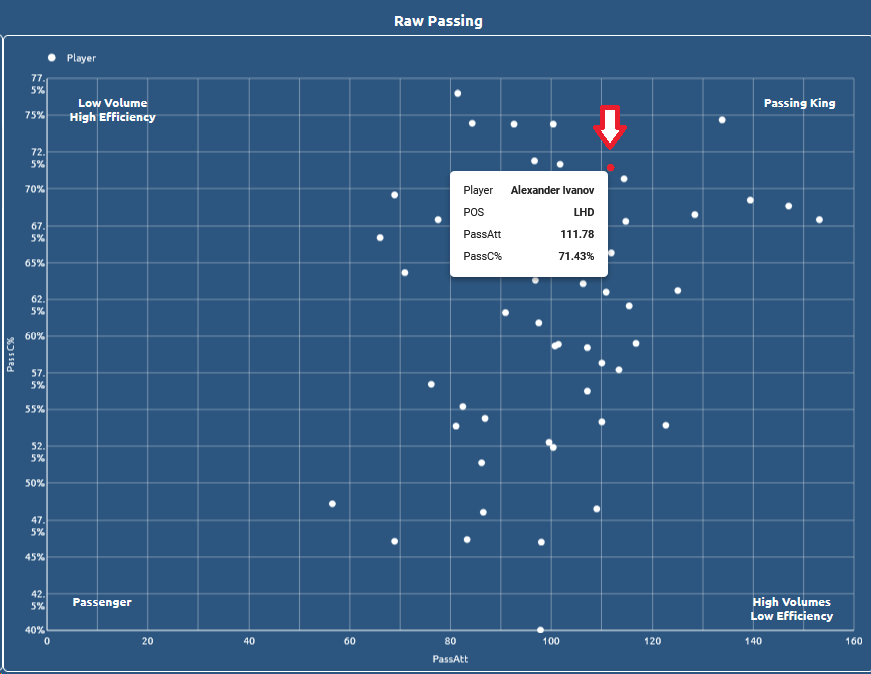
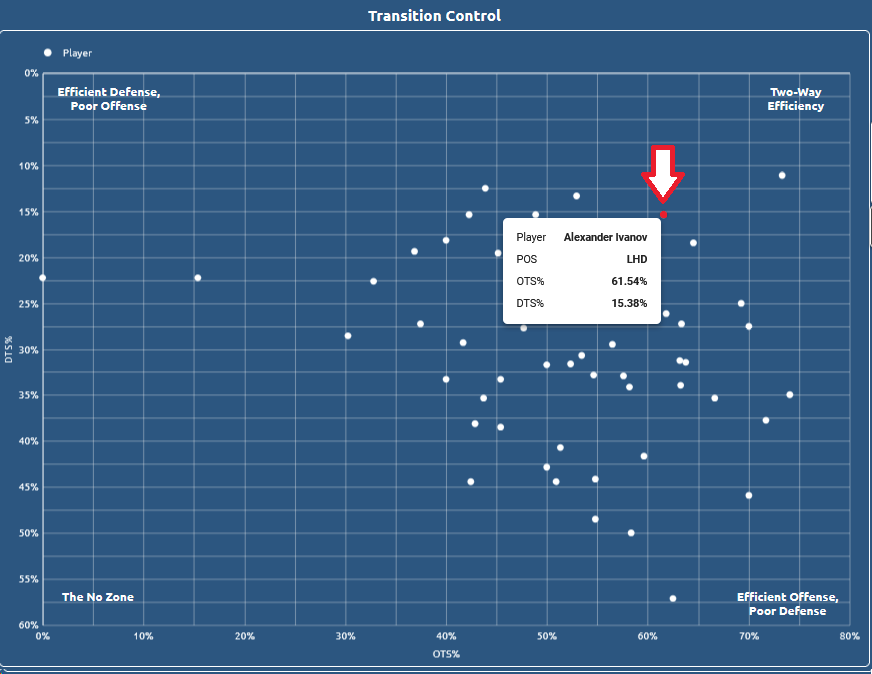
The issues for his projection as a prospect are around the fact he doesn't really have standout tools. He's got a bit of size but its not overwhelming. He is mobile but it's not elite. He can move the puck okay but he isn't a great passed or puck handler, and his offensive impacts seem like they'll be more limited. He's someone whose defensive skill comes from knowing how to play within a strict system, which is great because that's something valuable for a potential NHLer, but not great because it means he's very rigid in how he defends. It's not necessarily coming from being a smart or instinctual defender – in fact, in his tracking data his success defending against transitions doesn't come from being physical or having a good stick, it's mostly from just having good positioning. Again, not inherently a bad thing, but illustrative for who he is as a player. More importantly for me, he is one of the better two-way defensemen when it comes to driving offensive transitions and defending them.
VERTTI SVENSK
- Position: Left-shot defenseman
- League(s): Liiga
- Height: 6'1"
- Weight: 168 lbs
- Birthdate: Nov 09, 2007
Svensk has decent height (6'1") but is too light at only 168 lbs. However, he is an extremely mobile skater and uses that heavily in his defensive and offensive game. He activates into the offense aggressively at times but can get back on defense. I've seen a few scouts praise his confidence with the puck, which he is also very skilled at. The combination allowed him to dominate junior, where he had 31 points in 33 games in Finland's U20 league, and earned 18 games in the Liiga. There are some scouts who have him high in the second round, borderline in the first. But others don't even have him ranked at all.
A great end-to-end rush from Vertti Svensk (#2026NHLDraft) in Finland's 4-2 win over Czechia in yesterday's U18 Five Nations action.
— Lassi Alanen (@lassialanen) February 8, 2025
His skating has stood out across the first two games of the tournament. pic.twitter.com/L6FGvGSxNE
The biggest reasons I've seen given from those who aren't as high on Svensk is his decision making and average size. Particularly when he was playing on his Liiga squad, he struggled at times to deal with the pace and pressure of professional forecheckers which led to more turnovers than you'd like. And as I mentioned for Klimpke, average sized defensemen who are skinny is not an archetype that most NHL teams will go for unless they have overwhelming skill. Svensk is fun to watch, but he is not at an elite level. But for a late round gamble...?
ALEXIS FORTIN
- Position: Left-shot defenseman
- League(s): QMJHL
- Height: 6'4"
- Weight: 220 lbs
- Birthdate: Oct 4, 2007
I've said it many times and I'll say it many more. I won't consider someone to be a good "defensive defenseman" if they can't at least move the puck at an adequate level. If you can't get the puck out of your end so you're always stuck on defense, how can you be considered to be defensively good? Fortin is a good example of a guy who I think has the potential to be a good defensive defenseman in that regard. He's big, he plays in the QMJHL where he had 9 points in 63 games for the regular season and then 3 points in 9 playoff games. He gets good reviews from scouts for using his physical advantages smartly, and has good vision and awareness to know where people are on the ice and adjust his position accordingly. So even if he doesn't have elite speed and mobility, he can be where he needs to be to defend. Most importantly, he can deal with forechecking pressure in his own zone to make good, accurate exit passes and drive breakouts at a good level.
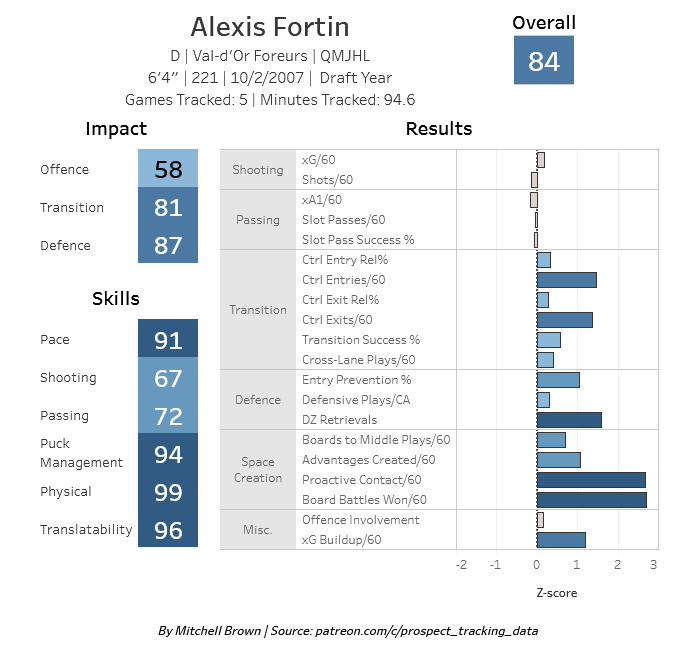
The big question marks around Fortin are around his explosiveness, moments of passiveness or hesitancy on defense, and his ability to execute on offensive playmaking. For the explosiveness, his positioning and awareness covers his slow acceleration to get up to speed. Otherwise, he'd already be considered to have NHL-level mobility. For his passiveness, the issue is he sometimes seems to forget he can just erase guys or pin them on the boards and outmuscle them there and focuses too much on trying to tie up sticks. And for the offensive execution, it's kind of weird because he's good on passing for breakouts, but outside of that his accuracy is much less consistent. That may be why he slips to the later rounds but I wouldn't be surprised if someone takes him in the middle rounds.
OLA PALME
- Position: Left-shot defenseman
- League(s): U20 Nationell
- Height: 6'2"
- Weight: 201 lbs
- Birthdate: Feb 9, 2008
Palme is a lesser-known defensive prospect out of Sweden this year, but he showed some interesting utility this year a mobile and puck moving defenseman. He played most of the season in Sweden's U20 junior league, where he had 14 points in 20 games. With fewer games played than most, his point per game pace there would have been 3rd in the league for U18 defensemen, right behind second place (Mans Gudmundsson). In the playoffs he had 8 points in only 5 games, good for 2nd for U18 defensemen and 9th overall. His per game pace in the playoffs was tops for all defensemen.
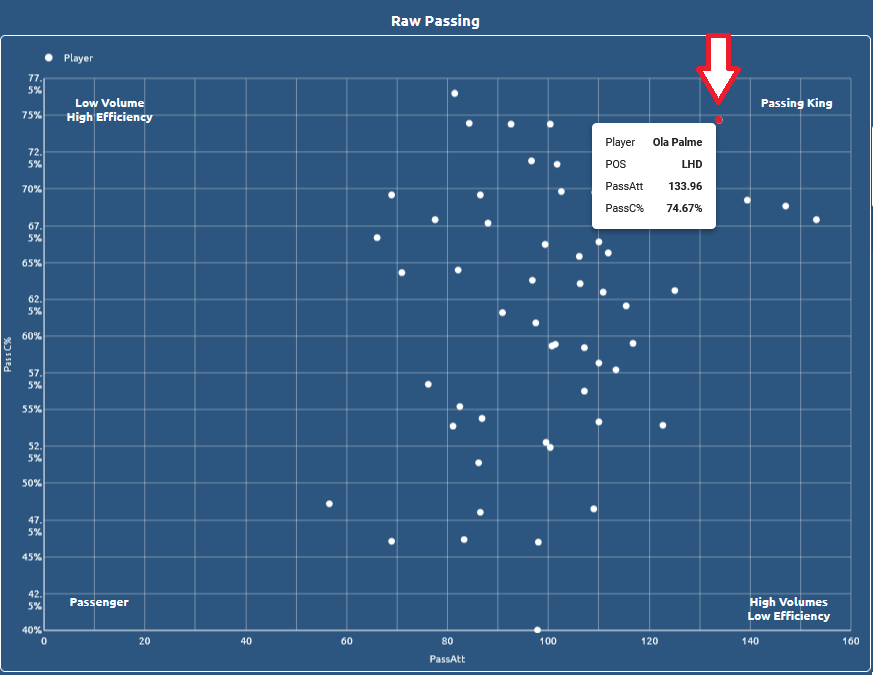
Palme's strength is as a puck mover. He showcased elite passing rates in his tracked data per Will Scouch, in terms of volume, accuracy, and creating high danger scoring chances. He is reliable and patient with the puck so he doesn't turn it over in a panic. He has very smooth and fluid skating mechanics, and while his speed and agility isn't elite it seems above average. It helps him manage the blueline in the offensive zone, and to jump into the play to help out offensively. Defensively, he isn't bad but could improve his rush defense by managing a tighter gap, and by asserting himself more physically in his own zone. He just feels like a more prototypically "modern" puck moving defenseman. He'd be a longer term project but he foundation he has with his current strengths are enticing for a later round pick.
THEODOR KNIGHTS
- Position: Right-shot defenseman
- League(s): U20 Nationell
- Height: 6'4"
- Weight: 207 lbs
- Birthdate: Apr 16, 2008
The reason why Knights would make for an interesting late round pick is because he's big, physical, aggressive, and has great mobility. That makes him an ideal pick if you're looking for someone to become a depth defenseman who can neutralize offense and kill penalties. He's fast and explosive, and with his size and reach he can really suffocate puck carriers and create turnovers. I've seen scouts say that his projection is as a pure shutdown defenseman and a high-level play killer. The question is if he'll actually fall to the later rounds, or if a team who loves that type of defenseman gambles on him earlier than that?
Theodor Knights ties it up with his first goal of the tournament!
— TSN (@TSN_Sports) August 16, 2025
It's 2-2 just 7 minutes into the Gold Medal Game.#HlinkaGretzky pic.twitter.com/ofM86AGzC6
For me, there are good reasons why I wouldn't take Knights until the fifth or sixth rounds. As you'd expect from a young, big and physical defenseman, his discipline is inconsistent and he can take some bad, dumb penalties. He also really does seem like a null factor with the puck, with only a few points this season playing in junior. I did say (often) that I like a defenseman who can defend well, but I include having the ability to get the puck out of your own end so you don't just always have to defend to be a big part of being good at defense. And that's a concern for Knights. Couple that with the odds of him being able to make it to the NHL just on the defense he has now, and there's no way I'd be betting on him as high as some people rank him. But as a 5th or 6th round guy? I like him.
BRAYDEN KLIMPKE
- Position: Left-shot defenseman
- League(s): WHL
- Height: 6'0"
- Weight: 168 lbs
- Birthdate: Oct 08, 2007
Klimpke is a change of pace from the others on this list so far. His projection as a defenseman lies more on the offensive side of the puck, of which I will include transitions. His 46 points in 68 games for Saskatoon in the WHL was good for 5th among defensemen in his age group. He added 5 points in 11 games for their playoff run. Something to note about his production is that not a lot of it came on the powerplay. He averaged around 25 minutes per game this season, with regularly reaching 28-30+ minutes down the stretch for important games. In junior he's literally an all situations defenseman that was heavily relied on. He killed penalties, ran the powerplay, held leads, pushed for offense during comebacks, the lot.
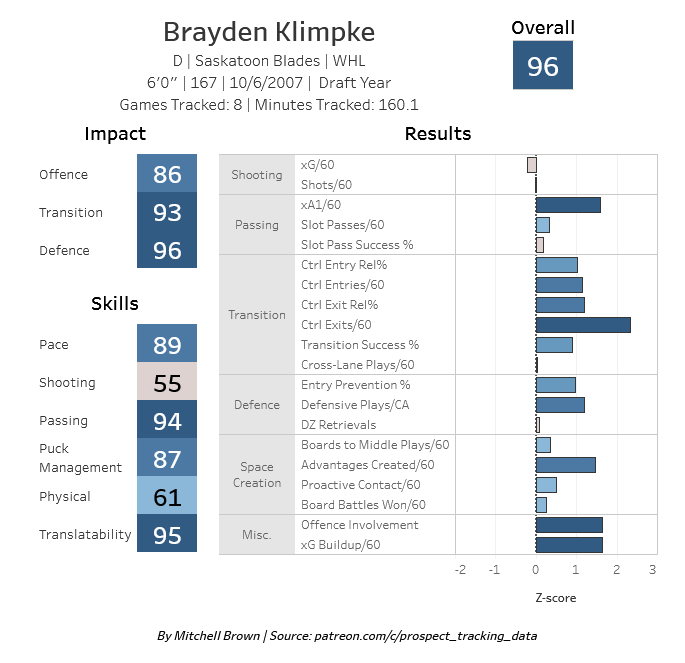
The strengths of Klimpke's game comes with his mobility, rush defense, motor, and two-way potential. He projects to have potentially elite mobility, which helps him be aggressive defending against rushes to disrupt entries with good timing on stick checks. His motor comes from being used heavily in all situations by his coaches, playing 30+ minutes in big games, and from being an absolute dog on the boards. He's a bit undersized now, his height being average and his weight being too light, but he has good strength in his lower body and uses low postures as leverage against bigger opponents to pin bigger opponents on the boards. The issues he faces are projecting him to the NHL when he has good but not spectacular offensive skills and defensive skills while just being an average/slightly below average sized defenseman. Those don't typically project well to the NHL. I still like taking a swing on him in the later rounds because of his mobility, good stickwork, and already showing he has some tricks to still have a physical element when battling with bigger players.
Klimpke lights the fire 🔥 pic.twitter.com/HnPgAaP791
— Saskatoon Blades (@BladesHockey) February 12, 2026
JIRI KAMAS
- Position: Right-shot defenseman
- League(s): WHL
- Height: 6'2"
- Weight: 198 lbs
- Birthdate: Mar 4, 2008
Kamas is a decent sized right-shot defenseman from Czechia who split his season between Penticton before being traded to Red Deer halfway through the season. His point production was similar with both teams, and he had a total of 18 points in 59 combined regular season and playoff games. Penticton had a deep defense group, hence why they saw him as expendable and traded him to beef up for the playoffs. By the end of the year with Red Deer he was a mainstay on their second pair, but earned his way to a regular top pairing guy by the time the playoffs came around. He played for Czechia at the Hlinka, where he had 3 points in 4 games, and was leading Czechia in ice time through three games at the World U18s before a concussion ended his tournament. He got a good amount of time on the penalty kill, and a bit of powerplay usage as well.
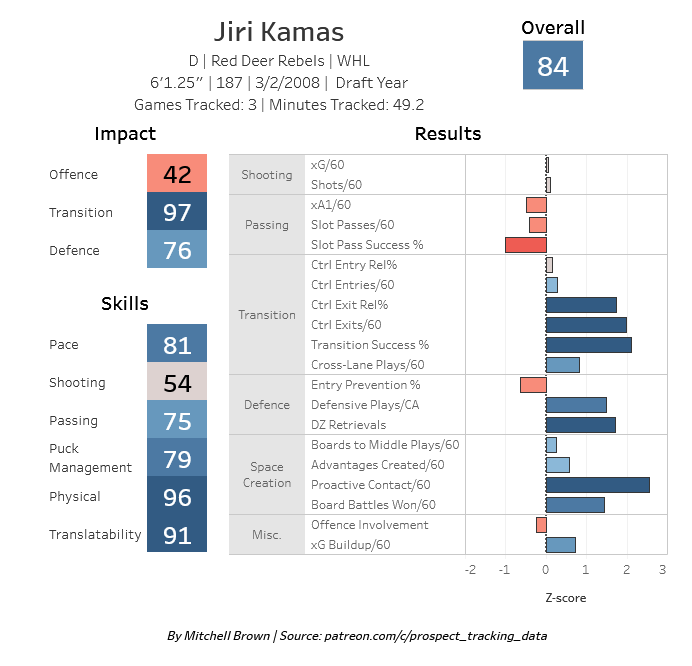
The good parts of Kamas' game is his combination of decent size and having above average four-way mobility – good acceleration, north-south speed, solid edgework for east-west agility, and smooth pivots between forward and reverse skating. That combination helps him a lot in driving excellent defensive results retrieving dump ins and driving transitions. He can retrieve the dump ins, elude forecheckers and/or absorb the initial wave of contact and then make good short/medium length passes to start a clean breakout. He also has very strong transition results through the neutral zone. He has a cannon of a shot from the point, but it's not something he is yet able to use to much effectiveness. The issues with his game has to do with his game seeming more raw and inconsistent, and not having offensive skills outside of driving good transitions – but ask me how much I care about that. He needs time to put on more muscle and refine his skills so he can gain better consistency.
Jiří Kamas se prosazuje jako první střelec osmnáctky a vyrovnává stav utkání!#CZESUI #narodnitym #ceskyhokej pic.twitter.com/6cHhflbsns
— Český hokej (@czehockey) August 11, 2025
BRIAN MCFADDEN
- Position: Right-shot defenseman
- League(s): US High School–Prep
- Height: 6'5"
- Weight: 181 lbs
- Birthdate: Jan 2, 2008
McFadden is another high schooler who, unlike Kurtz, never played in the USHL this year. He's two inches taller and somehow lighter, so he has a lot more physical projection. His play-style is as a big and mobile defensive specialist. He was considered one of the best shutdown defenders, rush defenders, and penalty killers in his high school circuit this past year. This is thanks to his combination of size, reach, and straight line mobility. He plays more of a physical style, which will be helped as he fills out more.
McFadden seems like a real diamond in the rough. Big, mobile, and right shot. Really strong physically at the prep level and I think that projects to higher levels. Not going to be a high end point producer as he moves up the ladder, but has a chance to be a real defensive asset. pic.twitter.com/9SYNBLDggm
— Brock Otten (@BrockOtten) March 25, 2026
The question marks around him are a much weaker set of offensive skills – you should know you're getting a defensive specialist if you draft him, but the worry will be that he isn't as good as you need him to be at getting the puck out of his end when he needs to be that guy. And while his defensive instincts and intelligence are good, his mobility is a concern with his mechanical refinement. That comes out when he has to make sudden pivots or use lateral edges to deal with shiftier forwards. Combine that with the fact that he has no experience outside of high school, and there's more wariness around how good his defense would actually be against tougher competition.
RYLAN SINGH
- Position: Right-shot defenseman
- League(s): OHL
- Height: 6'0"
- Weight: 187 lbs
- Birthdate: Oct 04, 2007
At the start of the year, Hardev asked me about him. I wound up following him and including him here because, for a potential late round pick, he has some potential. He's got average size, but he is a very hard working defender on the ice, has high level mobility and two-way potential. He activates a good amount for a defenseman, and was one of the top rush defenders in the OHL this season. His defense in his own zone was less good, but he was also very successful at driving zone exits to get his team out of danger and onto the attack.
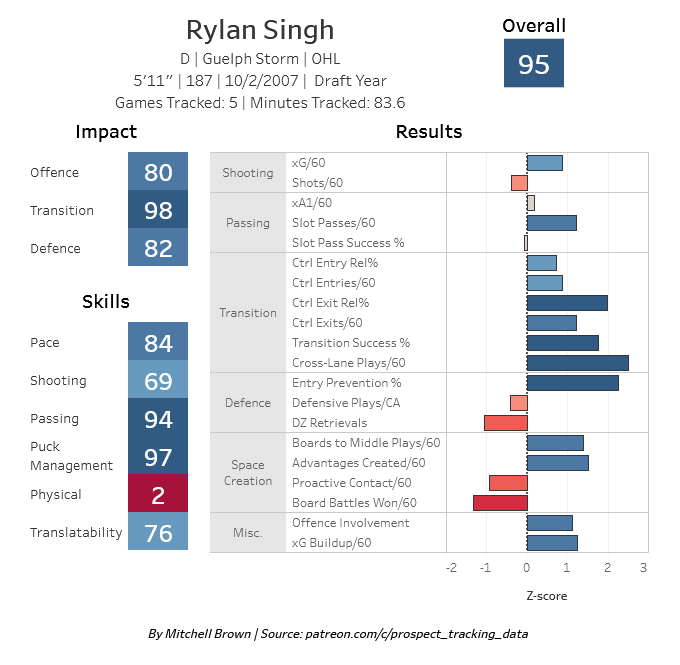
Singh's weaknesses are basically exactly the same as the other average sized guys I already mentioned on this list. He's not elite offensively, he has good defensive metrics in junior but because of his size, passive physical play, and lack of any real elite standout skill, there's concern he would struggle against heavier, faster, bigger, and more physical forechecks at higher levels. He also isn't much of an offensive driver, aside from driving really good transition rates in junior. But if you buy in on his mobility, maybe he grows an inch or two and develops tricks and tools to hold his own physically over time, you can buy into swinging on him in the late rounds.
Look good, feel good, play good 👍
— Ontario Hockey League (@OHLHockey) September 28, 2025
Dressed to impress in the @Storm_City alternates, Rylan Singh dazzled with a nice move to open the scoring against Saginaw.@FloHockey pic.twitter.com/k8RZx8SpId
JET KWAJAH
- Position: Right-shot defenseman
- League(s): USHL
- Height: 6'0"
- Weight: 177 lbs
- Birthdate: March 13, 2008
Kwajah is a local boy from Etobicoke who chose to go the NCAA route, so he's been playing for Madison in the USHL the past two years. This season he was second in the USHL for points by defensemen with 7 goals and 27 points in 55 games. He's committed to Penn State in the 27/28 season as of now. Penn State we know well from Gavin McKenna spending his draft season there, and they've become a bit of a powerhouse in recruiting talent since the NIL regulations and the eligibility rules with CHL players changed. He was one of their top powerplay defensemen this year, not necessarily their top even strength defenseman but not far from it, and was more of a secondary penalty kill guy.
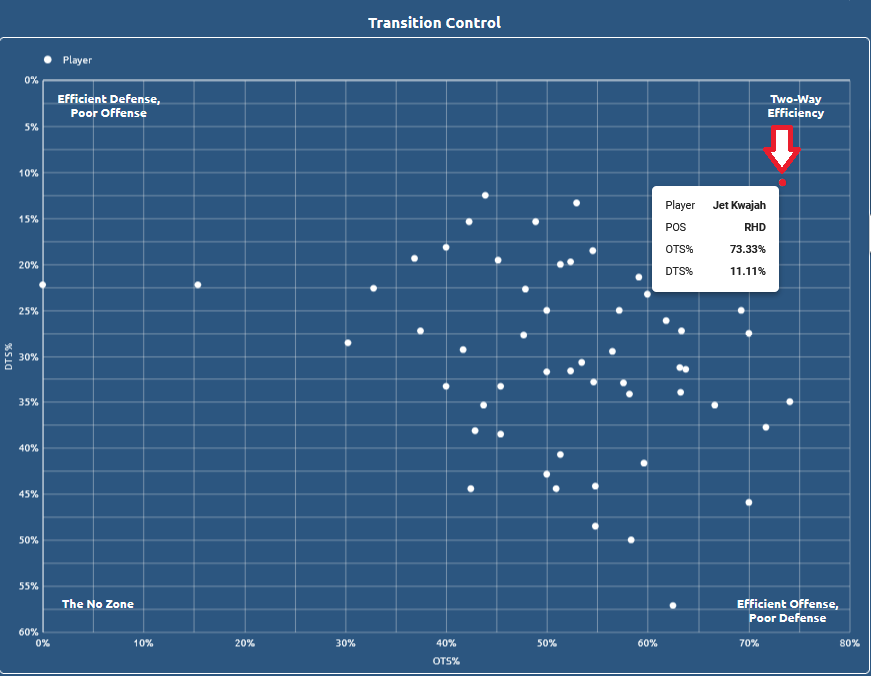
I would say that Kwajah is an interesting player to take a gamble on with a later pick. His skating, puck movement and transitions are legitimate talents. His defense I think can be improved by adding strength and working with good defense coaches. He already showed some good improvements in this area over the season, so if you want a mobile puck mover who can maybe turn into something a bit more why not take a swing at a guy who is already very good in half of those areas?
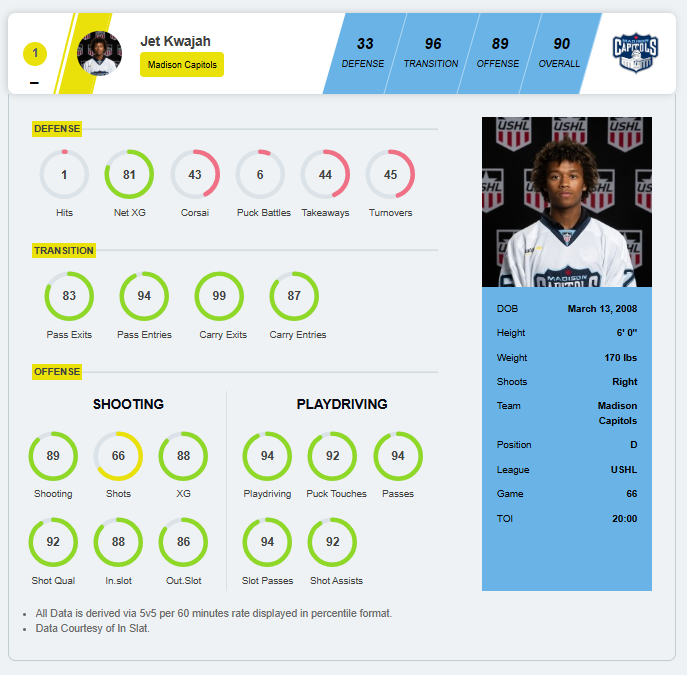
Kwajah's weaknesses are mostly around not being that big and not playing bigger than he is either. He's not very physical and can get pushed around a bit, so he relies on his skating and stick mostly. He can get too aggressive in his decision making offensively as well, especially when activating into the offense and pinching off the blueline. Defensively he has mixed results, with a bigger weakness in his own end, but that's something that scouts said improved a lot over the season thanks to improved awareness and positioning in his coverage.
But Kwajah's main strengths are around his mobility, both with his skating and in terms of moving the puck. He has potentially elite level skating, with excellent edges, explosive acceleration, and a separation gear in his straight line speed. With the puck, he is one of the most impactful and efficient transition drivers of any defensemen in this draft class. He has good passing, using his skating to get to retrievals first and elude forecheckers so he can make that first pass up the ice. Defensively he may have had problems in his own end, but he showed very good results defending against the rush.
Thanks for reading!
I put a lot of work into my prospect articles here, both for the draft and Toronto's prospects. I do it as a fun hobby for me, and I'd probably do it in some capacity even if PPP completely ceased to exist. But if you like reading my work, some support would go a long way! I pay for a few streaming services (CHL, NCAA, USHL, the occasional TSN options for international tournaments that are broadcast) to be able to reliably watch these prospects in good quality streams. I also pay for some prospect-specific resources, such as tracking data and scouting reports from outlets like Elite Prospects, Future Considerations, McKeen's Hockey, The Athletic, and more.
Being able to get paid for this helps me dedicate more time and resources to it, rather than to second/third jobs. And whatever money I make here, a lot of I reinvest back into my prospect work through in those streaming and scouting services. Like I said, I'd be doing whatever I can afford for this anyway, so any financial help I get through this is greatly appreciated!


Comment Navigation & Markdown
Navigation
cc to focus on comments section
c next comment
x previous comment
z next unread comment
Inline Styles
Bold: **Text**
Italics: *Text*
Both: ***Text***
Strikethrough: ~~Text~~
Code: `Text` used as sarcasm font at PPP
Spoiler: !!Text!!