

THE BASICS: STATS AND CONTEXT
Position: Left-shot centre
League: WHL
Height: 6'1"
Weight: 163 lbs
Birth date: Feb 18, 2008
Williams is a guy who had a lot of hype going into the season. He was taken 41st overall in the WHL draft. At the time he was listed at 5'10" and 144 lbs, and coming off a season where he finished 7th in his AAA league in points. The next season, before he was old enough to play a full year in the WHL, he played in an U18 AAA league and finished 3rd in his age group for points. So while he was never a very elite offensive producer, he was a very good one. He also already had a reputation for being a solid defensive center, so his two way potential seemed pretty high.
That assumption continued last year after Williams put up 57 points in 68 games for a rebuilding Saskatoon team. It was the most in the WHL for his age group, only behind super-prospect Landon Dupont who, as of right now, is likely to be the first overall pick in the 2027 draft. But he did also finish ahead of Mathis Preston and Liam Ruck, two top offensive forwards in the league who were both taken pretty high in the draft this year. But again, Williams also had a much better defensive reputation than those two.
So going into this season, Williams was unanimously (or near to it) considered to be a first round guy for the upcoming NHL draft. He was all but given the 1C spot by Saskatoon to start the year. But contrary to the hope and expectation that he would improve on the previous season, he seemed to stagnate. He only matched his point production with 57 points, albeit in two fewer games, and while he still got rave reviews for his defensively responsible play as a center by scouts, the hope was definitely for more. Especially since he actually had a noteworthy increase in powerplay production, so he actually had a worse year at even strength if you just go by points (you shouldn't, for the record). I'll get more into what "went wrong" in the strengths and weaknesses section.
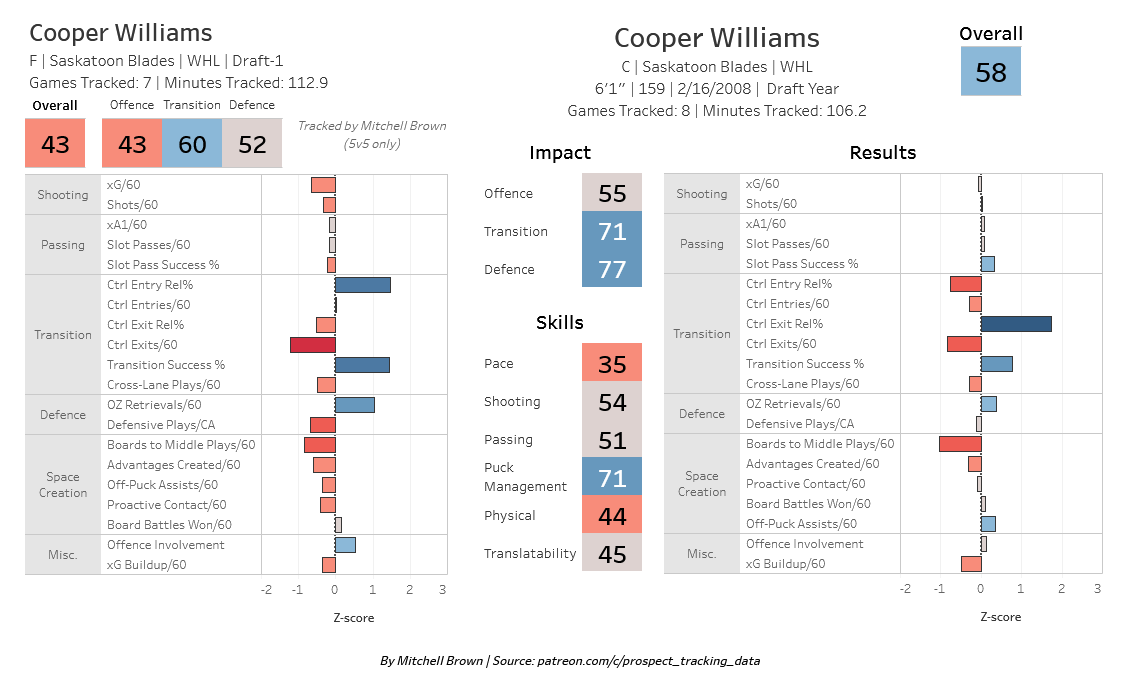
In the tracking data, you can see a slight improvement across the board in pretty much every tracked metric. Williams' offensive impact was a bit better, his transition metrics were a bit better, and his defensive impacts showed the biggest improvement. But as a whole, they don't scream elite player. Between that and the stagnated production, Williams' draft rankings continually fell all year.
Beyond that basic information, what's good to know about Williams' season in context is his usage. He was a top six forward for Saskatoon all year. He mostly played center, but he was shuffled to left wing at times. His coaches liked to use him as a 'support valve' as far as being a focal point for their transitions, staying above the puck and being the guy to provide the outlet for his defensemen and being the first guy back to cover for a pinch. At even strength, he'd typically get deployed in the high leverage situations, especially when they were trying to hold a lead and wanted someone to lock things down defensively. He'd match up with the other team's top lines a lot as well.
On special teams, Williams was pretty heavily used on the powerplay, where led the team in PP points. On the powerplay, he was a swiss army knife. I've seen him spend long stretches where he was up high as the second defender or on the half wall, slinging passes down low or across the ice. I've seen him play at the net front going for deflections, rebounds and back door passes. I've seen him play in the bumper/slot, though not as much. I think I mostly saw him up high though, playing a Marner role, or not unlike the role Fraser Minten played on the powerplay in junior. He'd look for cross ice passing lanes or an avenue to shoot on net himself. Barring either of that, he'd pass down low and sometimes switch places to play as a net-front deflection target. On the PK where he had been a mainstay since his 16 year old season.
THE GOOD: DEFENSIVE DETAILS, PLAYMAKING VISION, NET-FRONT COORDINATION
The three biggest strengths that Williams offers as a prospect, both right now and when projecting him into the future, it is based on his defensive impacts, his potential as a playmaker, and his offensive skills around the net – in that order.
Defensively, Williams has been compared at times to a "light" version of Bergeron, Point, or Cirelli – and light is doing some heavy lifting there. He has been considered to be a highly mature defensive center with pro-like attention to detail and habits. He is very adept at adhering to the team's structure in all three zones. You will not see him wander or be lured out of his position very often. His dedication to making the right decisions on defensive rotations when defending against the cycle is legitimately impressive. He's also a very capable play killer in the neutral zone, always tracking above the puck and angling opponents into the boards or his defensemen who are waiting for a trap. Beyond that, he is a very capable puck thief. He is not physically dominating (which I'll get to in the weaknesses section), so his defense relies a lot on positioning, intelligence, and having a very active stick to block passing lanes, lift sticks, poke the puck loose, intercept passes, and just strip an opponent for a steal. He had a few goals and assists come directly from his defense or forechecking.
Cooper Williams (#16) - Offense from Defense Highlights
When it comes to Williams' offense, his best skill right now – and, to me, when projecting his future development – is as a playmaker. He shows good vision and acts as a connector between the defensemen and wingers, but has some skill to be a play creator as well. He fakes, delays, and manipulates defenders to wait for or create a passing lane and has good accuracy to threat it to his teammate. He's especially good at making quick passes off the boards, something he does in all three zones. He's capable with hook and slip passes to get it around or through a defneder's stick and body, and he's quite good at making quick one-touch passes in traffic to make it difficult for the defense or goalies to get square to the puck carrier.
Cooper Williams (#16) - One-Touch/Quick Passing Highlights
Where you really saw his playmaking shine was on the powerplay, where he was a legitimate weapon. He was brilliant as a passer creeping down from the point or out from the half wall, holding the puck just long enough to draw focus to him, and then doing a no-look or look off pass across the ice for a one timer or to the man right in front of the net for a tap in/deflection goal.
Cooper Williams (#16) - Passing Highlights
Another offensive area where Williams looks quite good to me is his play in front of or around the net. I find this especially interesting considering how light he is, and how he struggles with winning physical battles. Even still, he doesn't shy away from the greasy areas down low or around the net, and he showcases what could be actually elite hand-eye coordination and awareness for things like deflections or quickly pouncing on a loose puck off a rebound. Funnily enough, just like with Olson I thought Williams shows great instinct for his off-puck routes. He'll time his arrivals into soft spots on the ice just in time to take a pass for either a quick shot, or a quick one-touch pass of his own to get the defenses truly scrambling. When he's there, he has a pretty wicked shot in close – both a wrist shot where he can roof it over the goalie in a hurry, and a very slick backhand he can roof as well. Honestly I wasn't going to write a lot about it but he has a pretty sick shot for accuracy, I think it will get even better when he adds more muscle and power behind it. But he's also a guy that seems to take a lot of his shots in close already, so it doesn't need to have elite velocity.
Cooper Williams (#16) - Shooting Highlights
Williams also shows some solid puck handling and puck protection when he's in that home plate area. He has even flashed some high level skill in close quarters, such as a between the legs goal. After watching all of his goals, I think I counted 4-5 deflection goals and a few more that were sort of deflections but more receiving a pass and directing-deflecting it into the net.
Cooper Williams (#16) - Net-Front & Deflections Highlights
THE FLAWS: STRENGTH & PHYSICAL IMMATURITY, SKATING MECHANICS, LOW PACE, SIMPLE OFFENSE
The biggest issue with William's game right now is that he's too light and not strong enough. 6'1" is a good enough height to have, but at 163 lbs he definitely needs to fill out with some muscle. That will not only help add more power to his shot, like I touched on above, but it will help virtually every part of his game because he's too easily pushed around or knocked off the puck. Think about the strengths I mentioned above – he's good at playing a defensive, checking role, and he's good at generating offense around the net.
Both his defense and net-front game typically require enough strength to hold your own in close quarter battles. So imagine how much better Williams could be in those areas once he's packed on some weight and gained better strength in his core and upper body in order to not only hold his own, but potentially start being the one pushing people around. He's already a guy who won't quit or shy away from contact, and will battle hard all the time. But he needs that strength to succeed more often, especially at higher levels.
The second issue that I think was hampering his production and offensive impact, especially at even strength, is Williams' speed in his decision making. When he's on the powerplay and has more time and space to work with, he's shown he can be lethal. At even strength I do think he was held back at least a bit by being so dedicated to his defensive role, but even then when his line had possession in the offensive zone he didn't have the same level of high-end playmaking execution. This may be an adjustment thing, this may be him having too much going on in his head trying to remember all the defensive and positional things he needed to remember to do, but whatever it is I hope the development coaches help him improve on that... however that can be done.
A third issue, and it isn't as significant for me but it could be something that projects as a bigger problem if Williams can't improve on it, is his skating. On the mechanics side, I've seen scouts describe his stride as awkward and clunky, with an inconsistent posture and a lunging stride that limits his quickness, agility, and ability to change directions. I'm not fully sure I saw a lot of that last part, I thought his agility and quick pivots was, if anything, a strength. But the other issue has to do with a lack of high end power and explosiveness in his skating, and this is the other area where I think him adding more muscle and weight will help a lot. Being able to separate from more players will help him with his offensive creation a lot.


OVERALL ASSESSMENT
So one thing I'll say is that going into this deep dive into Williams, I already knew and had seen at least something of him. I knew he was in a lot of rankings in the first or second round for most of the season, and I had seen some games of his when they were playing Edmonton in the regular and playoffs, and when I did my deep dive into Olson. But I was not expecting to come away from my research and game tape of his and feeling like he could be a steal, but I did.
The sheer number of times I saw him repeatedly execute on some pretty high skilled plays – that one-touch playmaking, that high to low and/or cross seam pass to a teammate right in front of the net for a tap in where he's almost just banking it off the player's stick, those net-front deflections, shots from in tight, they're all the kinds of offensive plays that project very well to higher levels. If he could add a better rush offense to his repertoire he could be a very versatile offensive creator, even if he isn't necessarily elite at any one of them.
Combine that offensive potential with Williams' dedication and impact on the defensive side of the puck, and I see a player that could turn into a hidden gem or a steal or whatever you want to call it. I know the problem is that some of his physical tools and the pace of his decision making at even strength are holding him back from being able to consistently execute those high level plays on a consistent enough basis. But to me, that just means he has the potential to take a big leap forward if he can improve on those tools and his decision making enough to unlock more of that high level skill.
One thing that I think would help Williams a lot is to move him to the wing. He's not bad at center, but in the long term if he can't get strong enough, or improve those tools or decision making enough, his abilities would play up a lot better on the wing. The fact that, so far, he seems to be a pretty poor faceoff guy (~40% this season), and also the fact that Toronto's system is already rife with defensive two-way centers like him (Koblar, Holinka, Hopkins, Quillan, Haymes...) then, well, if you have to move someone over to the wing anyways he makes more sense to me.
Thanks for reading!
I put a lot of work into my prospect articles here, both for the draft and Toronto's prospects. I do it as a fun hobby for me, and I'd probably do it in some capacity even if PPP completely ceased to exist. But if you like reading my work, some support would go a long way! I pay for a few streaming services (CHL, NCAA, USHL, the occasional TSN options for international tournaments that are broadcast) to be able to reliably watch these prospects in good quality streams. I also pay for some prospect-specific resources, such as tracking data and scouting reports from outlets like Elite Prospects, Future Considerations, McKeen's Hockey, The Athletic, and more.
Being able to get paid for this helps me dedicate more time and resources to it, rather than to second/third jobs. And whatever money I make here, a lot of I reinvest back into my prospect work through in those streaming and scouting services. Like I said, I'd be doing whatever I can afford for this anyway, so any financial help I get through this is greatly appreciated!




Comment Navigation & Markdown
Navigation
cc to focus on comments section
c next comment
x previous comment
z next unread comment
Inline Styles
Bold: **Text**
Italics: *Text*
Both: ***Text***
Strikethrough: ~~Text~~
Code: `Text` used as sarcasm font at PPP
Spoiler: !!Text!!