

The NHL draft is a funny thing. For all the time scouts and hockey media put into following prospects through the season, putting together rankings and tier lists, what actually happens on draft day can differ wildly.
Take, for example, where Tinus Luc Koblar and Tyler Hopkins were ranked vs where they were drafted. Hopkins' rankings were in the 60ish-90ish range, for the most part. Koblar was not ranked at all by most outlets. And yet, it was Koblar who was taken almost a full round before Hopkins.
So let's talk about why.
THE BASICS: STATS AND CONTEXT
Position: Left-shot centre
League: OHL
Height: 6'1"
Weight: 183 lbs
Birth date: January 23rd, 2007
Hopkins as a player has always had some hype around him. As a 14 year old, he led his team and league in points with 55 in just 30 games. He had the second most points, but led in points per game the next year as a 15 year old. After that, he was drafted by Kingston in the OHL 4th overall. At the time, he was already 6'0" but just 160 lbs. Then last year, he had his first full season in the OHL where he had 13 points in 59 games. Among players in his age group, that was good for 23rd in the OHL.
Hopkins also has a history on the international stage. He was part of one of the two Canadian teams at the World Under-17 Hockey Challenge, where he had 5 points in 8 games. That was good for 3rd on Canada White, along with other top prospects like Cameron Schmidt or Caleb Desnoyers. But it was in a tie for 23rd in the tournament, behind the more offensive powerhouse teams like the USA, Sweden, and the Canada Red team.
That international play extended to this season. He started last summer on Canada's Hlinka Gretzky roster, used in a depth role in the bottom six, where he had 1 point in 5 games for the gold medal winning squad. And he finished the season on Canada's World U18 roster, again playing a bottom six depth role, where he had 1 point in 6 games. But at times, he was bumped up to higher lines as a supporting winger.
One of the main reasons why he has been used so much by Team Canada is because of his reputation as a smart, fast, two-way forward. In his post-draft interview, he mentioned how he's really worked on his defensive game the past couple of years. In that sense, he's ahead of the game in making himself a higher end role player.
For Kingston in the OHL, Hopkins' offensive breakout came this season. He had 20 goals and 51 points in 67 games, good for 6th on the team on a very veteran laden roster. He only got PP1 time at the start of the year before their NHL drafted prospects returned from the NHL camps. He played mostly on the 2nd or 3rd line, not sure of the ice time distribution but his line changed in the official lineups despite being with the same players. He did get some PP2 time, but they tended to run PP1 a good chunk more from what I saw in the games I watched. He also got some time on the penalty kill, and to help defend leads late.
Hopkins will have a much bigger chance next season, by the look of it. Of the top nine scoring players from Kingston, only two of them will be returning to Kingston next year – Hopkins and their leading scorer. Basically, if Hopkins sticks around with Kingston and doesn't get traded or sign to an NCAA team, he's going to be on a decimated and rebuilding roster with only their top scoring winger. In that sense, there's a good chance that he will get a lot of playing time in all situations – he could wind up in a similar situation to Minten's in his D+2 year on a rebuilding Kamloops team, where he played a TON until he was traded to another team that needed to shore up their centres.
So, the short of it is that Hopkins will very likely see a big spike in his production. He'll be playing more in a top role with the best offensive talent on the team, and in a league where a lot of top talent are heading to the NCAA so he'll be facing younger/worse competition. So rather than caring too much about points, the fact that he will be in a position to play as much as possible AND be needed to play more offensively could mean that he is in a more optimal situation to develop more of his offensive game.
THE GOOD: SKATING, TRANSITIONS, TWO-WAY PLAY
The immediate, standout skill that Hopkins has is his skating. You don't need the scouts raving about it to see he can really fly. He's fast, he's explosive, and he's agile. He's probably one of the better all around skaters in the draft, to be honest. That helps him a lot in driving transitions at a high level. He doesn't necessarily weave through defenders with slick hands and feints at a high level – he won't be mistaken for Nylander in that regard. He doesn't really need to since he has enough speed to get by most junior defenders.
However, Hopkins is not without skill. He does have moves that he can break out when the situation calls for it, but he also doesn't need to that often because he is very willing to make a pass instead of dangling through a defense. He'll use give and go's, or draw pressure to him and slip a pass to a teammate that's now got more space to work with, even if they aren't as quick as he is. The gravity Hopkins has on transitions because defenders are wary of his speed is something he uses to his advantage pretty well. Again, not at an elite level, but it's a promising trait he has.
Here's some examples of his transitions and forechecking.
Tyler Hopkins - Transitions Highlights
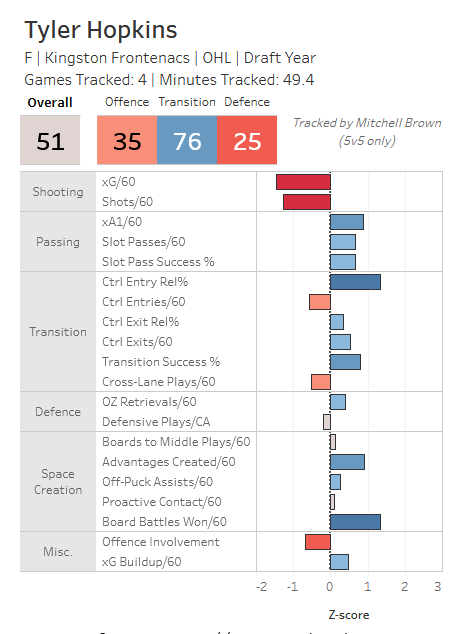
Let's talk more about that offensive skill. Hopkins' tracking data doesn't look all that great, albeit in only four games tracked that likely includes some from the start of the year when he was still in the early stages of his breakout season. But I honestly think it's because he doesn't think offense-first. Again, he is not without skill. You can see plenty of evidence below that he has more than just one or two flashes of dangling through guys, making highly creative cross ice passes, or ripping a hard and accurate wrist shot past goalies from medium distance.
Hopkins is more cerebral than flashy. He picks his spots when he thinks he can afford to, as he has a bit of Fraser Minten in him when it comes to starting plays down low in his own end to support the defense, and covering for defensemen who jump into the play on the rush. But when he chooses to go, he can really go. His skating is at a high enough level that he can be moderately risky and know he can get back on defense to help if he needs to.
So let's see some of that offensive skill in action:
Then there's Hopkins' two-way capabilities, which I've touched on. He gets rave reviews for his intelligence and for his pro-ready skills as a supporting player. That includes battling for positioning, timing his speed to pounce on an opponent at the right moment to force a turnover, jumping into passing lanes, and smothering and swarming puck carriers to prevent them from having the time and space to make plays. While he isn't the biggest guy, he's got a bit of a physical edge to him that helps him make those defensive plays – though again, he's more cerebral with it than a real physical grinder always looking to lay the body.
Hopkins' defensive play is similar to his offense, in that as of right now it's more about his potential than his fully realized impacts. When he fully dedicates himself to being a pure defensive forward, he excelled in the role with Team Canada this year. His defense was a lot more aggressive than what I saw in the few OHL games I could catch before they shut down the streaming library for the season.
Here's some examples of his two-way work:
THE FLAWS: OFFENSIVE SKILL, HIGH END POTENTIAL
While Hopkins has a lot of pro-ready habits and skills, his projection is not of a guy who is an NHL certainty. There are a few areas where he could really improve his game.
The first I'll start with is weaponizing his speed more, both offensively and especially defensively. I saw it more when he was playing on Team Canada, where he'd be really flying for more of his shifts to really close on opponents with the puck and force them to make a play or turn it over. In the OHL games I caught, there were more times when he seemed more passive, coasting at a lower speed and intensity until the play came to him. I don't know this for any sort of fact, but I wonder if this is partly a fitness thing – he only played fourth-line minutes for Canada, but on Kingston he was getting more of a top-six, all-situations role. If that is the case, then fitness is also a must for improved endurance.
Actually, the second point I wanted to make was also concerning his physical training. If he wants to make it in the NHL as a defensive, supporting forward, he'll need to become more of a physical specimen. Being able to physically smother his opponents and battle well enough to hold his own against NHL caliber forwards means he'll need every edge he can get, and that means more muscle and strength. That could also wind up helping his skating and shot a bit more too.
The final thing is to improve his offensive execution, which means practicing his higher level offensive plays until he can use it reliably on a consistent basis. Make himself a threat off the rush on transitions, unlock more dynamic passing and playmaking to be able to create offensive chances for his linemates, and work on his board battles, cycle game, puck protection, forechecking, and cleanup game in front of the net so he can support an offense and capitalize on chances in close. That's the kind of game that will make his chances of being an impactful depth player in the NHL more likely.
OVERALL ASSESSMENT
Hopkins is in a similar position as Koblar, in that he seems like he's already on the cusp of figuring things out and having a big breakout with his all-around game. The difference between the two is their ceiling. Koblar, by virtue of his bigger size, physical tools, and his physical game, has the potential to be a legitimate Minten-level prospect. Do I rate his chances to do so that high? No. But I've seen guys like Knies and Grebyonkin make huge leaps and steady improvements after to turn into the best possible versions of what I saw when they were the same age. It's rare, but not impossible.
Hopkins' absolute ceiling, from his playstyle and strengths, I think would be like a poor man's Alex Kerfoot or a slightly better version of Pontus Holmberg. Not quite good enough to be someone who can play up in the top six regularly as a supporting guy, but someone who can fill in at centre or the wing, kill penalties, maybe contribute on a secondary powerplay unit if his offense develops more, who can be the defensive conscience of his line and drive transitions, and does all the smart, little things well.
While Hopkins has work to get there, I think he can do it and might be closer than it seems. His flashes of higher end offensive skill were more frequent than other prospects I've talked about with the same kind of issue. Plus, he already has a pretty solid base for advanced tools or skills that would serve him well in that kind of supporting role. Those last hurdles to reach that level may seem like they're right in front of him, but they're also probably the most significant hurdle to clear.
So watching him this season will be fascinating. Toronto does have a recent history at being able to find prospects who make an immediate leap in their development, and they seem to have picked two guys in Koblar and Hopkins who are showing some of the right signs that they could be next.
Thanks for reading!
I put a lot of work into my prospect articles here, both for the draft and Toronto's prospects. I do it as a fun hobby for me, and I'd probably do it in some capacity even if PPP completely ceased to exist. But if you like reading my work, some support would go a long way! I pay for a few streaming services (CHL, NCAA, USHL, the occasional TSN options for international tournaments that are broadcast) to be able to reliably watch these prospects in good quality streams. I also pay for some prospect-specific resources, such as tracking data and scouting reports from outlets like Elite Prospects, Future Considerations, McKeen's Hockey, The Athletic, and more.
Being able to get paid for this helps me dedicate more time and resources to it, rather than to second/third jobs. And whatever money I make here, a lot of I reinvest back into my prospect work through in those streaming and scouting services. Like I said, I'd be doing whatever I can afford for this anyway, so any financial help I get through this is greatly appreciated!



Comment Navigation & Markdown
Navigation
cc to focus on comments section
c next comment
x previous comment
z next unread comment
Inline Styles
Bold: **Text**
Italics: *Text*
Both: ***Text***
Strikethrough: ~~Text~~
Code: `Text` used as sarcasm font at PPP
Spoiler: !!Text!!