

Back in mid-May, Darren Dreger mentioned on the radio that the Leafs were interested in Vincent Trocheck, centre for the New York Rangers. The New York Post's Molly Walker repeats that today:
The latest on #NYR Vincent Trocheck⬇️https://t.co/dQFww8SQqY via @nypost pic.twitter.com/CH2ydjwgVR
— Mollie Walker (@MollieeWalkerr) June 3, 2026
She speculates about a trade price, mentioning that the Rangers aren't shopping Trocheck, but consider him valuable and will want a big return particularly because of his low cap hit. This is standard team talk at this time of the year. She suggests they will want a first-round pick and the Leafs only have one viable pick of that sort to trade and that's the Colorado first in 2027 they got for Nic Roy.
The Rangers absolutely will want that pick, which is not in reality worth a meaningful amount more than the second-rounder they got for Scott Laughton (unless something really unusual happens in Colorado next year), but that is the traditional starting price for a player like Trocheck. Her speculation about players who might be requested includes Nick Robertson and Ben Danford as the Leafs top prospect. Which is exactly what everyone should expect to start hearing this summer. That first, Danford and Robertson are obvious "trade capital" of which the Leafs have very little.
Why Trocheck? Well, the same reason there are reports that the Canadiens are interested in him. He's not too, too old, he's a legitimate centre, not just a guy who can take faceoffs and he's got a name and a reputation as both a good player and a good pro. But the real reason is that the list of UFA centres is very short, and most of them are older than Trocheck.
The Player
Who is he? He is American, will be 33 this summer, and is a very tiny amount bigger than Gavin McKenna. His reputation is very different though. He's a tough guy a beast, it's right in his name. He checks!
He is under contract for three more years at $5.625 million, which is a bargain in the rising cap world. He also has a 10-team no-trade list which means not only would he have to be willing to move to Canada* he'd need to be willing specifically to play in Toronto. At least the real estate prices wouldn't scare him off.
*I know there are people who assert that there is nothing to the idea that American players don't want to play in Canada, and the justification for this assertion is that there are some who do. I think you're wrong in the general sense, and so clearly does this American sportswriter who mentions this specifically in her piece. Yes it is a thing. More so now than in the past.
This is the first article of the season about someone the Leafs might trade for, so now is as good a time as any to tell you that if you want to know his points, I'll put in the EP table, but I won't talk about them. I don't care about points.
So aside from his bargain price, and his status, is he any good? Well... that's complicated. Models that isolate impact, like the Career Summary and SG model on HockeyViz or the RAPM charts on Evolving Hockey are not just on-ice measures.
Sometimes when I talk about these numbers or post a chart, people respond by saying, "oh that's all just his teammate, etc. etc." Well no, no it isn't. Removing the teammate effect is the main purpose of these models.
There are two main areas where the model cannot overcome the limitations of available information. One is when two players play almost exclusively with each other, and not just players who go on to be co-GMs of the Canucks. Auston Matthews and Mitch Marner on the Leafs were one such problem pair. The other is something I believe is about how we as consumers of this information think about the very idea of impact.
Let's take a literal metaphor here and imagine you are the blacksmith in the pioneer village and you have your big hammer and your anvil and you pound down on a bar of lead. Splat. Now try copper. Splat-ish. Now try steel. Bong! And no splat. (Sorry for the technical metal-working language there.)
This is how I view impact. So if you roll up and play on the Carolina Hurricanes you have the ability to impact offence because the entire team spends more time in the offensive zone than any other team. If you are a centre on the Rangers these days, well... no you really don't. They are hard to have an impact on.
I think this shows up a great deal in defensive measures for forwards. Something I care about almost as little as I do points. What I do care about with any forward is offence creation. That is, doing the things that lead to situations where goals can be scored. Getting the puck, transitioning, keeping it, getting it back if you have to, making passes, shooting, and on and on. The higher up the lineup they play the more necessary it is a forward has a positive impact on offence creation.
How much opportunity for impact was there by any member of the Maple Leafs this past season? If I look at the RAPM Expected Goals For per 60 (xGF/60) at even strength these are the forwards above zero (so a positive impact):
- Auston Matthews: 0.182 (career since 2016 of 0.316)
- William Nylander: 0.103 (0.196)
- John Tavares: 0.072 (0.181)
- Matias MacCelli: 0.036
- Dakota Joshua: 0.02
- Easton Cowan: 0.012
So if we are going to understand that some of what even John Tavares experienced this season was the inability to have impact because of things he did not control, then I think we have to do the same for Trocheck.
Even-Strength xG% for Toronto and the Rangers was 46% and 49%.
The Rangers only player with elite xGF/60 RAPM values was Adam Fox. The best forward was J.T. Miller at 0.161. Trocheck has the worst number of any big-minute forward. And if you really, really think defending is important in a centre, be advised his xGA/60 is worse. He sucked. On a team that was bad with a very poor roster.
Trocheck's career since 2016 value is 0.073, and his xGA/60 over that period is 0.024 (or just a little into the bad). He is, when you get him off the very poor rangers team, and give him some malleable teammates to impact, a good, but not excellent middle-six centre.
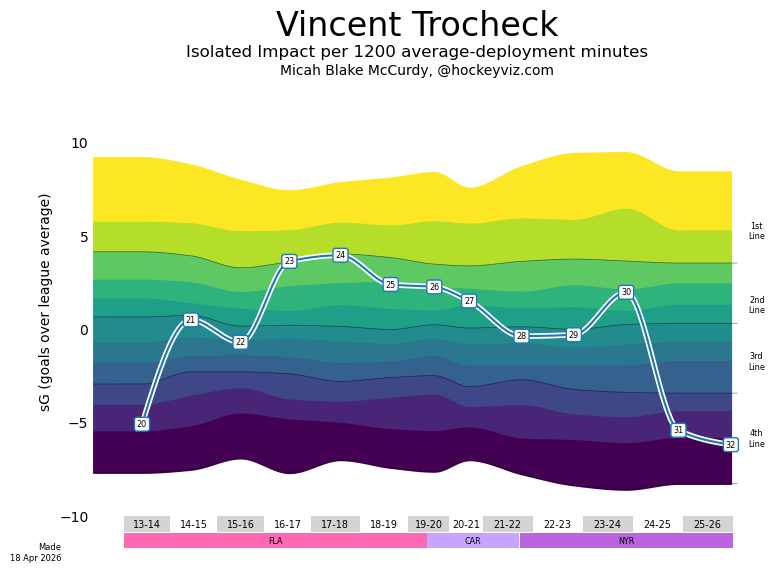
Which is what that says too. A lot of people will look at a chart like that with a big dip and decide he's hit the ageing curve cliff! He's over the hill, and sliding down the other side. But what's him and what's the team?
The expectation out there is that John Tavares is losing it. You saw that one game that one time, and he's not up to it, and even that article up there thinks that about him with no real foundation given for it.
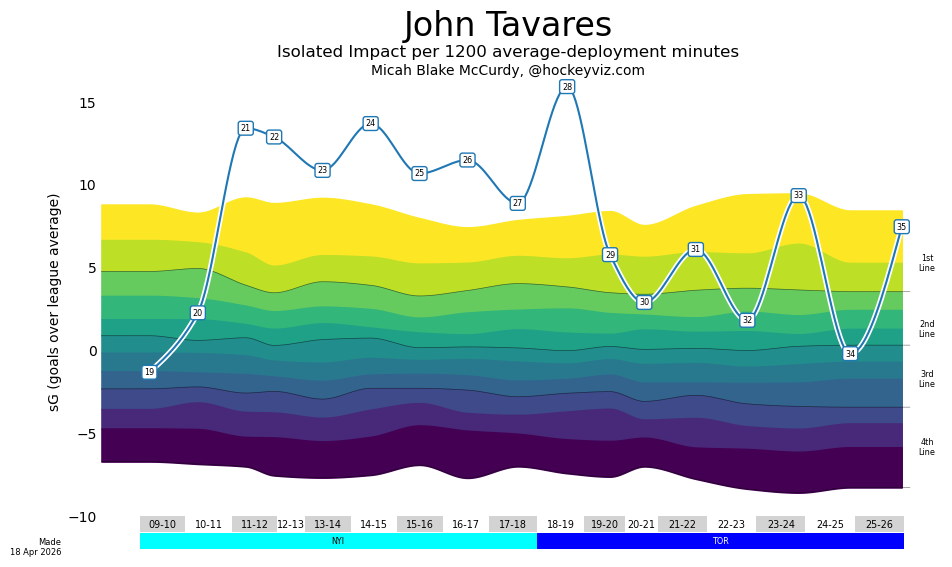
I mean, yeah, he ain't what he used to be, but that's because what he used to be was a top-ranked 1C. And if you looked at that graph last year you might have spun a tale about him being over the hill and on the way down. That's a classic case of assuming the tomorrow will be just like today only more so.
So I'm supposed to tell you definitively yes or no, Vincent Trocheck is a good guy to spend a pick I don't care about and players I do to acquire.
I think this is my answer: no one knows the future. He's capable of playing as well as Tavares did in 24-25. He's not capable of playing better than Tavares did this past year. He can damn near beat him in faceoff percentage, though, and few can. He's capable of better things than he would be on the Rangers as they rebuild.
It's a risk. He's better than Nic Roy or Scott Laughton. He's better than any UFA option. And that's the real calculus here. Not is he the player you want, but is the pick Roy turned into than turned into this guy improving the team. Yeah, it would be. The sticking point is what else it would cost. And maybe I broke my own rule and named the piggies with Ben Danford. Is he going to join the Leafs in the next two years and make an impact of any sort? Maybe yes, maybe no.
I'm not surprised the Leafs are interested. They need who Trocheck was two years ago. Maybe he can be that again.




Comment Navigation & Markdown
Navigation
cc to focus on comments section
c next comment
x previous comment
z next unread comment
Inline Styles
Bold: **Text**
Italics: *Text*
Both: ***Text***
Strikethrough: ~~Text~~
Code: `Text` used as sarcasm font at PPP
Spoiler: !!Text!!