
Remember how I said a good sized group of scouts were opining that this year's draft had a top tier of 3-4 players instead of just one (McKenna) or two (Stenberg)? Malhotra was the third forward, but the other player and a guy who has gotten talked about a lot as potentially being taken second overall by San Jose, is defenseman Chase Reid.
He was included in that same pair with Malhotra that Pronman said had a combined 20% chance of going first overall. There's no reason to take those made up odds as gospel, just note the general fact that some teams he's spoken with have been considering Reid at first overall. In Scott Wheeler's first mock draft after the lottery he had Chase Reid going to the Sharks at second overall. In various podcasts with multiple scouts, one thing they all emphasize is that while most fans are pretty clear that obviously McKenna is first overall and then Stenberg and then... etc; the top four in that top tier is much, much closer than the general public realizes. So if Malhotra has emerged late as the top pure center of the draft, Reid seems to have solidified himself as the top defenseman. I've seen some scouts even say that he has the best chance to be a clear number one defenseman.
Let's talk about why.
THE BASICS: STATS AND CONTEXT
- Position: Right-shot defenseman
- League(s): OHL
- Height: 6'2"
- Weight: 187 lbs
- Birthdate: Dec 30, 2007
Here are his draft rankings, as of writing this:
- TSN NHL Scout Poll: 10th
- Cam Robinson NHL Scout Poll: 6th
- Corey Pronman: 1st
- Will Scouch: 9th
- Elite Prospects: 3rd
- Scott Wheeler: 3rd
- McKeen's Hockey: 3rd
- Upside Hockey: 5th
- NHL Central Scouting: 2nd (North American skaters)
The most interesting ranking in that list is from Corey Pronman. With Bob McKenzie retired, he is probably the guy I would trust the most to make a ranking that most closely represented what NHL teams are thinking. So the fact that he has him ranked first overall should be an indication to you that Reid has real hype – from some scouts, and probably some NHL teams, more hype than even McKenna or Stenberg.
Like Malhotra, Reid was on a more typical path to the NCAA. He's an American who played in AAA leagues until he was old enough to make a short debut in the USHL for 10 games in his draft-2 season. Then, last year, he split time between the NAHL and joined the OHL after the new rules for maintaining eligibility for the NCAA were official. In 39 games for his D-1 season, Reid had 40 points in 39 games, making him already a high impact defenseman offensively.
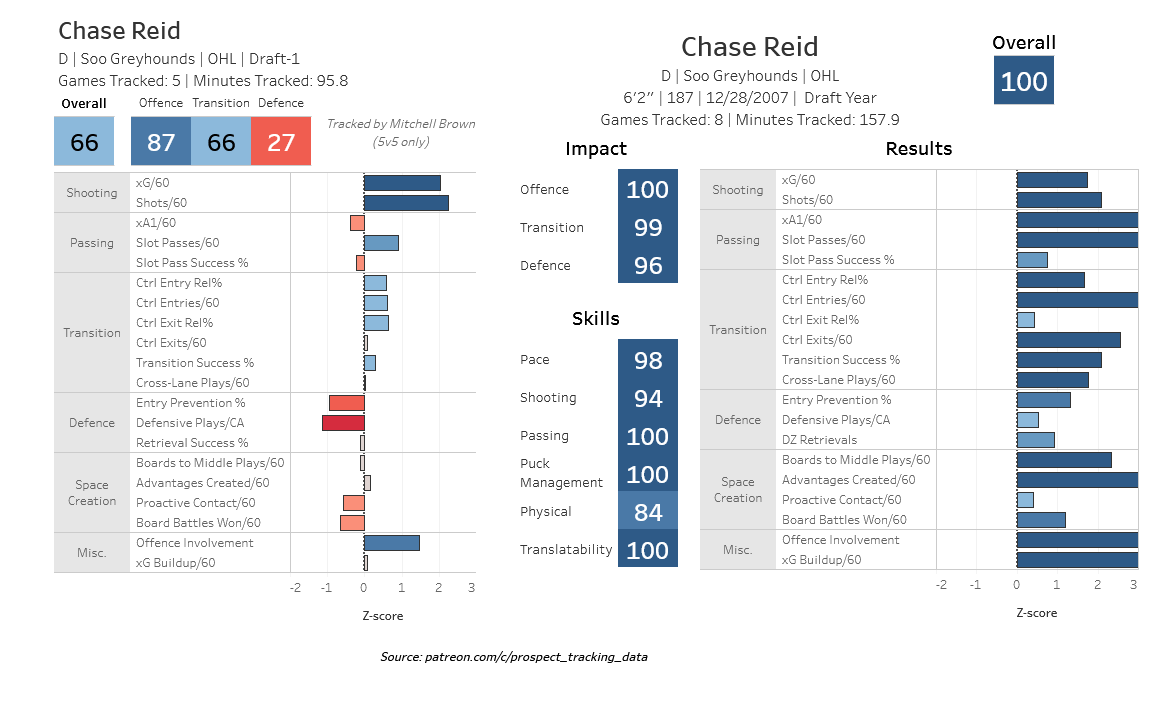
Similar to Malhotra, Reid made huge improvements over this season, in every way possible. His already great offense became truly elite. His transition impact went from okay to elite. Even his defense, which was by far his biggest weakness, became elite for the level. His point totals didn't slow down a bit towards the end of the year as he missed a chunk of games due to injury, but he still put up 18 goals and 48 points in 45 games. As I like to say, I really don't care much about points by defensemen... I'm more interested in seeing what he can do to help impact the offense outside of points, which we'll get to in the next section. He was the Soo Greyhounds' top defenseman, used in all situation, usually in the mid to high 20's per game.
Also like Malhotra, Reid's ascent to top prospect consideration only really happened this year. He was never recruited to top programs in the US junior system or by Team USA for any international tournaments. This year, the first international roster he ever made was for the World Juniors despite his relative youth. And when America's top offensive defense prospect, Cole Hutson, missed time due to an injury, it was Chase Reid who they turned to for his even strength and powerplay role. In all five games, he played 19+ minutes, and finished with 4 points in 5 games. He didn't look the most solid or dominant, but he looked like he belonged as a 1-2 year younger defenseman. He also played on Team CHL in the Prospect Challenge tournament against the top prospects playing in America (not necessarily all American-born).
THE GOOD: ELITE MOBILITY, TRANSITIONS, OFFENSIVE IMPACTS, RUSH DEFENSE, NUMBER ONE DEFENSEMAN POTENTIAL
When talking about Reid's biggest strengths, I have to start with his skating. He has an argument for being the best overall skater in this draft, in terms of his speed, edgework, four-way mobility, explosiveness, whatever else you can think of. It is the core of his game, on transitions, in the neutral zone, on defense, and driving offense in the offensive zone.
Reid's ability to drive transitions is already elite, potentially the best of any other defense prospect in this draft. It starts by his ability to get to pucks dumped in behind him first thanks to his speed, then use his edges and elusiveness to escape forecheckers, carry it out safely, weave through the neutral zone, enter the offensive zone, and then use his edges and lateral mobility to walk the blueline and attack deep into the zone where he has space to move into. When he faces pressure on retrievals, he manages it with a lot of calmness and poise. He uses feints, fakes and misdirection to buy enough time and space, and if he has space he can speed away or if not he can fire a no-look feed pass to an open teammate. He's so efficient with his retrievals and passes that he has one of the lowest turnover rates in any tracking data I've seen.
It also forms the foundation for Reid's offensive game. His speed allows him to be aggressive in jumping into rushes, or to activate from the point and act like another forward. In junior he's so good at it that he will jump off the point to capitalize on a rebound, let alone a pass. He'll also pinch in deep with his explosiveness to close on an opponent trying to break it out, causing turnovers and prolonging his team's possession. Even if the puck does get by him, his skating helps him get back on defense. His offense isn't just about his skating, however. He has elite vision, playmaking and a very good set of hands when handling the puck. His vision allows him to lead the rush and pull multiple defenders toward him before slipping accurate passes to open teammates open in dangerous scoring areas. The intelligence of his playmaking is already considered by some to be NHL-level. He can see plays developing and then knows what he can do to turn potential scoring chances into actual scoring chances.
The other strength in Reid's offense is his shot, which is also potentially elite... for a defenseman. If you've been one of those people who have been lamenting Toronto's lack of a "big point shot" from their defensemen, on the powerplay or in general, then Reid is your boy. Beyond just the power and accuracy of the shot, he uses it smartly and not just to score. I swear he also sometimes shoots with no intention to score, but to create a specific kind of rebound he wants to turn into a scoring chance for his teammates in front of the net. He can use a heavy, down-on-one-knee one-timers as well as quick and accurate wrist shots through traffic, and he knows how to time it with screens forming in front of the net. He also seems to shoot specifically for a teammate to go for a deflection, or create indirect passes to his teammate. That heavy shot, plus his ability to walk the blueline and create lanes through feints, makes him a legitimate offensive threat from the blueline.
Defensively, Reid's skating is also the foundation for his positive impact. It shows in his ability to defend transitions – his speed and mobility help him maintain an aggressive gap and close on puck carriers quickly and effectively, making it hard to beat him wide with a deke or with speed. He is excellent at angling rushes, keeping his backwards momentum perfectly timed with the attacker's acceleration to force them into low-danger areas. He'll either force them to dump it in past him, or use his stick to knock it away to stall their entry attempt, and more rarely throw a hit to stop them dead.
Beyond Reid's skating, at 6'2" he has above average reach and a physical frame that honestly looks bigger than that at times. He'll use the reach and frame to deflect, deter, and snuff out opponent possessions. This gives him an arguably unique level to act as a containment defender at even high paces from elite skating forwards. He uses his agility to plug holes and close off lanes before the opposition can establish a cycle.
One of the more polarizing parts of his game is his physical play. I've seen some say when they watch him, he wasn't great when defending in close quarter scrums and can be too soft in allowing opposing puck carriers to get by or through him without him using his size and skating to erase them on the boards. On the other hand, I've seen other scouts praise his physical play to initiate contact on retrievals, bury forwards in the corner on the cycle, and rub off puck carriers trying to go wide around him on zone entries. From what I've seen, I think he's just inconsistent with it because I have seen him play physical, maybe just not as much as you'd want at times. I've also seen more scouts say that his physical play was much improved by the end of the season.
THE FLAWS: CONSISTENCY, STRENGTH, DEFENSIVE PROJECTION
Honestly, I'd say there is nothing to nitpick with Reid's game outside of his defense. I mean I could find some things to point out with maybe his shooting or breakouts, but I would be reeeeeeaaaaaaaally nitpicking to the point I don't want to even bother. I've seen some scouts debate whether his offensive game is actually dynamic or if it's just highly efficient, but neither would be a weakness to me.
Reid's defensive consistency and his strength in physical play are the main areas of concern that make scouts question how well his defensive ability can be projected to the NHL. Because it's at a very good if not elite level right now in junior, but that's a much different game. Next year, he's committed to join a top program in Michigan State in the NCAA, where he'll be exposed to older, bigger competition with much more pro-like coaching and systems.
The biggest area of concern would be his defense on sustained possessions in his own end. He can have occasional lapses in his focus and lose his man, or he'll do the opposite and hyper-focus on the puck and leaves a backdoor passing lane open. In junior, his defense is more cerebral – he anticipates how the play may develop, times his stick to deflect a puck, poke it away, lift a stick, etc. There's nothing inherently bad with that, just ask Nick Lidstrom, but having more diversity in his tools to defend help project him to the NHL as a defender more easily. The issue is more around the uncertainty of how well his current style and level of overall defense projects to the NHL.
OVERALL ASSESSMENT
So, back to the question I posed in the introduction – why would Chase Reid be considered the top defenseman, the defenseman with the best chance to be a bona fide star/number one defenseman on a good team, and potentially even good enough to be a first overall pick?
It's because of how much potential he has. So much of his offensive and transition game is already at an elite level, maybe even NHL-level. He has incredible skating and mobility. His defensive game as a whole has parts that are questionable, but he already looks to be a high level defender against the rush. The consistency issues he has defending in his own end and to take advantage of his physical size and strength more can be resolved with good coaching and development, and literal physical growth. He has NHL-size at 6'2" with a chance to still grow, especially in adding more muscle to his frame.
I've seen more than a few scouts say that if his defense doesn't transfer well or he doesn't improve in various ways, he'd turn out as a Morgan Rielly kind of glass cannon defenseman. Which, while that may not be the most ideal outcome you want if you're going to take him so high in the draft, that's a pretty nice floor to have! If you tell me that at worst you get a Morgan Rielly, but at best you get that level of offense with better defense than Mo? That's a damn enticing player to pick at number one.
I keep coming back to this... while I think McKenna has the best chance of being the biggest hit in this draft, becoming another Kucherov kind of winger who can lead the NHL in points multiple years, I also think that of the 2-4 players in the conversation to be first overall at any odds, he has the biggest question marks and flaws. His season this year was not smooth sailing, there were plenty of doubters by the time the World Juniors came and ended. In fact, I think a lot if not most of the mid-season rankings that came out around that time bumped him out of that first overall spot.
Put a gun to my head and make me choose that first overall pick, I squeeze my eyes shut and go with McKenna. It's not a clear and easy choice for me, and maybe that's because he's a style of player I am more wary of. Maybe I'd feel more confident of him if he was at least a good center that could stick there. I can just see why some people are so high on Reid they'd take him second or even first overall.
But what I would say, clear and easy, is that if Toronto does wind up trading down from first overall to somewhere else in the top 5, I'd be doing so with Reid on the top of my target list for who you hope to get with Malhotra next. He's the one defenseman I look at and I can understand why someone would want to take him first overall. He may not play in the NHL next year where McKenna and Stenberg probably will, but in the long term if he hits his ideal outcome he could become the most impactful player at a premium position that Toronto has desperately wanted for my entire lifetime.
If you want a good look at a round table of some of the top public scouts debating about these topics, it's pretty insightful to the kinds of discussions going on among that group who have conversations with NHL teams.
Thanks for reading!
I put a lot of work into my prospect articles here, both for the draft and Toronto's prospects. I do it as a fun hobby for me, and I'd probably do it in some capacity even if PPP completely ceased to exist. But if you like reading my work, some support would go a long way! I pay for a few streaming services (CHL, NCAA, USHL, the occasional TSN options for international tournaments that are broadcast) to be able to reliably watch these prospects in good quality streams. I also pay for some prospect-specific resources, such as tracking data and scouting reports from outlets like Elite Prospects, Future Considerations, McKeen's Hockey, The Athletic, and more.
Being able to get paid for this helps me dedicate more time and resources to it, rather than to second/third jobs. And whatever money I make here, a lot of I reinvest back into my prospect work through in those streaming and scouting services. Like I said, I'd be doing whatever I can afford for this anyway, so any financial help I get through this is greatly appreciated!


Comment Navigation & Markdown
Navigation
cc to focus on comments section
c next comment
x previous comment
z next unread comment
Inline Styles
Bold: **Text**
Italics: *Text*
Both: ***Text***
Strikethrough: ~~Text~~
Code: `Text` used as sarcasm font at PPP
Spoiler: !!Text!!