

THE BASICS: STATS AND CONTEXT
Position: Right-shot winger
League: WHL
Height: 6'1"
Weight: 207 lbs
Birth date: Mar 16, 2008
Olsen doesn't have as interesting a path in his development as others I've profiled, or even as Ethan MacKenzie that I wrote about yesterday. He was drafted 29th overall by Saskatoon in the WHL in 2023. He was an average sized center with decent but not great numbers in the minors. When he joined Saskatoon full time, he got bumped to the wing. Where Olsen's teammate and fellow Maple Leafs draft pick Brandon Lisowsky finished second in the league for their age group in scoring, Olsen finished tied for 18th with 23 points in 60 games. He was used in mostly a bottom six depth role, and though his point totals don't scream success he was quietly earning the increased admiration of his coaches and the respect of his teammates and peers around the league.
This season, Olsen opened again mostly in the bottom six – on the third line, specifically. He played on a line that was dedicated to checking and defensive hockey, and playing with energy and intense, physical forechecking. In interviews, his head coach mentioned he relied on him and the rest of that line to establish a physical tone early in games, wear down opposing teams' top defensemen behind the goal line, and then protect leads late in games. He apparently did such a good job that he eventually earned more playing time, getting the bump to the second line (some say the top line) right wing. That brought more ice time at even strength, but he also started getting more time on the powerplay but especially on the penalty kill. By the time the playoffs came around he was playing 17 to 19+ minutes per game, up from the 12-14 he played at the start.
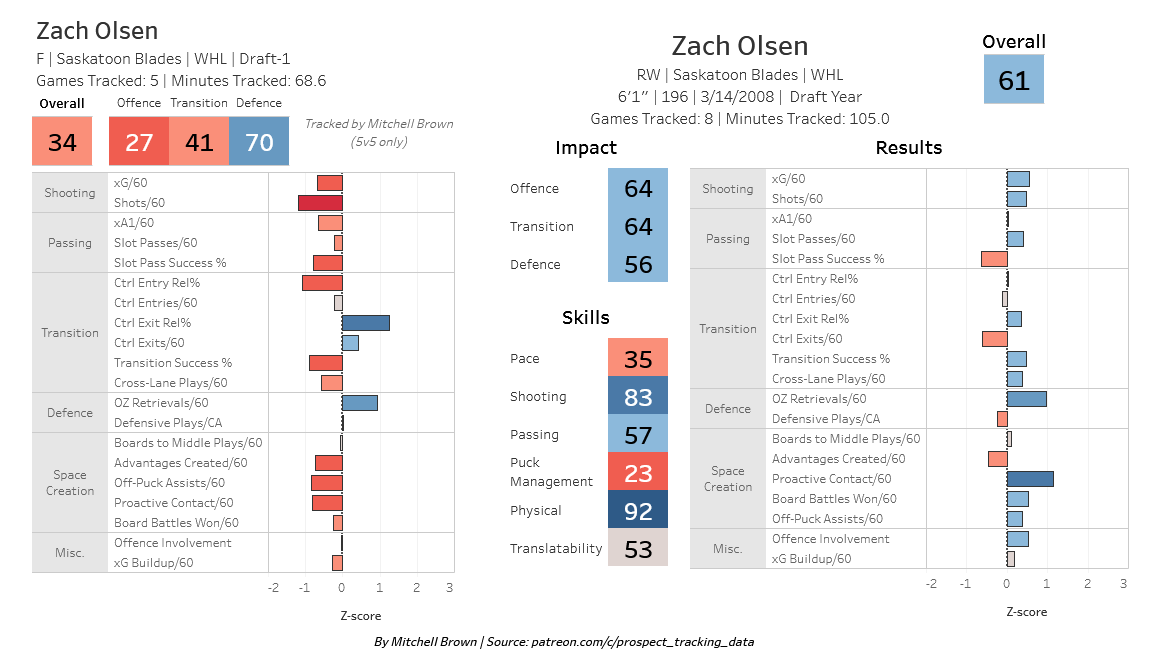
With the increased role, Olsen was relied on to be the Zach Hyman/Matthew Knies player on his line with some of their top offensive players. He played a lot with Saskatoon's leading scorer, David Lewandowski in a complimentary power forward role. Olsen did the dirty work on the forecheck, winning board battles, parking his butt in front of the net to tie up the defenseman and screen the goalie, and create clear pockets of ice for his linemates. He used his speed and physical play to create turnovers to prolong their offensive zone possessions.
When he got the bump to the second/top line, he also started getting time on their secondary powerplay unit. He was used mainly as the net-front guy, battling with defensemen in front to set screens and using his good shot down low. He was a big part of their primary penalty killing unit, to the point that he was being used to take faceoffs on a two-winger configuration. Funnily enough, he won 60% of the faceoffs he took, and depending on how much time they were killing penalties in a game, he was taking as many as 7-8 faceoffs in a game.
When Saskatoon's season was over, after beating Edmonton in the first round then getting swept in the second round, Olsen was invited to Canada for the World U18s. He started the tournament as the 13th forward, but saw his role get bumped up and up until he was a third line winger and a regular on their penalty kill as well. He played as little as 4:16 in a game but as much as 11+ minutes in a couple games. While with Canada, he scored twice and was a +3 with no minus games, but didn't get much ice time when they were trailing against the other powerhouse countries. Maybe if they needed to hold a lead he'd have gotten more ice time.
THE GOOD: SPEED, MOTOR, PHYSICALITY, SHOT
Now we get to the meat and potatoes of Zach Olsen, which is his meat and potatoes-style of hockey. I'll start with the three elements of his game that are by far his biggest strengths – his skating and mobility, his physicality, and his shot.
Speed & Skating Mechanics
Olsen is the definition of a power skater. His explosiveness and his straight line, north-south speed are both elite and very underrated for this draft class. I'll take scouts' word for it that his mechanics are exceptional. It's good timing because when the discussion around the value of just speed in a player, I made this comment:
I'd also like to throw in that straight line speed does not encompass the whole of how good a player is at skating. East-west agility, pivots, explosiveness, and like Cathy explained in more detail speed of mental processing and knowing how to use your speed to have an axial impact on the play aside from just “in going fast” are all different elements to how I look at skating beyond just north-south top speed.
It's funny I was saying this and here I am lauding Olsen for his straight line speed. But as I said in the comment, what's more important isn't that Olsen is a very fast and powerful skater, but how he weaponizes it. He has a relentless motor at chasing down loose pucks and dump ins on the forecheck. He wins races even when he started from well behind, and even if he can't get to the puck first he will at least immediately be on the opponent to pressure them to delay them or create a turnover. You can see a good example of this in some of these goals he scored or assisted on, where his speed allows him to beat defenders who had a head start:
Zach Olsen - Speed Highlights
Elite Physicality
The other elite element of Olsen's game is his physical play and his sheer will to win every battle he engages in – and he engages in a lot. His quick and explosive acceleration helps him launch into a huge body check with only 2-3 strides (which is good because, you know, charging). His quickness regularly catches defensemen off guard as they're trying to use the net as protection, or to chase down a dump in that goes that way.
Zach Olsen - Physical Battling Highlights
With his 6'1" and 203 lb frame, Olsen is someone who plays even bigger and stronger than he looks. He is more than eager to do the heavy lifting in the dirty areas of the ice, mainly along the boards, down low, and in front of the net. He has a good understanding of leverage and how to twist, spin, and position his body to establish inside positioning on opponents so he has the advantage to set screens and pounce on loose pucks first. He proved to be pretty adept at making plays in front of and around the net – deflections, fighting for loose pucks and rebounds, and so on.
Zach Olsen - Net Front Highlights
On the other side of the puck, Olsen also projects as a solid defensive winger, and again his skating and his physical style drive a lot of that. His backchecking can be ferocious and suffocating – he catches up to puck carriers and angles them towards the boards, closes on them and seals them along the boards with a check to then battle for possession of the puck. You see this combination on the penalty kill, with his acceleration and speed he can quickly pounce on opponents who think they have more time and space to work with then they do, and his reach is a lot wider than you'd expect from just his physical size and wing span. He'll jump into passing lanes, pressure puck carriers to force them into making mistakes and turnovers, and creating rush chances using his speed.
Biggest Areas of Improvement
Rather than write a third section on just Olsen's shot, since there isn't really much to write aside from... he has a really good shot, the last section I wanted to call out the biggest areas of improvement he showed over this season, because they are important to his future projection. After reading his scouting reports from the start of the year through to the end, and watching some of his games at various points in the season, I've picked out four elements to focus on.
I'll start with Olsen's shot, since that is his biggest offensive weapon. Olsen has always had an accurate wrist shot, but he hasn't always had the best ability to get his shot off as often as he could have. What improved over this season was he greatly improved his catch-and-release mechanics, allowing him to better handle pucks of all kinds and letting them rip. So even if the puck was deflected on its way to him, rolling, or the pass was a bit off and not in the perfect spot for him to make a quick reception and shot, he is now able to quickly adjust his body so he can still get a good shot off that can beat the goalie.
Zach Olsen - Shot Highlights
A related improvement that will help Olsen's ability to score goals or create scoring chances is his off-puck routes and positioning. He's a lot better now at moving without the puck and finding soft spots on the ice and moving in more deceptive fashion. He's more clever and intuitive without the puck now, in between the moments where he's battling along the boards or for position in front of the net. Now he'll sneak in behind a defender at times instead of just bulldozing his way in front of them, and he'll time his sliding into soft areas in front to get open for a pass at the right moment. So while he's not necessarily a playmaker or puck carrier, he has the potential to be a good finisher while helping facilitate offensive possessions with his forechecking and board work.
Zach Olsen - Off Puck Movement Highlights
Now, on the topic of puck carrying, one of the other areas Olsen improved a lot is in how he drives transitions and rush offense. Where before he was more of a pure north-south skater, go in a straight line and just try and plow through everyone in his way and beat everyone with speed, now he's added more complexity to his transition game. He will vary his pace, use delays and stop ups to draw defenders out of position and hit a trailing teammate with speed to carry it past the now stationary defenders.
And on the playmaking side, Olsen also showed some improvement already in what was arguably his biggest weakness in terms of his consistency issues. His vision wasn't great, and his passing always seemed stiff, rushed, forced and/or awkward. By the end of the year, he had learned how to make short and subtle breakout passes and give and go sequences to weaponize his speed. He looked much more calm and composed when passing the puck rather than rushed or panicked. He also started using things like bank passes off the boards, or making quick slip passes after coming away with the puck off scrums. In the offensive zone, he learned when to make his passes – mainly, he learned to wait until he had established a stable position and then make a quick pass, so he was making it from a stable base and it was much more likely to be accurate than if he tried to do it off balance.
Zach Olsen - Passing and Playmaking Highlights
THE FLAWS: PUCK HANDLING, PLAYMAKING, DISCIPLINE
So there are three main issues with Olsen's game, and they are not little things.
The first one is the biggest one, and that's his ability as a passer and playmaker. While Olsen did improve in this area a good deal, it hasn't gotten to the point where you can project him to be an above average passer at higher levels. At this point, I'd say the best he could hope is to keep improving so it would at least be average at best. Which, given the kind of player he is, would still make him valuable. But this is, I'd say, the biggest reason why you can't project him to be above a bottom six checking line winger. Even if he plays a similar game as Hyman or Knies, I can't really see him being able to play as a supporting power winger in the top six like them because he doesn't have their level as a playmaker or a puck handler.
Speaking of puck handling, that's a similar issue. Olsen is a bit better as a puck carrier than he is as a passer, but it's still not something that he should be relied upon to do very much. He's better at handling the puck in close quarters, like along the boards or in front of the net, but carrying it through open ice is where he has more limitations. He's learned to adapt to this issue by using his speed – chipping it past defenders and chasing it down, or using a give and go so he can get around a defender and get the puck back at speed. The two issues do compound on each other, though. For example, because he's not a great puck handler he can't break down defenders to create passing lanes or buy more time for a teammate to get open. He got better at being able to do that kind of thing to some extent, but he still needs to work on it a good deal.
The final issue Olsen has, and again this is something he got better at but still needs to continue working at it, is his discipline. Last year he only had 36 penalty minutes as a rookie, in 60 games. This year that ballooned to 79 penalty minutes in 57 games, and then 18 penalty minutes in 10 playoff games. He did play clean for Canada in their five games at the World U18s. His penalty totals was made worse by 3 game misconducts and 3 fighting majors totaling 45 of those PIMs, but all of the penalties he took in the playoffs were minors. Some of this may come with the territory for his aggressive and physical style of play, and how he gets under opponents' skin, but to be an ideal rat he'll need to learn how to stay on the non-penalty taking side of the line more consistently.
OVERALL ASSESSMENT
Olsen is definitely a specialized player, but he plays a style that is highly valued by NHL teams for a reason. I think his strengths are already at such a level that you could reasonably project him pretty safely to be some kind of bottom six forward. He's got Tverberg's skating and speed, but he's bigger and stronger and plays with more physical aggression. He's got a better shot too, and I think will be better defensively and on the forecheck.
How impactful Olsen can be in that role will depend on how much more he can improve on his ability to execute more skilled plays. I'm not talking about him being able to suddenly become a passer like Marner, puck handler like Nylander, or dangler like Matthews. Actually now that I think about it, I think his best comparable in the NHL as far as what his best (but still realistic) possible outcome would be is a Bobby McMann. In terms of his ability to play a fast and heavy game, use his good shot to pot some goals, provide some two way impacts and maybe play up on a second line at times though he isn't a good enough play driver to make that stick long term, that's what you'd hope to get out of Olsen.
Even if Olsen doesn't quite get to that level, I think you just wind up with a lesser version of that more on your fourth line who plays hard and kills penalties, plus has a bit of the Landon Sim-rat type qualities. He can be the type of "tough to play against" player that becomes a fan favourite and that's honestly a pretty great outcome for a third round pick.
Thanks for reading!
I put a lot of work into my prospect articles here, both for the draft and Toronto's prospects. I do it as a fun hobby for me, and I'd probably do it in some capacity even if PPP completely ceased to exist. But if you like reading my work, some support would go a long way! I pay for a few streaming services (CHL, NCAA, USHL, the occasional TSN options for international tournaments that are broadcast) to be able to reliably watch these prospects in good quality streams. I also pay for some prospect-specific resources, such as tracking data and scouting reports from outlets like Elite Prospects, Future Considerations, McKeen's Hockey, The Athletic, and more.
Being able to get paid for this helps me dedicate more time and resources to it, rather than to second/third jobs. And whatever money I make here, a lot of I reinvest back into my prospect work through in those streaming and scouting services. Like I said, I'd be doing whatever I can afford for this anyway, so any financial help I get through this is greatly appreciated!



Comment Navigation & Markdown
Navigation
cc to focus on comments section
c next comment
x previous comment
z next unread comment
Inline Styles
Bold: **Text**
Italics: *Text*
Both: ***Text***
Strikethrough: ~~Text~~
Code: `Text` used as sarcasm font at PPP
Spoiler: !!Text!!